Recertified prices across all seven models
Recertified units are the same models under the same FDA premarket approvals, restored, tested and sold with a minimum three year warranty.
| Model | New | Recertified | You keep | Buy |
|---|---|---|---|---|
| Philips HeartStart OnSite | $1,589 | $875 | $714 (45%) | AED Leader or Response Ready |
| Philips HeartStart FRx | $2,099 | $875 | $1,224 (58%) | AED Leader or Response Ready |
| ZOLL AED Plus | $2,082 | $875 | $1,207 (58%) | AED Leader or Response Ready |
| ZOLL AED 3 | $2,399 | $1,150 | $1,249 (52%) | AED Leader or Response Ready |
| HeartSine Samaritan PAD 350P | $1,411 | $875 | $536 (38%) | AED Leader or Response Ready |
| HeartSine Samaritan PAD 450P | $1,761 | $875 | $886 (50%) | AED Leader or Response Ready |
| Cardiac Science Powerheart G5 | $2,157 | $1,225 | $932 (43%) | AED Leader or Response Ready |
Prices verified 30 September 2026 against the public product data of both stores. Both list identical recertified prices, so buy from whichever fits your order size: AED Leader for one to four units, Response Ready for five or more and for compliance and fleet programmes. New prices are the AED Leader list price on the same date.
The honest risk. A recertified AED is a used device. The three year minimum warranty is what makes the saving worth taking. Read recertified versus new and how to choose a refurbished AED before you decide.
Putting an AED in your church is vital for protecting your congregation. However, picking the right device can be confusing without clear advice. It’s important to know which features matter and to set a realistic budget. This helps you make a confident decision. Sudden cardiac arrest impacts many people every year. Being prepared isn’t just a choice; it’s essential. This guide makes it easy to choose an AED. It helps you respond quickly and effectively when every second matters.
Survival after sudden cardiac arrest is closely tied to how quickly care begins. A quick response boosts recovery chances. Even a short delay can cut those chances down. In these critical moments, acting without hesitation can make all the difference.
In a cardiac emergency at church, quick thinking and a calm response are essential. Modern defibrillators are simple to use. They provide clear voice instructions, so anyone can help confidently, even without training. Choosing the right device helps your congregation act quickly when it matters most.
Is Your Church Prepared for a Cardiac Emergency?
Understanding Sudden Cardiac Arrest at Church
Sudden cardiac arrest can happen anywhere, even during church services. Many cases occur outside hospitals each year. Congregations have people of all ages and health conditions, so the risk is always there. Having an AED on-site shows a strong commitment to safety. It helps support the physical and spiritual well-being of your community.
The Numbers: SCA Risk in Congregations
Every church must be ready for the reality of sudden cardiac arrest. In the U.S., there are about 350,000 out-of-hospital cardiac arrests a year, and most happen at home (AHA). Survival chances fall by about 7 to 10% for every minute without CPR or defibrillation (AHA). So, acting fast is crucial. Relying only on emergency responders may not be enough. That’s why having an AED on-site is crucial. It helps your community act fast and could save a life.
Why Every Second Counts in a Cardiac Emergency
When cardiac arrest happens, every second counts. Without CPR or defibrillation, survival chances drop with every minute. Emergency responders can take several minutes to arrive. So, taking quick action is crucial. It greatly boosts recovery outcomes. Having an AED on-site helps bystanders act fast. But real readiness means having a trained and confident team ready to use it well.
How Survival Rates Drop by the Minute
Recognizing the urgency of a cardiac emergency is key to protecting your community. Each minute without CPR or defibrillation lowers survival chances. So, acting quickly is vital. Having an AED on hand lets you act quickly. This means you won’t have to wait for help. Acting fast can greatly boost the chances of a good outcome.
Emergency responders usually take a few minutes to arrive. So, those first moments are up to you. During this time, survival chances decline rapidly, making immediate action essential. Simply having an AED is not enough; your team must be trained and confident in using it. Modern devices are made to be user-friendly. They offer clear, step-by-step guidance, so anyone can respond easily.
An AED and a trained team can save lives right after cardiac arrest. It makes your church a safer place. People will feel ready to respond with confidence. This commitment goes beyond meeting expectations. It protects your congregation. A strong AED program makes sure the device is ready, your team is prepared, and your community feels safe.
Why Every Church Needs an AED
Choosing the right automated external defibrillator for your church is crucial. It ensures reliable performance during emergencies. Focus on features that boost safety and reliability. This way, you’ll select a device that performs well when it counts.
- Ease of use: Most churches lack medical professionals on-site. So, it’s important to choose an AED that is easy to use. A simple device helps staff or congregation members respond fast. It delivers lifesaving help when every second counts.
- Easy pediatric capabilities: While sudden cardiac arrest is more common in older adults, children can also be affected. You need an AED that supports pediatric use. Younger patients require lower energy levels for safe and effective treatment.
- Multi-language capabilities: Choose an AED with instructions in both English and Spanish if your church has Spanish-speaking staff or members. This ensures clear communication and correct use in an emergency.
- Affordability: Church budgets are often tight. So, it’s crucial to pick an AED that is both affordable and reliable. Most reliable models cost $875 recertified, or about $1,411 to $2,400 new. They provide a good investment in safety without stretching your budget.
Key Features to Consider
We looked at key features and performance standards. Then, we found several automated external defibrillators that fit well in church settings.
Physio-Control LIFEPAK CR2: Simple for Anyone to Use
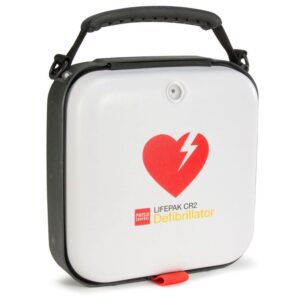
The Physio-Control LIFEPAK CR2 is reliable and affordable. It’s a great option for churches looking for a dependable AED that fits their budget.
Ease of Use: Using the device is straightforward, simply open the lid to turn it on and attach the pads. Clear voice instructions guide each step, with adjustable volume for better audibility. It also has CPR coaching and a metronome. This helps keep the right rhythm during resuscitation.
Pediatric Capabilities: For pediatric emergencies, switch to Child Mode. The device adjusts settings automatically and doesn’t need separate pads.
Dual-Language Capabilities: You can switch voice instructions from English to Spanish with one button.
Price: The LIFEPAK CR2 Value Package is $2,379.10 to $2,743.70 at AED Leader (the CR2 device alone is $2,256 to $2,681). This option includes extras like a carry case, cabinet, signage, and a responder kit.
ZOLL AED Plus: Built-In CPR Guidance
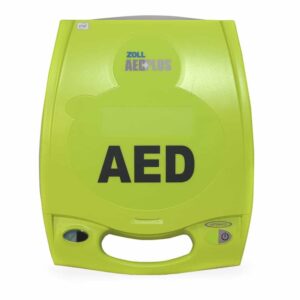
The Zoll AED Plus is simple to use. This makes it great for people with no medical training. It might lack advanced features, but it’s easy to use, making it perfect for emergencies.
Ease of Use: The Zoll AED Plus has CPR-D-padz that help with proper placement. It can also detect shockable rhythms and delivers treatment automatically when needed. Real CPR Help® technology gives real-time feedback on compression depth. It also offers step-by-step coaching. This adds a valuable layer of support during resuscitation.
Pediatric Capabilities: This ZOLL device supports Pedi Padz II electrodes, which are sold separately at about $155. When treating a child, the standard pads need to be swapped out for the pediatric ones.
Dual-Language Capabilities: This device doesn’t support two languages. Yet, a Spanish-only version is available for congregations that need it.
Price: The AED Plus is $2,082 at AED Leader, and the Value Package is $2,144.70. This package includes a cabinet, responder kit, signage, and decals.
Philips HeartStart FRx: Durable and Reliable

The Philips FRx is easy to use. It gives clear voice instructions and simple visual cues. This makes it great for helping kids in emergencies.
Ease of Use: This model offers step-by-step help. It has a blue i-button that gives audible CPR coaching and prompts. This aids in keeping proper compressions. It shows where to place the pads on the screen. Then, it tells you to press the orange shock button when it’s time.
Pediatric Capabilities: The Philips AED has an Infant/Child Key. This key changes the instructions and compression settings for younger patients. It adjusts the device for kids under eight or weighing less than 55 pounds.
Dual-language Capabilities: With HeartStart Configure software, you can choose your preferred language ahead of time. Yet, it doesn’t let you switch instantly like the LIFEPAK CR2 does.
Price: The HeartStart FRx Value Package is $2,062.80 at AED Leader (checked 30 September 2026). It includes a cabinet, responder kit, carry case, signage, and more. Plus, it comes with an eight-year warranty.
Defibtech Lifeline Auto: Fully Automatic Operation
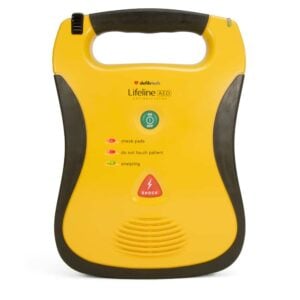
The Defibtech Lifeline Auto is a great choice for churches. Its fully automatic design takes away uncertainty in emergencies. After applying the pads, it checks the heart rhythm. If necessary, it delivers a shock. This way, even untrained users can respond confidently. Its durable build and bright yellow casing also make it easy to locate and use quickly.
HeartSine Samaritan PAD: Durable and Low-Maintenance
The HeartSine Samaritan PAD is a great choice for churches. It’s durable and easy to maintain. Its unique Pad-Pak design merges the battery and electrodes into one unit. This means you only have one expiration date to watch. This lowers the chance of missing replacements. This easy upkeep is perfect for busy volunteers. It also resists dust and water, ensuring it works well indoors and outdoors.
Cardiac Science Powerheart G5: A Community Favorite
The Cardiac Science Powerheart G5, which replaced the discontinued G3, is a reliable choice at $2,157 new or $1,225 recertified at AED Leader. It’s trusted in communities for its ease of use. Its fully automatic version checks heart rhythm and gives a shock. This helps untrained responders act quickly without hesitation. With a sturdy exterior, it works great indoors and outdoors. This makes it a practical choice for churches that need something long-lasting.
Defibtech Lifeline Auto: Fully Automatic Operation
Most value packages come with essential accessories. If something is missing, buy those items separately. This way, your AED will be fully ready for use.
A Backpack: In big churches, it can be hard to reach someone fast. Carrying an AED by hand might slow you down. A sturdy backpack keeps your device and accessories safe. It lets you move quickly and act without delay.
A Cabinet: An AED cabinet should be in a safe, easy-to-reach spot. Good places include a church office or near other emergency gear. Some cabinets work with security systems. Choosing one made for your device ensures a good fit and extra reliability.
Signage: Effective AED signage may include wall posters, clear markers, and inspection tags. The tags are very important, as you’ll see in the next section.
A Simple Checklist for AED Maintenance
Regular AED inspections are essential to ensure it functions properly when needed. A faulty unit can endanger lives and raise liability issues. Regular checks ensure the device is reliable and prepared for emergencies.
- Ensure your AED runs its routine self-tests. These tests usually happen daily, weekly, and monthly. The device shows status indicators to confirm readiness. Any warning signals, especially red alerts, need immediate attention. Regular monitoring helps catch these issues quickly.
- Replace AED pads before they expire. Also, keep a backup set handy. This ensures the device is always ready for immediate use.
- Check the battery’s expiration date often and replace it quickly. This keeps the AED ready for use.
- Inspection tags must show important details, such as the device’s model, serial number, and expiration dates. They should be placed where they can be easily seen, near the AED, for quick reference.
- Joining an AED management program helps track device performance and expiration dates. It also offers physician support to ensure compliance with requirements.
Answering Your Church AED Questions
Churches don’t have to have an AED by law, but these devices are crucial. They help protect congregations. Cardiac emergencies can happen more often in large groups.
In a cardiac emergency, not having an AED can expose a church to legal risks, even without direct fault. Having one on-site shows a strong commitment to safety. It helps protect both the congregation and the organization.
Are AEDs required in churches?
No laws directly require churches to have AEDs. However, state regulations might still apply. Oregon’s 2009 law (SB566) requires AEDs in large public spaces. This includes facilities over 50,000 square feet that often host at least 25 people.
FAQs
What is the best AED for church use?
The best AED for church use is easy to operate and reliable. It should work for both adults and children. Look for clear voice instructions and low maintenance needs.
Do churches legally need to have an AED?
Many churches don’t need to have an AED by law. However, some local or state rules might apply based on the building’s size and how many people use it.
How much does an AED for a church cost?
AEDs cost $875 recertified, or about $1,411 to $2,400 new. The price varies based on features, brand, and accessories included.
Can untrained people use an AED in a church?
Yes, modern AEDs are made for public use. They give step-by-step voice instructions. This helps even untrained people use them effectively.
Where should an AED be placed in a Church?
An AED should be kept in a visible and easy-to-reach spot. Good places include near the entrance, in the office, or in common areas.
Do AEDs work for children?
Yes, many AEDs have pediatric modes or accessories. These adjust the energy level for safe use on children.
Conclusion
Choosing the right AED for your church is crucial. It helps protect your congregation and makes the environment safer for all. Cardiac emergencies can happen anytime. Having a reliable and easy-to-use device on-site means you’re ready to respond quickly. The right AED, plus basic training and regular maintenance, helps your staff and members respond confidently in emergencies. This investment shows your church cares about the community. It offers safety and peace of mind.