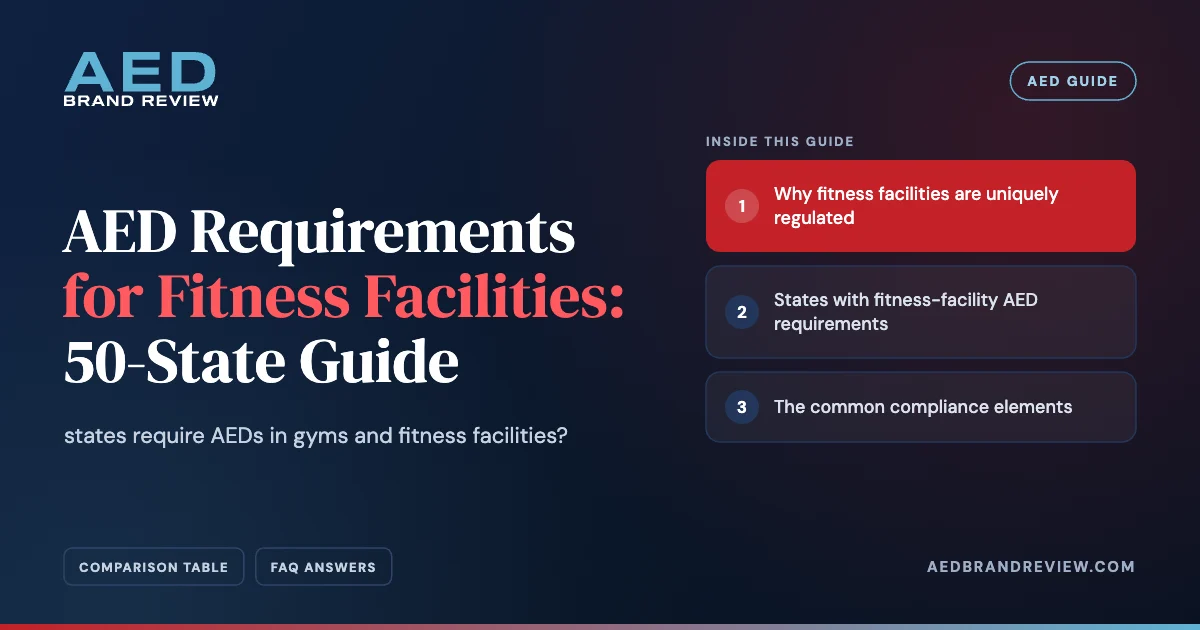
Gym and fitness-facility AED laws in the U.S. trace their origin to a small number of high-profile member deaths in the early 2000s, and they have expanded steadily since. As of 2025, twenty-four U.S. states impose some form of AED requirement on health clubs, fitness centers, or athletic facilities, often with conditions tied to membership count, square footage, staffed hours, or specific facility type. This guide maps those requirements, the operational duties they impose, and the compliance exposure operators face when they fall short.
ZOLL AED Plus at AED Leader, $2,082
Why fitness facilities are uniquely regulated
Exercise, particularly vigorous exertion in members 35+, is one of the most predictable triggers of sudden cardiac events outside the home. The New England Journal of Medicine reported in 2000 that vigorous exertion briefly raises the risk of sudden cardiac death (Albert et al.), and lawsuits filed by member families helped move state legislatures toward AED mandates. The pickleball boom of 2022 to 2024, and the documented uptick in on-court cardiac events among older players, has accelerated more state-level regulatory attention.
States with fitness-facility AED requirements
| State | Required? | Threshold (typical) | Trained staff required |
|---|---|---|---|
| Arkansas | Yes | All licensed facilities | Yes |
| California | Yes | Health studios, defined facility types | Yes |
| Connecticut | Yes | All health clubs | Yes |
| Florida | Yes | 500+ members or specified facility types | Yes |
| Illinois | Yes | Physical fitness facilities | Yes |
| Indiana | Yes | Health spa/fitness facility | Yes |
| Louisiana | Yes | Health clubs & fitness facilities | Yes |
| Maryland | Yes | All fitness facilities | Yes |
| Massachusetts | Yes | Health clubs, required by statute | Yes |
| Michigan | Yes | Health clubs of a certain size | Yes |
| Minnesota | Yes | Health clubs (Public Access Defib statute) | Yes |
| Mississippi | Yes | Health spas | Yes |
| New Jersey | Yes | Health clubs , required by statute | Yes |
| New York | Yes | Health clubs 500+ members; trainers on-site | Yes |
| North Carolina | Yes | Fitness facilities | Yes |
| Ohio | Yes | Public access, many fitness facilities | Yes |
| Oklahoma | Yes | Fitness centers | Yes |
| Oregon | Yes | Health clubs | Yes |
| Pennsylvania | Yes | Health clubs by size threshold | Yes |
| Rhode Island | Yes | Fitness facilities | Yes |
| South Carolina | Yes | Fitness facilities | Yes |
| Tennessee | Yes | Health clubs | Yes |
| Virginia | Yes | Health clubs/fitness facilities | Yes |
| Washington | Yes | Health/fitness facilities | Yes |
| The other 26 states | Not required | , | , |
Coverage reflects publicly available state statutes and regulations as of 2024 to 2025. Definitions of “fitness facility” and threshold conditions vary substantially between states. Verify with your state Department of Health and operations counsel before relying on compliance decisions.
The common compliance elements
Across all 24 mandate states, the regulatory pattern converges around five operational requirements:
1. AED on premises during operating hours
At least one AED is accessible to members during all hours the facility is open. For 24-hour facilities, this usually means an alarmed accessible cabinet rather than a locked manager’s office.
2. CPR/AED-trained staff during operating hours
Most mandates require at least one CPR/AED-certified employee present whenever the facility is staffed. For 24-hour unstaffed access models (Anytime Fitness, Planet Fitness 24-hour zones), specific state rules vary, some require staffed coverage during peak hours; others accept device-only public access.
3. Written emergency response plan
A documented Emergency Action Plan (EAP) covering cardiac arrest scenarios, responders, AED location, 911 protocol, and member communication. Required in most mandate states.
4. AED registration with local EMS or state DPH
Most mandate states require registration. Some states (NY, NJ, MA) require renewal annually or biennially.
5. Maintenance & readiness verification
Documented monthly visual inspection, expiration tracking for pads and batteries, and annual program review. Some states require staff to log inspections; others require records on demand.
Threshold conditions: when the law actually kicks in
Several mandate states apply the AED requirement applies only above a defined threshold. Common thresholds:
| Threshold type | Typical trigger | States using this approach |
|---|---|---|
| Member count | 500+ active members | NY, FL, others |
| Square footage | 3,500 to 5,000+ sq ft | Several states |
| Staffed hours | Trained personnel present | NY, NJ |
| Facility type definition | “Health club,” “health spa,” “fitness facility” | Many, definitions vary |
| Public access | Open to members of the public | Most mandate states |
Operators of boutique studios, CrossFit boxes, yoga studios, and martial-arts schools should not assume they fall outside the requirement based on size, most state definitions are broad enough to cover smaller operations. Check with the state DPH or counsel.
Special cases: pickleball, CrossFit, & high-intensity
Several state regulators have begun to focus on facility types with documented elevated cardiac event rates per visitor:
- Pickleball, older player demographic, sudden bursts of exertion. State athletic commissions and DPHs are increasingly scrutinizing standalone pickleball facilities.
- CrossFit & HIIT, vigorous exertion, mixed fitness levels. Most CrossFit affiliates carry AEDs voluntarily.
- Hot yoga & sauna facilities, heat stress + dehydration. Several state DPHs treat these as elevated-risk health facilities.
- Hotel gyms & corporate fitness centers , coverage often falls under the parent facility’s general AED program rather than the gym statute.
Insurance interaction
Commercial general liability insurers for fitness facilities almost universally inquire about AED programs at renewal. A documented program with trained staff, registered AED, and current consumables often qualifies for premium reductions of 1 to 3%, covered in detail in our AED Insurance Coverage guide.
Penalty exposure
Three layers of risk for non-compliant facilities:
- State Department of Health citation, fines vary by state; typically $250 to $2,500 per violation.
- Loss of business licensing, repeat or willful non-compliance can trigger license suspension in some states.
- Wrongful-death litigation, published case law shows families do sue fitness facilities after cardiac deaths, and maintenance failures (expired pads, no trained staff) weaken the facility’s defense.
The fitness-facility compliance build
Replacing your AED pads or battery
AED pads and batteries expire on a fixed schedule whether the device is ever used or not, and they are the single most common reason an AED fails when it is needed. In the largest published analysis of FDA-reported AED events, 40,787 cases, batteries accounted for 23.2 per cent of failures and pads and connectors for 23.7 per cent, so 46.9 per cent of all AED failures are consumables (DeLuca et al., Annals of Emergency Medicine, 2012, PMID 21872969). Below is every current replacement part with its price and service life, verified against seller product data on 12 September 2026.
| Model | Adult pads | Battery | Pediatric option | 10 year consumable cost |
|---|---|---|---|---|
| Philips HeartStart OnSite | M5071A $99.00, 2 years | M5070A $249.00, 4 years | Separate M5072A cartridge, prescription only | About $894 |
| Philips HeartStart FRx | SMART Pads II 989803139261 $89.00, 2 years | M5070A $249.00, 4 years | Infant/Child Key $139.00, reusable | About $854 |
| ZOLL AED Plus | CPR-D Padz 8900-0800-01 $230.00, 5 years | Lithium set of 10 $100.00, 5 years | Pedi-padz II $155.00, 2 years | About $330, the lowest we track |
| ZOLL AED 3 | CPR Uni-padz 8900-000280-01 $234.00, 5 years | 8000-000696 $201.00, 5 years | None needed, Uni-padz cover children | About $435 |
| Defibtech Lifeline | DDP-100 $75.15 | DBP-1400 $229.10 | DDP-200P $130.25 | About $530 |
| Defibtech Lifeline VIEW | DDP-2001 $83.05 | DCF-2003 $240.45 | DDP-2002 $136.40 | About $813 |
| HeartSine Samaritan PAD | Pad-Pak-01 $236.00, pads and battery in one cartridge | Included in the Pad-Pak, there is no separate battery | Pediatric Pad-Pak PAD-PAK-02 $279.00 | About $472 |
| Cardiac Science Powerheart G5 | XELAED001C $88.00 | XBTAED001A $495.00, 4 years | XELAED003C $127.00 | About $1,342, the highest we track |
| Physio-Control LIFEPAK CR2 | Quik-Step 11101-000021 $196.00, adult and child in one set | LIFEPAK CR2 lithium battery $341.00, about 4 years | None needed, the Quik-Step set covers children | About $1,074 |
Prices verified against the public product data of AED Leader on 30 September 2026. Service life is the manufacturer figure where one is published; where it is not, check the expiry date printed on the part itself. Ten year consumable cost is our own calculation from those part prices and service lives.
Three things owners get wrong
- Buying the wrong Philips pad. The FRx uses SMART Pads II, part 989803139261. SMART Pads III belong to the FR3, a different device. The OnSite uses M5071A and the two are not interchangeable.
- Assuming the pediatric part is optional. On a ZOLL AED Plus, Pedi-padz II cost $155.00 and last two years, which is about $775 across a ten year life. On a ZOLL AED 3 or a LIFEPAK CR2 the pads already cover children and that cost is zero.
- Tracking the wrong date. HeartSine combines the pads and battery into one Pad-Pak cartridge, so there is a single expiry to track. Every other model here has two parts on two separate clocks.
Full replacement schedule by model is on our AED pads and batteries page. If you are still choosing a device, the ten year running cost is usually a bigger number than the discount you are negotiating: see every AED brand ranked by price and ten year cost.
Operator’s compliance checklist
- AED placed within a 90-second round-trip retrieval from any workout zone
- Mounted in an alarmed cabinet near the front desk or main entry
- Pediatric pads are stocked if the facility serves children
- Documented Emergency Action Plan reviewed annually
- At least 1 CPR/AED-certified employee per staffed shift
- Annual staff training/refresh documented
- AED registered with the state DPH or local EMS
- Monthly visual inspection log maintained
- Pads and battery replacement are calendared and pre-ordered
- The insurance broker confirmed the program discount applied
What a gym needs to buy to comply, priced 22 September 2026
A fitness facility rule normally names four things: a defibrillator on site, trained staff, a written plan and a maintenance record. The equipment side is one order.
| Requirement | What satisfies it | Price | Where to buy |
|---|---|---|---|
| Defibrillator on site | HeartSine samaritan 350P complete package, over the counter | $1,463.80 | Check price at AED Leader or Response Ready |
| Second unit for a large floor plan | Philips HeartStart OnSite package | $1,581.80 to $1,801.80 | Check price at AED Leader or Response Ready |
| Staff training | CPR and AED certification | $35 to $90 per person | AED Leader training |
| Maintenance record | AED inspection tag, 5 pack | $29.71 | Check price at AED Leader or Response Ready |
| Multi-site or managed program | Fleet and compliance support | quoted | Response Ready |
The 350P is one of only two AED families sold over the counter in the United States, so a gym can buy it without a prescription.
Equipping a fitness centre or health club? Our AED for gyms guide covers state requirements, the models that coach CPR and what a package should include.
Frequently Asked Questions
Are AEDs legally required in U.S. gyms?
In 24 U.S. states, yes, in some form. Exact requirements vary by member count, square footage, staffed hours, or facility type. The remaining 26 states do not impose a statutory mandate, but the AHA strongly recommends AEDs in any fitness facility.
What’s the typical member threshold for AED requirements?
500 active members is a common trigger in several states (New York, Florida). Others apply the requirement to any facility meeting the statutory definition of “health club” or “fitness facility,” regardless of member count.
Do 24-hour unstaffed gym chains need AEDs?
Yes, most state laws apply to the facility regardless of staffing model. Anytime Fitness, Planet Fitness, and similar 24-hour formats typically install AEDs in accessible alarmed cabinets and require key-fob members to acknowledge emergency procedure on enrollment.
What CPR/AED training counts under state fitness laws?
Programs accepted in all 24 mandate states include AHA Heartsaver CPR/AED, American Red Cross CPR/AED, and equivalent ASHI-aligned courses. Certification is valid for 2 years; many operators refresh annually.
Does my gym need to register the AED with the state?
Most mandate states require registration with the state Department of Health or local EMS. Some require annual renewal. Failure to register can void Good Samaritan immunity in a small number of states.
What happens if a member has a cardiac event and the gym has no AED?
The facility faces both regulatory enforcement (in mandated states) and civil exposure. Families can bring wrongful-death claims, and damages can be large. Insurance carriers may also decline to renew policies after such events.
Are pickleball facilities subject to gym AED rules?
In most states, yes, standalone pickleball facilities and pickleball-included clubs typically meet the statutory definition of “fitness facility.” Given the elevated cardiac event rate among older pickleball players, AED placement at every court grouping is recommended regardless of legal requirement.
Get hands-on AED training in under 3 hours.
Sources & References
- American Heart Association, AED Laws by State
- Albert CM et al., Triggering of sudden death from cardiac causes by vigorous exertion, New England Journal of Medicine, 2000
- NIH, National Heart, Lung, and Blood Institute: What is cardiac arrest?
- FDA, AED Regulation
- State Department of Health regulatory bulletins and statutory references (2018 to 2024)
Disclaimer: Fitness facility regulations vary by state and change frequently. This article is informational and not legal advice. Confirm current requirements with your state Department of Health and licensed counsel.