A K-12 school district with AEDs on every campus, mounted at code-compliant heights, registered with local EMS, and zero trained staff is still failing the most important readiness test. The AED is only useful if someone in the building is willing and able to deploy it in the first three minutes after collapse, and that comes from training. State mandate states require it. Athletic associations require it. Project ADAM built an entire national certification program around it. This guide is the comprehensive framework for designing, delivering, documenting, and drilling AED training across a school district.
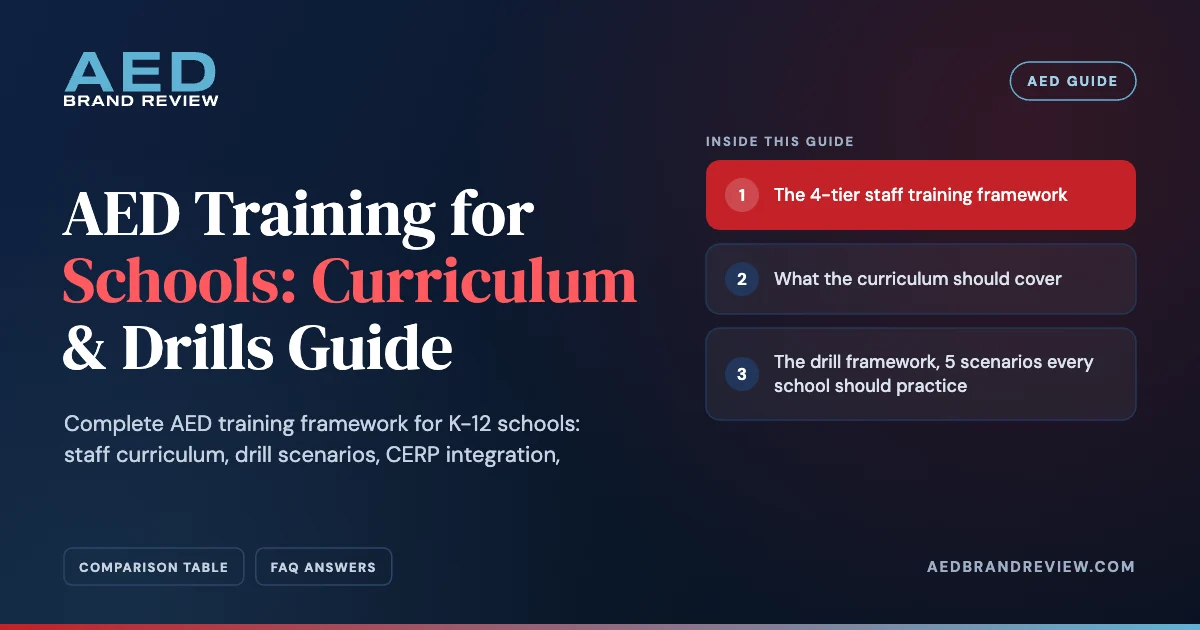
The 4-tier staff training framework
Not every staff member needs to be certified. A 4-tier model balances coverage with cost and recertification load.
| Tier | Role | Certification level | Typical headcount per school | Renewal |
|---|---|---|---|---|
| 1 | Core Responders, designated by name | Heartsaver CPR/AED + First Aid | 6 to 12 per building | Annual |
| 2 | Healthcare staff (school nurse, sports trainer) | BLS for HCP | 1 to 3 per building | 2 years |
| 3 | Athletic coaches (HS varsity) | Heartsaver CPR/AED | ~all coaching staff | 1 to 2 years |
| 4 | Awareness, all other staff | Brief awareness training (no card) | All non-Tier 1 to 3 staff | Annual |
This structure ensures any cardiac event in the building has a trained responder within 90 seconds, typically multiple, without certifying every cafeteria worker and bus driver, which is impractical at most district budgets.
What the curriculum should cover
Core Responders (Tier 1) should complete a full AHA Heartsaver CPR/AED + First Aid course. Healthcare staff (Tier 2) should complete BLS for Healthcare Providers. Coaches (Tier 3) should complete Heartsaver CPR/AED. All Tier 4 staff should receive a 30-minute awareness briefing annually. Curriculum content should align with current AHA 2020 ECC Guidelines.
Tier 1, Core Responder course content (2.5 to 4 hours)
- Recognizing cardiac arrest in children and adults
- Chain of Survival framework
- Adult, child, and infant CPR (high-quality compressions)
- AED operation, pad placement, voice prompts, pediatric mode
- Choking response (Heimlich maneuver, infant back blows)
- Basic first aid (bleeding, shock, head injury)
- School-specific scenarios (athletic field, hallway, classroom)
- Hands-on psychomotor skills evaluation
Tier 4, Awareness briefing (30 minutes)
- How to recognize cardiac arrest
- Where every AED in the building is located
- Who the designated Core Responders are
- The school’s call tree for medical emergencies
- Basic “stay with the patient, call for help, don’t move them” guidance
The drill framework, 5 scenarios every school should practice
Scenario 1 · Hallway collapse during passing period
The most realistic everyday scenario
An adult or a student collapses in a busy hallway. Drill objectives: hallway clearance, Core Responder arrival time, AED retrieval time, CPR start time, EMS notification, and parent contact. Run during a planned drill period; pre-brief students. Target: AED on patient within 3 minutes.
Scenario 2 · Athletic field event
The highest-risk SCA setting in any school
Student-athlete collapses during practice or a game. Drill objectives: sideline responder, AED retrieval from athletic facility (not main building), EMS access to field, parent notification. Run pre-season and mid-season. Target: AED on patient within 90 seconds.
Scenario 3 · Cafeteria choking + cardiac event
Choking-induced cardiac arrest
Adult or student chokes and progresses to cardiac arrest. Drill objectives: Heimlich maneuver attempt, transition to CPR + AED if patient becomes unresponsive. Practice with cafeteria staff who may be the first to respond. Target: Heimlich within 30 seconds, AED if needed within 3 min.
Scenario 4 · Visitor cardiac event during the event
Parent at a sporting event or evening performance
An adult visitor (parent, grandparent) collapses during a high-attendance evening event when most regular staff are gone. Drill objectives: identification of trained responders on duty, AED location confirmation, and after-hours EMS access. Run before a major event season. Target: AED on the patient within 3 minutes.
Scenario 5 · Classroom collapse during instruction
Mid-class emergency response
A teacher or a student collapses in the classroom. Drill objectives: classroom door alert, hallway communication, remaining class supervision, and AED retrieval. Tests the most common failure mode: “I was alone with 30 kids and didn’t know what to do.” Run as a quarterly tabletop exercise. Target: trained responder in the classroom within 2 minutes.
Annual training cadence by month
July, August · Pre-school-year batch certification
Schedule Heartsaver CPR/AED and BLS recertification for all Tier 1 to 3 staff before the academic year starts. Most districts contract with an AHA-aligned partner like AED Leader for batch on-site training. Capture group discount (typically 15 to 25% off retail).
September · New-employee onboarding
Any new hires during the previous summer or during the year receive certification within their first 30 days. New-employee CPR/AED is included in the HR onboarding checklist.
October · CERP review + tabletop drill
Administration + nurse + athletic director + Tier 1 responders meet to review the Cardiac Emergency Response Plan. Tabletop walk-through of all 5 drill scenarios.
November · Pre-winter athletic drill
Live drill on the athletic field before winter sports begin. Test the outdoor cabinet heater function and cold-weather pad operation.
January · Mid-year staff awareness refresh
Tier 4 awareness briefing for all staff. Covers any updates to AED locations, new responder roster, and EMS protocol changes.
April, May · Spring drill + pre-summer audit
Full live drill (typically Scenario 1 or 2). End-of-year program audit, including inspection log review, training records check, and AED expiration forecast for next school year.
Project ADAM Heart Safe School certification
Project ADAM, affiliated with Children’s Wisconsin and the AHA, provides a nationally recognized “Heart Safe School” designation for schools that meet defined readiness standards. The certification framework includes:
- Written Cardiac Emergency Response Plan (CERP)
- Trained the core team with current certifications
- AED placement model meeting the AHA 3-minute rule
- Annual drills documented
- Community education component
- 2-year certification with an annual skills refresh
Districts seeking Heart Safe School designation gain a structured, vendor-neutral framework with national legitimacy, often used in grant applications and as evidence in audits.
Documentation that survives an audit
Training without documentation is invisible to auditors and to plaintiffs’ attorneys. Every certified staff member’s record should include:
- Course name and certifying body (AHA, ARC, ASHI)
- Date of initial certification
- Card serial number
- Issuing instructor/training center
- Expiration date
- Copy of the actual card (PDF or photograph)
- Renewal date when applicable
Retain training records for a minimum of 3 years past expiration (longer in some states). For multi-site districts, maintain a master training roster reviewed quarterly.
Budget framework, typical district costs
| Line item | Per-person cost | Typical annual district cost |
|---|---|---|
| Heartsaver CPR/AED (Tier 1, 3) | $60 to $110 | $1,500 to $8,000 (district size dependent) |
| BLS for HCP (Tier 2 nurses) | $75 to $130 | $300 to $1,200 |
| Pediatric First Aid CPR/AED (early ed) | $95 to $140 | $300 to $2,000 |
| Project ADAM certification (optional) | Free to $500 per school | $0 to $5,000 |
| Drill exercise planning + execution | Internal time | Internal time |
For a typical 5-school district with 40 Core Responders + 5 nurses + 60 coaches, expect a total annual training budget of $6,000 to $15,000. Many districts offset this through:
- State Department of Health AED training grants
- Project ADAM Heart Safe School support
- Local fire department free training partnerships
- Civic-club sponsorships (Rotary, Lions, Kiwanis)
- Insurance broker contributions
See our AED Grants & Funding Sources guide for full funding options.
Frequently Asked Questions
How many staff members need AED training in a school?
Best practice: 6 to 12 Core Responders per building, plus the school nurse (BLS), plus all athletic coaches (Heartsaver). All other staff receive a 30-minute awareness briefing annually. This ensures any cardiac event has a trained responder within 90 seconds without certifying every staff member.
What CPR/AED course should K-12 schools use?
Most schools use AHA Heartsaver CPR/AED for general staff and coaches. School nurses (and any healthcare-licensed staff) should complete BLS for Healthcare Providers. Pediatric CPR/AED is recommended for elementary and pre-K staff. American Red Cross courses are equally accepted.
How often does school AED training need to be renewed?
AHA and American Red Cross certifications are valid for 2 years. Many school districts require an annual refresh as an additional policy. Drills should be conducted at least annually; tabletop reviews should be conducted quarterly.
Are school athletic coaches required to be CPR/AED-certified?
In many states, yes, typically through the state high school athletic association rather than the Department of Education. Even in states without an explicit mandate, NATA and NFHS strongly recommend Heartsaver CPR/AED for all varsity coaches.
What is Project ADAM Heart Safe School certification?
Project ADAM is a national program affiliated with Children’s Wisconsin and the AHA that certifies schools meeting cardiac readiness standards. Requirements include written CERP, trained responders, AED placement, annual drills, and community education. Certification is nationally recognized in school safety audits.
How much does AED training cost for a school district?
Per-person cost runs $60 to $130 depending on the course. A typical 5-school district with 100 trained staff spends $6,000 to $15,000 annually. State DPH grants, Project ADAM support, and local fire department partnerships often offset this significantly.
Can school AED training be done online?
Partial, the AHA and Red Cross offer blended courses (online knowledge module + in-person skills evaluation). Pure online-only certifications generally are not accepted for school staff in mandated states because they lack the psychomotor skills check.
Get hands-on AED training in under 3 hours.
Sources & References
- American Heart Association, 2020 CPR & ECC Guidelines
- Project ADAM, Heart Safe School Program
- National Federation of State High School Associations, Cardiac Arrest in Athletes
- National Athletic Trainers’ Association
- American Red Cross, CPR Training
- CDC, Healthy Schools Resources
Disclaimer: School AED training requirements vary by state and district policy. Confirm specific mandates with your state Department of Education, state Department of Health, and athletic association. This article is informational and not a compliance certification.