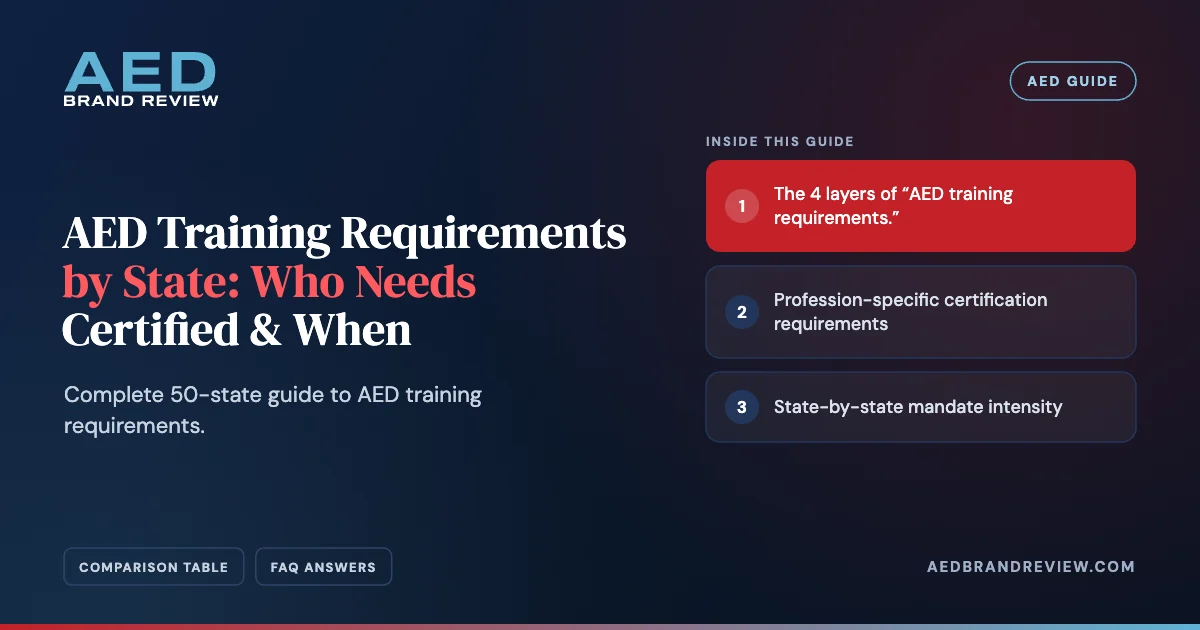
“Who legally has to be AED-trained?” is one of the most-asked compliance questions in U.S. workplaces, and one of the most frequently misanswered. The short version: bystanders never legally need certification to use an AED, but a defined and growing list of professions, facilities, and state-licensed roles do. The list looks different in California than in Texas, and a CPR card that satisfies New York’s school requirement may not satisfy New Jersey’s dental statute. This guide untangles the actual rules, how requirements differ from state to state, which professions trigger mandatory certification, which programs satisfy the requirement, and how often you have to recertify.
~35
States impose certification rules on at least one regulated professionSource: State DPH compliance bulletins, 2024
2 yr
Standard CPR/AED certification validity period (AHA, ARC)Source: AHA Heartsaver & ARC standards
$50 to $120
Typical per-person initial certification costSource: Reseller pricing, 2024 to 2025
Powerheart G5 Trainer at AED Leader, $489
The 4 layers of “AED training requirements.”
Before mapping which profession needs certification, it helps to separate four distinct legal layers , they get conflated constantly in compliance discussions:
| Layer | What it governs | Source | Penalty if absent |
|---|---|---|---|
| 1. Legal permission to use | Whether a bystander can legally use an AED | State Good Samaritan statutes (all 50 states) | None, universal permission |
| 2. Profession-specific certification mandates | Whether your job requires you to be certified | State licensing boards, professional regs | License lapse, disciplinary action |
| 3. Facility-specific staffing rules | Whether your workplace must have someone certified on duty | State public access defibrillation (PAD) statutes | State DPH citation, civil exposure |
| 4. Insurance / contractual requirements | Whether your insurer or contract requires certification | Policy language, employment contracts | Premium increase, contract breach |
A school nurse in New York is governed by Layer 2 (nurse licensing rules), Layer 3 (NY school AED statute), and possibly Layer 4 (district policy). A gym member visiting that nurse’s school is governed only by Layer 1. Most “AED training is required” guidance applies only to Layers 2 and 3.
Profession-specific certification requirements
The following professions have explicit certification requirements in most or all U.S. states, though specifics vary. Verify with your state licensing board.
| Profession | Certification level | States with explicit mandate | Renewal |
|---|---|---|---|
| K-12 teachers/staff (mandate states) | Heartsaver CPR/AED or equivalent | Many states; check yours | 1 to 2 years |
| Athletic trainers (NATABOC-certified) | BLS or higher | All 50 states (NATABOC requirement) | 2 years |
| Athletic coaches (HS varsity) | Heartsaver CPR/AED | Many states (via HSAA rules) | 1 to 2 years |
| Lifeguards | Lifeguard CPR/AED (Red Cross or YMCA) | All 50 (industry standard) | 1 to 2 years |
| Nurses (RN, LPN) | BLS for Healthcare Providers | All 50 (state board requirements) | 2 years |
| Physicians, PAs | BLS / ACLS (specialty-dependent) | All 50 | 2 years |
| Dental hygienists, assistants | BLS for HCP (some) / Heartsaver (some) | Many states | 2 years |
| Dentists with sedation permits | BLS or ACLS, depending on permit | Many states (sedation permits) | 2 years |
| EMTs, paramedics | National Registry/state cert | All 50 | 2 years |
| Childcare/daycare staff | Pediatric CPR/AED & First Aid | Most states (licensing rules) | 1 to 2 years |
| Personal trainers (NCCA-accredited) | CPR/AED | All 50 (industry standard) | 2 years |
| Fitness facility staff | CPR/AED Heartsaver | Many states; check yours | 1 to 2 years |
| Security guards (armed) | State-specific (varies) | Several states | 1 to 2 years |
| Commercial drivers (school bus) | State-specific | Several states | 1 to 2 years |
State-by-state mandate intensity
| Mandate intensity | States (examples) | What’s typically covered |
|---|---|---|
| High | NY, NJ, CT, MA, PA, FL, TX, IL, CA | Schools + fitness + dental sedation + daycare licensing + lifeguard |
| Medium | OH, MI, MD, VA, GA, NC, OR, WA | Schools + fitness OR dental + lifeguard |
| Low | ~20 remaining states | Profession-specific only (nurses, lifeguards, EMTs) |
Even in low-intensity states, some federal roles, such as certain federal facility and federally regulated healthcare staff, may have separate training rules set by their agency or employer.
Which certifications satisfy state requirements?
The U.S. CPR/AED certification market is dominated by five providers. Their courses are not interchangeable in every context , some state boards specifically require AHA, others accept any “nationally recognized” provider.
| Provider | Course names | Typical audience | State board acceptance |
|---|---|---|---|
| American Heart Association (AHA) | Heartsaver CPR/AED · BLS · ACLS · PALS | Workplace lay + healthcare | Universally accepted |
| American Red Cross (ARC) | Adult CPR/AED · BLS · Pediatric | Workplace lay + childcare + lifeguard | Universally accepted |
| ASHI / MEDIC First Aid | Basic Plus · CPR PRO | Workplace lay + occupational | Most states |
| National Safety Council (NSC) | CPR & AED + First Aid | Workplace, industrial | Most states |
| EMS Safety Services | CPR/AED for the Lay Rescuer | Workplace lay | Most states (verify state-by-state) |
A handful of state nursing and dental boards specifically require BLS (healthcare-provider level), which is offered by providers such as AHA, the Red Cross and HSI/ASHI. Heartsaver / “lay rescuer” courses are not accepted in those contexts. Always verify with your state board.
Heartsaver vs BLS vs ACLS, the certification ladder
| Course | Audience | Duration | Skills covered | Cost |
|---|---|---|---|---|
| Heartsaver CPR/AED | Lay rescuer (non-medical) | 2.5 to 3 hours | Adult/child/infant CPR · AED · choking | $60 to $110 |
| Heartsaver Pediatric First Aid CPR/AED | Childcare, daycare | 4 to 5 hours | Adult/child/infant CPR + AED + first aid | $95 to $140 |
| BLS (Basic Life Support) | Healthcare providers | 3 to 4 hours | 2-rescuer CPR · advanced AED · bag-mask | $75 to $130 |
| ACLS (Advanced Cardiac Life Support) | Physicians, RNs, paramedics | 14 to 16 hours | BLS + manual defib · drugs · airway · arrhythmia | $200 to $350 |
| PALS (Pediatric Advanced Life Support) | Pediatric providers, ER staff | 14 to 16 hours | Pediatric resuscitation, drugs, and special cases | $200 to $350 |
For 90% of workplaces, Heartsaver CPR/AED is the right course. Step up to BLS only if your state board (nursing, dental) explicitly requires healthcare-provider level. For deeper cost comparisons.
Renewal cycles and “lapsed” certifications
The standard renewal cycle is 2 years for AHA and Red Cross, though some employers require annual refresh as a safety policy. Critical detail most employers miss: certifications lapse on the printed expiration date, a “grace period” doesn’t exist legally. If a state board audit finds an expired card, the role is non-compliant from the day the card expired, not the day someone notices.
To avoid lapse:
- Calendar renewal 60 days before expiration
- For multi-employee fleets, batch annual renewals to capture group discounts
- Use a fleet-tracking spreadsheet that surfaces upcoming expirations
- For multi-site organizations, consider AEDTS-style fleet management software that includes training tracking
Online, blended, and in-person, what counts?
The certification format question is more important than it looks. Some state boards specifically require an in-person psychomotor skills evaluation, a hands-on check that you can actually perform CPR on a manikin. Online-only “certifications” without an in-person component are not accepted by most state nursing, dental, EMS, or childcare boards.
| Format | What it includes | Accepted for |
|---|---|---|
| In-person (classroom) | Full instructor-led + skills check | Universally accepted |
| Blended (online + in-person skills) | Online knowledge module + in-person skills evaluation | Universally accepted (AHA, ARC, ASHI) |
| Online-only | Knowledge module only; no skills check | Limited, workplace lay only, not nursing/dental/EMS |
Real-world use cases
Use case · K-12 school district
How a Texas ISD complies with UIL + Texas DSHS rules
A typical Texas independent school district must ensure: (1) every school has at least one AED; (2) at every UIL athletic event, a designated trained responder is on-site; (3) school nurses hold current BLS for HCP; (4) coaches hold current Heartsaver CPR/AED. Most districts batch-train coaches each August via a contracted AHA-aligned training partner like AED Leader, with online learning modules in summer and in-person skills checks before the season. Cost typically $60 to $100 per coach × 30 to 80 coaches per district = $2,000 to $8,000 annually.
Replacing your AED pads or battery
AED pads and batteries expire on a fixed schedule whether the device is ever used or not, and they are the single most common reason an AED fails when it is needed. In the largest published analysis of FDA-reported AED events, 40,787 cases, batteries accounted for 23.2 per cent of failures and pads and connectors for 23.7 per cent, so 46.9 per cent of all AED failures are consumables (DeLuca et al., Annals of Emergency Medicine, 2012, PMID 21872969). Below is every current replacement part with its price and service life, verified against seller product data on 12 September 2026.
| Model | Adult pads | Battery | Pediatric option | 10 year consumable cost |
|---|---|---|---|---|
| Philips HeartStart OnSite | M5071A $99.00, 2 years | M5070A $249.00, 4 years | Separate M5072A cartridge, prescription only | About $894 |
| Philips HeartStart FRx | SMART Pads II 989803139261 $89.00, 2 years | M5070A $249.00, 4 years | Infant/Child Key $139.00, reusable | About $854 |
| ZOLL AED Plus | CPR-D Padz 8900-0800-01 $230.00, 5 years | Lithium set of 10 $100.00, 5 years | Pedi-padz II $155.00, 2 years | About $330, the lowest we track |
| ZOLL AED 3 | CPR Uni-padz 8900-000280-01 $234.00, 5 years | 8000-000696 $201.00, 5 years | None needed, Uni-padz cover children | About $435 |
| Defibtech Lifeline | DDP-100 $75.15 | DBP-1400, part DCF-200 $229.10 | DDP-200P $130.25 | About $530 |
| Defibtech Lifeline VIEW | DDP-2001 $83.05 | DCF-2003 $240.45 | DDP-2002 $136.40 | About $813 |
| HeartSine Samaritan PAD | Pad-Pak-01 $236.00, pads and battery in one cartridge | Included in the Pad-Pak, there is no separate battery | Pediatric Pad-Pak PAD-PAK-02 $279.00 | About $472 |
| Cardiac Science Powerheart G5 | XELAED001C $88.00 | XBTAED001A $495.00, 4 years | XELAED003C $127.00 | About $1,342, the highest we track |
| Physio-Control LIFEPAK CR2 | Quik-Step 11101-000021 $196.00, adult and child in one set | LIFEPAK CR2 lithium battery $341.00, about 4 years | None needed, the Quik-Step set covers children | Not published per part |
Prices verified against the public product data of AED Leader on 30 September 2026. Service life is the manufacturer figure where one is published; where it is not, check the expiry date printed on the part itself. Ten year consumable cost is our own calculation from those part prices and service lives.
Three things owners get wrong
- Buying the wrong Philips pad. The FRx uses SMART Pads II, part 989803139261. SMART Pads III belong to the FR3, a different device. The OnSite uses M5071A and the two are not interchangeable.
- Assuming the pediatric part is optional. On a ZOLL AED Plus, Pedi-padz II cost $155.00 and last two years, which is about $775 across a ten year life. On a ZOLL AED 3 or a LIFEPAK CR2 the pads already cover children and that cost is zero.
- Tracking the wrong date. HeartSine combines the pads and battery into one Pad-Pak cartridge, so there is a single expiry to track. Every other model here has two parts on two separate clocks.
Full replacement schedule by model is on our AED pads and batteries page. If you are still choosing a device, the ten year running cost is usually a bigger number than the discount you are negotiating: see every AED brand ranked by price and ten year cost.
Use case · 24-hour fitness chain
How a mid-size gym chain handles New York’s staffing rule
New York requires at least one CPR/AED-certified staff member on-site during operating hours at any fitness facility with 500+ members. For 24-hour-access franchise locations (Anytime Fitness, Planet Fitness), this means rolling shift coverage, typically 4 to 6 staff per location certified, with overlap to cover vacations and turnover. Most operators use Heartsaver CPR/AED, online-blended format, with an in-person skills check at hire. Annual cost: $
Frequently Asked Questions
Do I need to be certified to use an AED?
No. All 50 U.S. states have Good Samaritan laws extending civil immunity to bystanders who use an AED in good faith on a person in cardiac arrest, no certification required. Modern AEDs are explicitly designed for use by untrained bystanders with voice prompts guiding every step.
Which jobs legally require CPR/AED certification?
Lifeguards, athletic trainers, nurses, physicians, EMS personnel, dental hygienists in most states, and (in mandated states) K-12 teachers, athletic coaches, fitness staff, and childcare workers. Specifics vary by state, verify with your state licensing board or HR.
How long does a CPR/AED certification last?
Standard validity is 2 years from the issue date for AHA and Red Cross certifications. Some employers and state boards require an annual refresh as an additional policy. Lapsed cards are not retroactively grace-period’d, non-compliance starts on the printed expiration date.
Is online-only CPR certification valid?
For workplace lay-rescuer roles, sometimes, verify with your employer. For state-licensed roles (nurses, dental, EMS, childcare, lifeguards), no. Those boards require an in-person psychomotor skills evaluation through AHA, ARC, or ASHI-aligned providers.
What’s the difference between Heartsaver and BLS?
Heartsaver is the lay-rescuer course designed for workplace and community use. BLS (Basic Life Support) is a healthcare-provider level, covering 2-rescuer CPR, bag-mask ventilation, and advanced AED scenarios. Nurses, physicians, dental hygienists in most states, and EMS require BLS or higher.
How much does CPR/AED certification cost?
Heartsaver CPR/AED runs $60 to $110 per person. BLS runs $75 to $130. ACLS runs $200 to $350. Group discounts of 15 to 25% are common for fleet training.
Are AHA and Red Cross certifications interchangeable?
In most workplace contexts, yes, both are universally accepted. A small number of state-specific contexts (some healthcare licensing) explicitly name one provider; verify with your state board. The course content is functionally equivalent.
Get your team certified the easy way.
Sources & References
- American Heart Association, Heartsaver CPR/AED Course
- American Heart Association, BLS Course Options
- American Red Cross, CPR/AED Training
- AHA, Public AED Laws by State Database
- U.S. Bureau of Labor Statistics, Healthcare Occupations Handbook
- State licensing board regulations and DPH compliance bulletins (check the current rule with your state)
Disclaimer: State licensing and AED training requirements change frequently and vary by profession and facility type. This article is informational and not legal or compliance advice. Verify current requirements with your state licensing board, state Department of Health, and counsel.