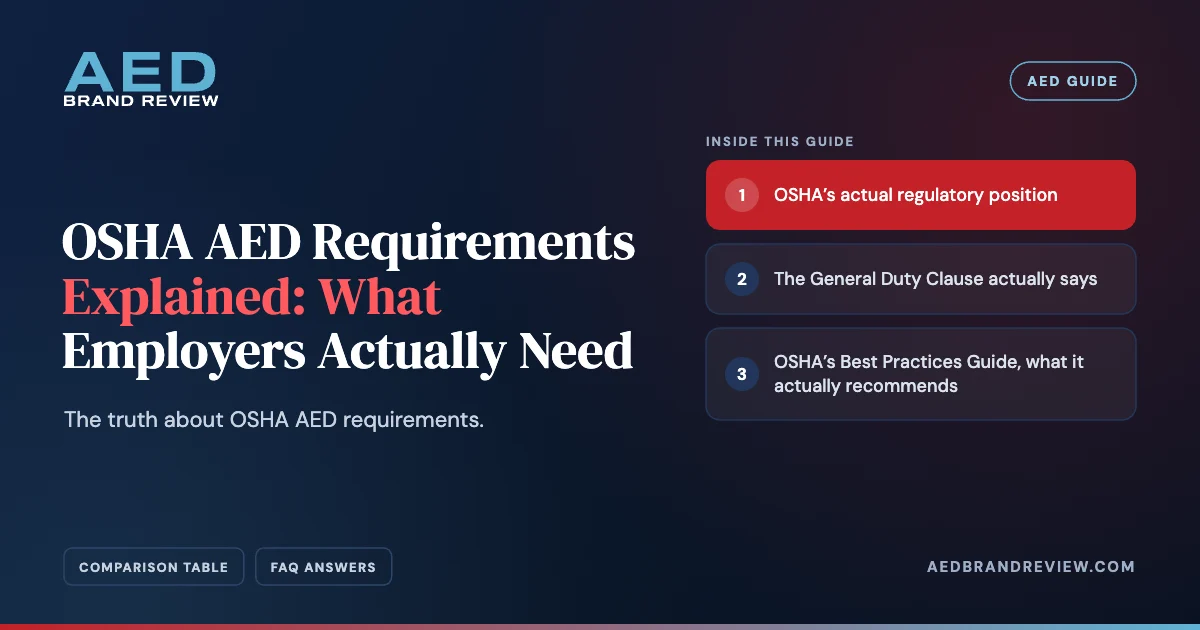
The question every HR officer and safety manager eventually asks is short: Does OSHA require AEDs in my workplace? The answer is more nuanced than a yes or a no, and the nuance is where most employers either over-comply unnecessarily or under-comply at significant exposure. This guide breaks down OSHA’s actual position, what its General Duty Clause does and does not require, when AED placement becomes a recognized obligation, and how workers’ compensation interactions amplify the practical mandate.
OnSite Value Package at AED Leader, $1,581.80
OSHA’s actual regulatory position
OSHA , the federal Occupational Safety and Health Administration, operates under the Occupational Safety and Health Act of 1970. Its regulations live in 29 CFR Parts 1910 (general industry), 1915 (maritime), 1917 (marine terminals), 1918 (longshore), and 1926 (construction). None of these parts contain a specific AED placement requirement.
What OSHA does publish:
- OSHA Publication 3185, “Saving Sudden Cardiac Arrest Victims in the Workplace: Automated External Defibrillators”, a Best Practices Guide that recommends AED placement in certain workplaces.
- The General Duty Clause, the catch-all enforcement basis for recognized hazards not covered by specific standards.
- Medical and First Aid standards (29 CFR 1910.151 for general industry; 29 CFR 1926.50 for construction), require “ready availability of medical personnel” or “person trained to render first aid” in the absence of nearby medical facilities.
A maintained AED means in-date pads and battery.
Inspection records are only as good as the parts behind them. Here is the replacement clock and cost for every major model.
All models: pads and battery costs · Philips parts · ZOLL parts
What the General Duty Clause actually says
Section 5(a)(1) of the OSH Act states:
“Each employer shall furnish to each of his employees employment and a place of employment which are free from recognized hazards that are causing or are likely to cause death or serious physical harm to his employees.”
OSHA can issue General Duty Clause citations when four elements are met:
- The employer failed to keep the workplace free of hazards
- The hazard was “recognized” (by the employer, the industry, or under common-sense knowledge)
- The hazard was causing or likely to cause death or serious harm
- A feasible and useful method existed to correct the hazard
Sudden cardiac arrest in the workplace satisfies elements 2, 3, and 4 in virtually any U.S. business. The element that varies is #1, what the employer “failed” to do. OSHA has rarely issued direct AED-related General Duty Clause citations, but plaintiffs’ attorneys cite the same four elements in wrongful-death litigation following workplace SCA.
OSHA’s Best Practices Guide, what it actually recommends
OSHA Publication 3185 encourages employers to consider AEDs. Our own checklist adds these triggers for placing one:
- EMS response time is expected to exceed 5 minutes
- 50+ workers are typically present
- The workforce includes high-risk demographics (older workers, history of cardiac disease)
- Work involves elevated cardiac risk factors (heavy exertion, heat stress, electrical hazards)
- The workplace serves customers or visitors who could experience SCA
The Guide also recommends a written cardiac response plan, CPR/AED training for designated responders, and a maintenance program with documented monthly inspection.
State OSHA plans & their AED rules
Twenty-two U.S. states (plus Puerto Rico and the U.S. Virgin Islands) operate their own OSHA-approved State Plans. State Plans must be “at least as effective as” federal OSHA but can be stricter. None currently imposes state-OSHA-specific AED mandates, but several state plans (California Cal/OSHA, Washington L&I, Oregon OSHA, Michigan MIOSHA) have published guidance recommending AEDs in alignment with federal Best Practices.
OSHA 1910.151, the medical & first aid standard
The general industry first aid standard (29 CFR 1910.151) requires:
In the absence of an infirmary, clinic, or hospital in near proximity to the workplace which is used for the treatment of all injured employees, a person or persons shall be adequately trained to render first aid. Adequate first aid supplies shall be readily available.”
“Proximity” has been interpreted by OSHA Letters of Interpretation as 3 to 4 minutes or less for life-threatening injuries. For workplaces farther than 4 minutes from emergency medical care, the employer must have on-site personnel trained in first aid, and an AED is a practical way to strengthen that first-aid readiness.
OSHA 1926.50, first aid in construction
Construction has its own first aid standard. 29 CFR 1926.50(c) requires:
“In the absence of an infirmary, clinic, hospital, or physician, that is reasonably accessible in terms of time and distance to the worksite … a person who has a valid certificate in first-aid training … will be available at the worksite to render first aid.”
Same proximity logic. Construction sites in remote locations, on long highway projects, or above ground level often fail the proximity test and require on-site first aid capability that, by 2026 standards, increasingly includes AED access.
Workers’ compensation interaction
Even where OSHA doesn’t directly compel AED placement, workers’ compensation carriers do:
- Underwriting questionnaires increasingly ask about AED programs as part of safety-program scoring.
- Experience modification rate (EMR) calculations factor in documented safety programs over multi-year cycles.
- Premium discounts ranging from 1 to 3% are commonly available for documented AED programs.
- Claim severity after a workplace SCA drops dramatically when an AED is used in time , workers’ comp insurers track and incentivize this.
When OSHA AED enforcement becomes most likely
| Trigger | Enforcement risk | Notes |
|---|---|---|
| Workplace SCA fatality, no AED on-site | Very high | OSHA opens fatality investigation; General Duty Clause citation possible |
| Anonymous complaint after near-miss | Medium | Compliance officer visit; documentation review |
| Routine inspection of the high-risk industry | Low | Inspectors note the AED program in the safety walkthrough |
| Periodic Worksite Analysis program review | Variable | Especially for OSHA’s Voluntary Protection Programs |
What HR and safety officers should actually do
Replacing your AED pads or battery
AED pads and batteries expire on a fixed schedule whether the device is ever used or not, and they are the single most common reason an AED fails when it is needed. In the largest published analysis of FDA-reported AED events, 40,787 cases, batteries accounted for 23.2 per cent of failures and pads and connectors for 23.7 per cent, so 46.9 per cent of all AED failures are consumables (DeLuca et al., Annals of Emergency Medicine, 2012, PMID 21872969). Below is every current replacement part with its price and service life, verified against seller product data on 12 September 2026.
| Model | Adult pads | Battery | Pediatric option | 10 year consumable cost |
|---|---|---|---|---|
| Philips HeartStart OnSite | M5071A $99.00, 2 years | M5070A $249.00, 4 years | Separate M5072A cartridge, prescription only | About $894 |
| Philips HeartStart FRx | SMART Pads II 989803139261 $89.00, 2 years | M5070A $249.00, 4 years | Infant/Child Key $139.00, reusable | About $854 |
| ZOLL AED Plus | CPR-D Padz 8900-0800-01 $230.00, 5 years | Lithium set of 10 $100.00, 5 years | Pedi-padz II $155.00, 2 years | About $330, the lowest we track |
| ZOLL AED 3 | CPR Uni-padz 8900-000280-01 $234.00, 5 years | 8000-000696 $201.00, 5 years | None needed, Uni-padz cover children | About $435 |
| Defibtech Lifeline | DDP-100 $75.15 | DBP-1400 $229.10 | DDP-200P $130.25 | About $530 |
| Defibtech Lifeline VIEW | DDP-2001 $83.05 | DCF-2003 $240.45 | DDP-2002 $136.40 | About $813 |
| HeartSine Samaritan PAD | Pad-Pak-01 $236.00, pads and battery in one cartridge | Included in the Pad-Pak, there is no separate battery | Pediatric Pad-Pak PAD-PAK-02 $279.00 | About $472 |
| Cardiac Science Powerheart G5 | XELAED001C $88.00 | XBTAED001A $495.00, 4 years | XELAED003C $127.00 | About $1,342, the highest we track |
| Physio-Control LIFEPAK CR2 | Quik-Step 11101-000021 $196.00, adult and child in one set | LIFEPAK CR2 lithium battery $341.00, about 4 years | None needed, the Quik-Step set covers children | Not published per part |
Prices verified against the public product data of AED Leader on 30 September 2026. Service life is the manufacturer figure where one is published; where it is not, check the expiry date printed on the part itself. Ten year consumable cost is our own calculation from those part prices and service lives: the replacement parts bought within ten years, after the first set that comes with the device.
Three things owners get wrong
- Buying the wrong Philips pad. The FRx uses SMART Pads II, part 989803139261. SMART Pads III belong to the FR3, a different device. The OnSite uses M5071A and the two are not interchangeable.
- Assuming the pediatric part is optional. On a ZOLL AED Plus, Pedi-padz II cost $155.00 and last two years, which is about $775 across a ten year life. On a ZOLL AED 3 or a LIFEPAK CR2 the pads already cover children and that cost is zero.
- Tracking the wrong date. HeartSine combines the pads and battery into one Pad-Pak cartridge, so there is a single expiry to track. Every other model here has two parts on two separate clocks.
Full replacement schedule by model is on our AED pads and batteries page. If you are still choosing a device, the ten year running cost is usually a bigger number than the discount you are negotiating: see every AED brand ranked by price and ten year cost.
Recertified prices across all seven models
Recertified units are the same models under the same FDA premarket approvals, restored, tested and sold with a minimum three year warranty.
| Model | New | Recertified | You keep | Buy |
|---|---|---|---|---|
| Philips HeartStart OnSite | $1,589 | $875 | $714 (45%) | AED Leader or Response Ready |
| Philips HeartStart FRx | $2,099 | $875 | $1,224 (58%) | AED Leader or Response Ready |
| ZOLL AED Plus | $2,082 | $875 | $1,207 (58%) | AED Leader or Response Ready |
| ZOLL AED 3 | $2,399 | $1,150 | $1,249 (52%) | AED Leader or Response Ready |
| HeartSine Samaritan PAD 350P | $1,411 | $875 | $536 (38%) | AED Leader or Response Ready |
| HeartSine Samaritan PAD 450P | $1,761 | $875 | $886 (50%) | AED Leader or Response Ready |
| Cardiac Science Powerheart G5 | $2,157 | $1,225 | $932 (43%) | AED Leader or Response Ready |
Prices verified 30 September 2026 against the public product data of both stores. Both list identical recertified prices, so buy from whichever fits your order size: AED Leader for one to four units, Response Ready for five or more and for compliance and fleet programmes. New prices are the AED Leader list price on the same date.
The honest risk. A recertified AED is a used device. The three year minimum warranty is what makes the saving worth taking. Read recertified versus new and how to choose a refurbished AED before you decide.
Practical OSHA compliance framework
- Document the EMS response time from your workplace via local 911 records
- If EMS response exceeds 5 minutes, install at least one AED (our recommendation, not an OSHA rule)
- For workplaces with 50+ employees, regardless of response time, install AEDs (our recommendation)
- Document a written Cardiac Emergency Response Plan
- Designate and train at least 2 responders per shift; recertify every 2 years (per card validity), with annual skills refreshers
- Maintain visible signage, an alarmed cabinet, monthly inspection log
- Register the AED with the local EMS authority where required
- Include the AED program in your written safety manual
- Review annually with workers’ comp broker for premium credit
Industries where OSHA AED expectations are highest
- Construction, OSHA 1926.50 first-aid proximity rules + General Duty Clause exposure
- Manufacturing & warehousing, older workforce, heavy exertion, large floorplates
- Healthcare & long-term care, vulnerable populations on-site
- Schools, overlapping state mandates and General Duty Clause
- Hotels & hospitality, guests + employees + remote response
- Office buildings 50+ employees, OSHA Best Practices Guide alignment
For deeper industry-specific guidance, see our warehouse and construction placement guides.
Equipping a plant or warehouse? Our guide to AED packages for manufacturing facilities covers what OSHA requires and what three units cost over ten years.
Frequently Asked Questions
Does OSHA require AEDs in U.S. workplaces?
OSHA does not have a specific federal regulation mandating AEDs. However, the General Duty Clause and OSHA’s Best Practices Guide create de facto expectations. OSHA encourages employers to consider AEDs as part of first-aid programs; the 50-employee and 5-minute triggers on this page are our own recommendation.
What is the OSHA General Duty Clause, and how does it apply to AEDs?
Section 5(a)(1) of the OSH Act requires employers to keep workplaces “free from recognized hazards” likely to cause death or serious harm. Workplace cardiac arrest is a recognized hazard with a feasible remedy (AED placement), creating General Duty Clause exposure when SCA occurs without an AED on-site.
Is there an OSHA 5-minute EMS response rule?
OSHA’s Best Practices Guide recommends AED placement as part of first aid, but sets no 5-minute trigger. OSHA interpretation letters treat 3 to 4 minutes as the response time for life-threatening injuries under 1910.151; there is no OSHA 5-minute AED rule.
Can OSHA cite an employer for not having an AED?
Yes, under the General Duty Clause when SCA has occurred. OSHA has issued a few direct AED-related citations historically, but the General Duty Clause framework is well-established and plaintiff attorneys cite it in wrongful-death litigation.
Do state OSHA plans have stricter AED rules than federal OSHA?
No state OSHA plan currently imposes a state-OSHA-specific AED mandate, but several (Cal/OSHA, Washington L&I, Oregon OSHA, MIOSHA) have published guidance aligned with federal Best Practices recommendations.
Does my workers’ compensation insurance require an AED?
Most carriers don’t require an AED but offer 1 to 3% premium credits for documented programs. Underwriters increasingly ask about AED programs in renewal questionnaires for high-risk industries.
What’s the difference between an OSHA “requirement” and a “recommendation”?
Requirements are codified in 29 CFR regulations and are directly enforceable. Recommendations appear in OSHA Publications and Best Practices Guides, they aren’t directly enforceable, but they establish the “feasible and useful” standard used in General Duty Clause citations and civil litigation.
Get your team certified the easy way.
Sources & References
Disclaimer: This article is informational and not legal advice. OSHA enforcement decisions are case-specific. Consult your safety counsel and local OSHA Area Office for guidance on your specific workplace.