Construction workers face a real risk of sudden cardiac arrest on the job, a concern tracked in NIOSH occupational health data. Combine heat stress, exertion, older workforce demographics, electrical hazards, and remote sites where EMS response can exceed 15 minutes, and the case for an AED on every jobsite becomes overwhelming.
OSHA does not federally mandate AEDs on construction sites, but its Best Practices Guide encourages employers to consider them, especially at sites where EMS response is slow. This guide ranks the 5 best AEDs for construction in 2026, weighted toward durability, ingress protection, and field deployability.
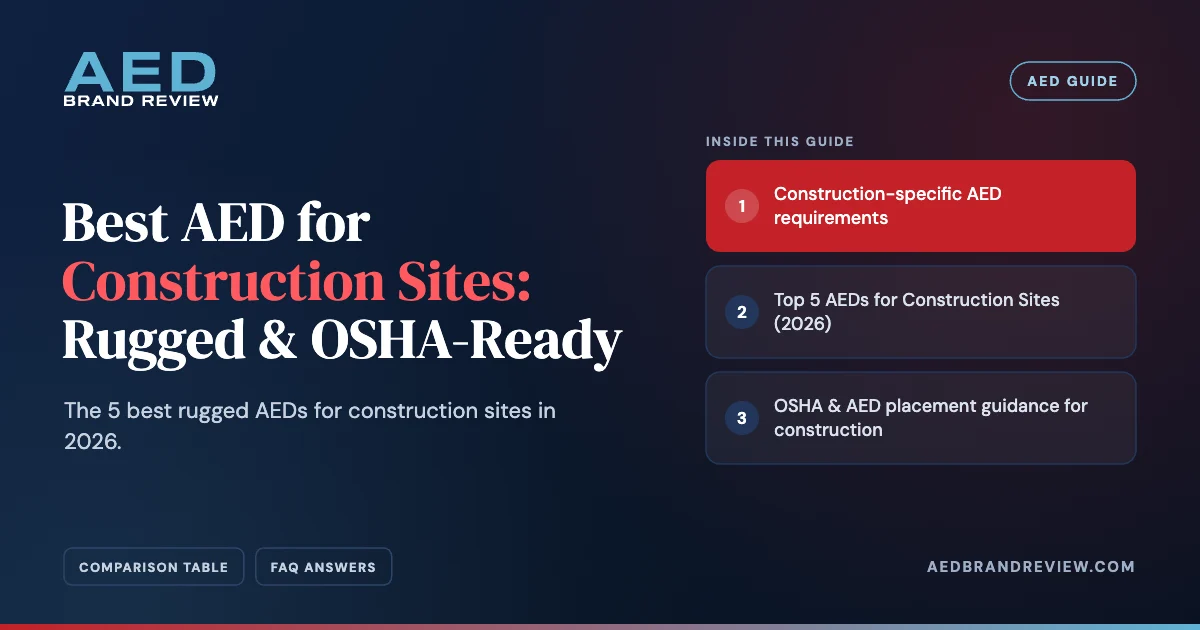
Construction-specific AED requirements
Five priorities for jobsite AEDs:
1. Highest possible IP rating
Dust, mud, rain, concrete particulate, and shop vac wash-down environments demand IP55 minimum, IP56 preferred.
2. Drop-test certification
Jobsite AEDs get dropped from trucks, ladders, and tool boxes. Drop-tested to 1.5 m (Philips FRx) is the industry standard for ruggedness.
3. Temperature tolerance
Outdoor jobsites swing 0 to 110 °F across seasons. All FDA-approved AEDs operate within 32 to 122 °F. Temperatures below 32 °F require a heated cabinet.
4. Long pad/battery life
Construction projects often last 1 to 3 years. ZOLL’s 5-year pad life means you replace once across a typical project lifecycle.
5. Theft-resistant cabinet pairing
Jobsite gear walks. A locked, alarmed AED cabinet with strobe and tamper alarm is non-negotiable.
Top 5 AEDs for Construction Sites (2026)
| Rank | Model | IP rating | Drop test | Pad life | Price |
|---|---|---|---|---|---|
| 1 Top Pick | Philips HeartStart FRx | IP55 | 1.5 m | 2 years | $2,099 to $2,199 |
| 2 | HeartSine Samaritan PAD 450P | IP56 | 1 m | 4 years (PAD-PAK) | $1,761 |
| 3 | ZOLL AED Plus | IP55 | 1 m | 5 years | $2,082 |
| 4 | Defibtech Lifeline VIEW | IP54 | 1 m | 2 years | $2,024.95 |
| 5 | LIFEPAK CR2 | IP55 | 1 m | 2 years | $2,256 to $2,681 |
1. Philips HeartStart FRx, Best Overall for Construction
The Philips HeartStart FRx is built for rugged use and is drop-tested to 1.5 m per Philips specs. IP55 ingress, 8-year warranty, 3.5 lb. For a jobsite trailer or weatherproof cabinet, this is the unit.
2. HeartSine 450P, Best CPR Coaching for Jobsite
The HeartSine 450P at IP56 (the highest ingress rating on this list) includes an integrated CPR rate metronome, useful when the rescuer is a foreman who recertified 18 months ago. 8-year device warranty. Single PAD-PAK cartridge replaces both pads + battery every 4 years.
3. ZOLL AED Plus, Best Long-Cycle Maintenance
The ZOLL AED Plus with 5-year pads is the best choice for projects expected to run 1 to 3+ years. Real-time CPR depth feedback handles muscular construction workers (where compression depth often falls short). 5-year warranty, 7 years when registered with ZOLL.
4. Defibtech Lifeline VIEW, Best Video-Coached for Untrained Site Crew
The Defibtech Lifeline VIEW includes a built-in color video screen showing live CPR + pad placement instructions. For an untrained site crew, the visual reinforcement matters. Its IP54 rating is below the IP55 jobsite minimum, so mount it inside a trailer or site office only.
5. LIFEPAK CR2, Best Clinical-Grade Site Unit
The LIFEPAK CR2 with cprINSIGHT analyzes the rhythm during compressions, uninterrupted CPR correlates with higher survival. Wireless connectivity supports fleet monitoring across multiple job sites for general contractors.
OSHA & AED placement guidance for construction
OSHA’s Best Practices Guide encourages AEDs as part of workplace first-aid programs. Our own planning rules of thumb:
- An AED at any site where EMS response exceeds 5 minutes
- One AED per ~50 active workers on a single site (rule of thumb)
- Located near the project office or trailer, with signage visible from the worksite
- Trained first responders on every shift
- Pre-coordinate with local EMS for site address and access route
Recertified prices across all seven models
Recertified units are the same models under the same FDA premarket approvals, restored, tested and sold with a minimum three year warranty.
| Model | New | Recertified | You keep | Buy |
|---|---|---|---|---|
| Philips HeartStart OnSite | $1,589 | $875 | $714 (45%) | AED Leader or Response Ready |
| Philips HeartStart FRx | $2,099 | $875 | $1,224 (58%) | AED Leader or Response Ready |
| ZOLL AED Plus | $2,082 | $875 | $1,207 (58%) | AED Leader or Response Ready |
| ZOLL AED 3 | $2,399 | $1,150 | $1,249 (52%) | AED Leader or Response Ready |
| HeartSine Samaritan PAD 350P | $1,411 | $875 | $536 (38%) | AED Leader or Response Ready |
| HeartSine Samaritan PAD 450P | $1,761 | $875 | $886 (50%) | AED Leader or Response Ready |
| Cardiac Science Powerheart G5 | $2,157 | $1,225 | $932 (43%) | AED Leader or Response Ready |
Prices verified 30 September 2026 against the public product data of both stores. Both list identical recertified prices, so buy from whichever fits your order size: AED Leader for one to four units, Response Ready for five or more and for compliance and fleet programmes. New prices are the AED Leader list price on the same date.
The honest risk. A recertified AED is a used device. The three year minimum warranty is what makes the saving worth taking. Read recertified versus new and how to choose a refurbished AED before you decide.
Trailer + cabinet pairing
Don’t mount the AED to the outside of a portable trailer (theft risk, temperature exposure). Best practice: locked + alarmed AED cabinet inside the trailer office, with exterior signage pointing to it. For remote sites without trailers, use a freestanding outdoor cabinet with a heating element and a tamper alarm.
Equipping a plant or warehouse? Our guide to AED packages for manufacturing facilities covers what OSHA requires and what three units cost over ten years.
Frequently Asked Questions
Are AEDs required on U.S. construction sites?
Not federally by OSHA. State and municipal rules vary. OSHA’s Best Practices Guide encourages employers to consider AEDs, especially where EMS response is slow, which applies to most rural or remote construction.
How rugged does a construction AED need to be?
Minimum: IP55 + drop-tested to 1 m. Preferred: IP56 + drop-tested to 1.5 m. Pair with a locked outdoor cabinet rated for your climate.
Can an AED handle electrical shock victims?
Yes. AEDs are designed to handle V-fib regardless of cause, including post-electrocution arrhythmias. Standard placement and protocol apply.
What happens to an AED in extreme heat?
FDA-approved AEDs operate up to 122 °F (50 °C). Above that, batteries degrade, and pads can dry out. Don’t leave an AED in a parked truck in summer.
How many AEDs per construction site?
As our own rule of thumb, plan roughly one per 50 active workers. For large sites or multi-building projects, plan one per major work area within a 3-minute walk radius.
Rugged picks for a construction site
Prices checked 30 September 2026 at AED Leader. Each link opens our full review with the buy path.
- Recertified Philips HeartStart FRx review and price$875Save 58%Recertified, 3-year warrantyBuy at AED Leader
- Philips HeartStart FRx review and price$2,099 to $2,199New, 8-year manufacturer warranty
- ZOLL AED 3 review and price$2,399New, 6-year warranty (8 with ZOLL registration)
Get your team certified the easy way.
Sources & References
Disclaimer: Construction safety compliance is project- and jurisdiction-specific. Verify with your project safety officer and local OSHA office.