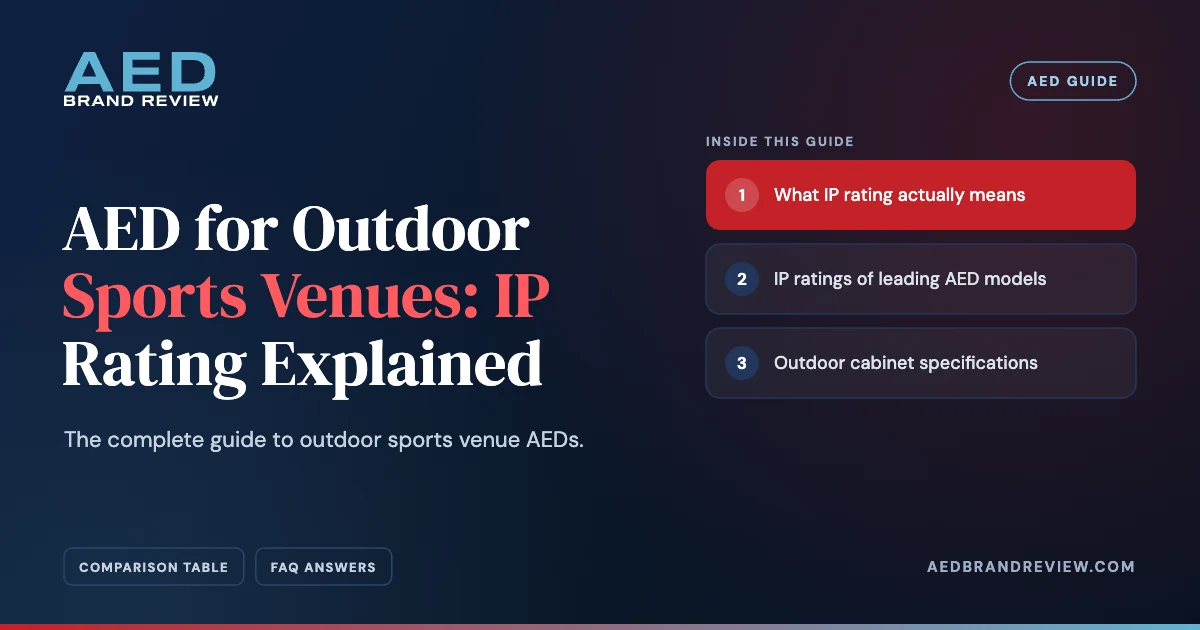
Outdoor sports venues are where the AHA’s 3-minute rule meets its hardest test. A baseball field is 400 feet end-to-end. A golf course covers 150 acres. A soccer pitch sits 200 yards from the locker room. An AED indoors in the clubhouse is, for any practical purpose, unreachable from the playing field, but the AED itself can’t survive direct sun, rain, and 100°F summers without proper engineering.
The technology that makes outdoor AED deployment possible is the IP (Ingress Protection) rating system. Understanding it , and pairing the right unit with the right cabinet, is the difference between a working defibrillator and a $1,500 paperweight after a rainstorm.
What IP rating actually means
IP ratings come from IEC 60529, an international standard published by the International Electrotechnical Commission. Every IP rating has two digits:
| 1st digit (solids) | Protection level | 2nd digit (liquids) | Protection level |
|---|---|---|---|
| 0 | No protection | 0 | No protection |
| 1 | ≥ 50 mm objects | 1 | Vertical drips |
| 2 | ≥ 12 mm objects (fingers) | 2 | 15° angle drips |
| 3 | ≥ 2.5 mm tools | 3 | 60° spraying water |
| 4 | ≥ 1 mm wires | 4 | Splashing water |
| 5 | Limited dust ingress | 5 | Water jets (6.3 mm nozzle) |
| 6 | Dust-tight | 6 | Powerful water jets (12.5 mm nozzle) |
| , | , | 7 | Temporary immersion (1 m, 30 min) |
| , | , | 8 | Continuous immersion |
Practical takeaway:
- IP54 = dust-protected + splash-resistant. Acceptable for sheltered outdoor placements.
- IP55 = dust-protected + water-jet resistant. Acceptable for direct outdoor exposure with cabinet pairing.
- IP56 = dust-protected + powerful water-jet resistant. Best for direct rain, marine environments.
- IP67+ = not available on FDA-approved AEDs in the U.S. market. Always pair outdoor AEDs with a cabinet.
IP ratings of leading AED models
| Model | IP rating | Drop test | Operating temp | Outdoor suitability |
|---|---|---|---|---|
| HeartSine samaritan PAD 350P / 360P / 450P | IP56 | 1 m | 32 to 122 °F | Best, direct exposure with the cabinet |
| Philips HeartStart FRx | IP55 | 1.5 m | 32 to 122 °F | Excellent, most durable |
| ZOLL AED Plus | IP55 | 1 m | 32 to 122 °F | Excellent |
| LIFEPAK CR2 | IP55 | 1 m | 32 to 122 °F | Excellent |
| Defibtech Lifeline VIEW | IP54 | 1 m | 32 to 122 °F | Sheltered placements only |
| Philips HeartStart OnSite | IP21 | , | 32 to 122 °F | Indoor only |
Outdoor cabinet specifications
No AED on the U.S. market is fully immersion-rated. Direct outdoor placement always requires a properly rated cabinet:
Standard outdoor cabinet
- IP65+ housing (dust-tight, water-jet resistant)
- UV-stabilized polycarbonate or steel
- Audible alarm + strobe on door open
- Tamper-resistant locking with push-to-open release
- Cost: from $293.25 at AED Leader (Outdoor AED Cabinet)
Heated outdoor cabinet (cold climate)
- All of the above, plus a thermostatically controlled heater
- Maintains interior 35 to 95°F regardless of exterior temperature
- Requires a 110V AC power supply within 10 ft
- Cost: $700 to $1,400
Premium monitored cabinet
- All of the above, plus cellular connectivity
- Sends a real-time alert to the facility manager on door open
- GPS-locatable for stolen units
- Often pairs with fleet-management software
- Cost: $1,000 to $2,000+
Climate-zone deployment
U.S. climate variation drives cabinet selection:
| Climate zone | Winter low | Summer high | Required cabinet |
|---|---|---|---|
| Southeast (Miami, Houston) | 50°F | 95°F | Standard IP65, UV-rated |
| Southwest (Phoenix, Las Vegas) | 40°F | 115°F | UV-rated + shade pairing critical |
| West Coast (LA, SF) | 45°F | 85°F | Standard IP65 |
| Mid-Atlantic (DC, Philly) | 20°F | 95°F | Heated cabinet preferred |
| Midwest (Chicago, Minneapolis) | -10°F | 90°F | Heated cabinet mandatory |
| Northeast (Boston, NYC) | 10°F | 90°F | Heated cabinet mandatory |
| Pacific Northwest (Seattle) | 30°F | 80°F | Standard IP65 (rain is biggest factor) |
| Mountain (Denver, SLC) | 0°F | 90°F | Heated cabinet recommended |
Venue-by-venue placement guide
Baseball/softball fields
Mount on the dugout exterior wall or concession stand, within 90 seconds of any base, pitcher’s mound, or stand area. For multi-field complexes (youth leagues), place one AED per pair of adjacent fields.
Soccer/football/lacrosse fields
Sideline placement is ideal, within 30 yards of the field. Most field complexes are mounted on the press box, concession, or scoreboard structure.
Golf courses
The hardest venue for AED coverage. A 150-acre course can’t have a 3-minute response from one unit. Best practice:
- Pro shop/clubhouse (1)
- Turn between 9th and 10th holes (1)
- Maintenance shed or driving range (1)
- Mobile AED in lead beverage cart for high-event days
Tennis & pickleball facilities
Pickleball draws many older players, a higher-risk group for cardiac events. Mount in a clubhouse or court-side cabinet. One AED per 4 to 6 courts at busy facilities.
Pools & aquatic centers
Pool decks combine drowning, cardiac, and electrical hazard risk. AED placement on the pool deck in an IP-rated cabinet within 30 seconds of any swimmer. Many state pool codes specifically require AED accessibility for staffed facilities.
Marinas & boating facilities
Salt spray + UV + temperature variation = the harshest outdoor environment. IP56-rated AED in stainless steel or UV-stabilized polycarbonate cabinet. Dock-house and fuel-dock placement.
Outdoor amphitheaters & festival grounds
Temporary or seasonal placement. Multiple units for crowd events. Coordinate with EMS for major event standby.
Parks & playgrounds
Increasingly common, many municipalities add AEDs to recreational parks. Standalone heated outdoor cabinet with anti-theft monitoring.
Real-world deployment patterns
Real-world model
Pickleball boom & pickleball cardiac events
Pickleball, the fastest-growing sport in the U.S., has documented a notable rate of on-court cardiac events, primarily in players over 60. Major facilities are now installing AED cabinets at every court group of 4 to 6 courts. The investment is small relative to the demographic risk.
Maintenance challenges of outdoor AEDs
Outdoor units age faster than indoor counterparts:
- Pad gel degradation: Temperature cycling accelerates conductive gel drying. Inspect every 90 days minimum.
- Battery life: Cold-climate winters reduce battery shelf life by ~10 to 20%. Replace earlier than the indoor schedule.
- Cabinet seals: Rubber gaskets degrade in UV. Inspect annually; replace every 3 to 5 years.
- Visual signage: UV bleaches plastic signage. Replace ISO 7010 signs that have faded.
Lighting & visibility at outdoor venues
Outdoor AEDs need visibility under all conditions:
- Photoluminescent signage (glows after dark) for after-hours venues
- Solar-powered illumination above remote cabinet locations
- Reflective tape on the cabinet for vehicle headlight visibility
- Bright red or fluorescent yellow cabinet finishes
Who should buy/use this approach
This framework fits:
- Athletic directors at schools, colleges, and club programs
- Parks & recreation department directors
- Golf course general managers
- Marina & boating facility operators
- Pool & aquatic center managers
- Stadium & arena operations directors
- Outdoor event organizers (festivals, races, concerts)
- HOA managers with community pools, courts, and playgrounds
Covering a stadium, field or athletics program? See our AED packages for sports stadiums guide for weather-rated models and how many units a venue needs.
Frequently Asked Questions
What IP rating do I need for an outdoor AED?
IP55 is the minimum for direct outdoor exposure. IP56 is the gold standard for rain-heavy or marine environments. No FDA-approved AED in the U.S. is rated for immersion (IP67+), so always pair with a cabinet.
Can an AED survive freezing temperatures?
Most FDA-approved AEDs operate down to 32°F. Below freezing, lithium batteries degrade rapidly, and the pad gel can freeze. In cold climates, use a heated outdoor cabinet that maintains 35°F+ interior temperature.
What’s the difference between IP54, IP55, and IP56?
IP54 = splash-resistant (sheltered outdoor only). IP55 = withstands 6.3 mm water jet (direct outdoor with cabinet). IP56 = withstands a 12.5 mm powerful water jet (marine, heavy rain).
How much does an outdoor AED cabinet cost?
Standard outdoor cabinet: from $293.25 at AED Leader. Heated cabinet for cold climates: $700 to $1,400. Premium cellular-monitored cabinet: $1,000 to $2,000+.
Are outdoor AEDs different from indoor models?
The AED itself can be the same FDA-approved unit. What changes are the cabinet, mounting, and maintenance frequency? Choose an AED with an IP55+ rating for outdoor reliability.
Can an AED be used outdoors in the rain?
Yes, per manufacturer guidance, an AED can be used in light rain or snow. Move the patient to a dry surface if possible. Don’t deploy in standing water; dry the patient’s chest before pad placement.
How often should outdoor AEDs be inspected?
Visual inspection every 30 days minimum (pads, battery indicator, cabinet seal integrity). Full pad/battery inspection every 90 days. Annual cabinet seal and signage replacement check.
Get hands-on AED training in under 3 hours.
Sources & References
- IEC 60529, Degrees of Protection Provided by Enclosures (IP Code)
- AHA, 2020 CPR & ECC Guidelines
- American Heart Association, Public AED Resources
- Manufacturer specifications: HeartSine, Philips, ZOLL, Defibtech, Physio-Control
Disclaimer: Climate, jurisdiction, and venue-specific rules vary. Verify with manufacturer specifications and your local Authority Having Jurisdiction before deployment.