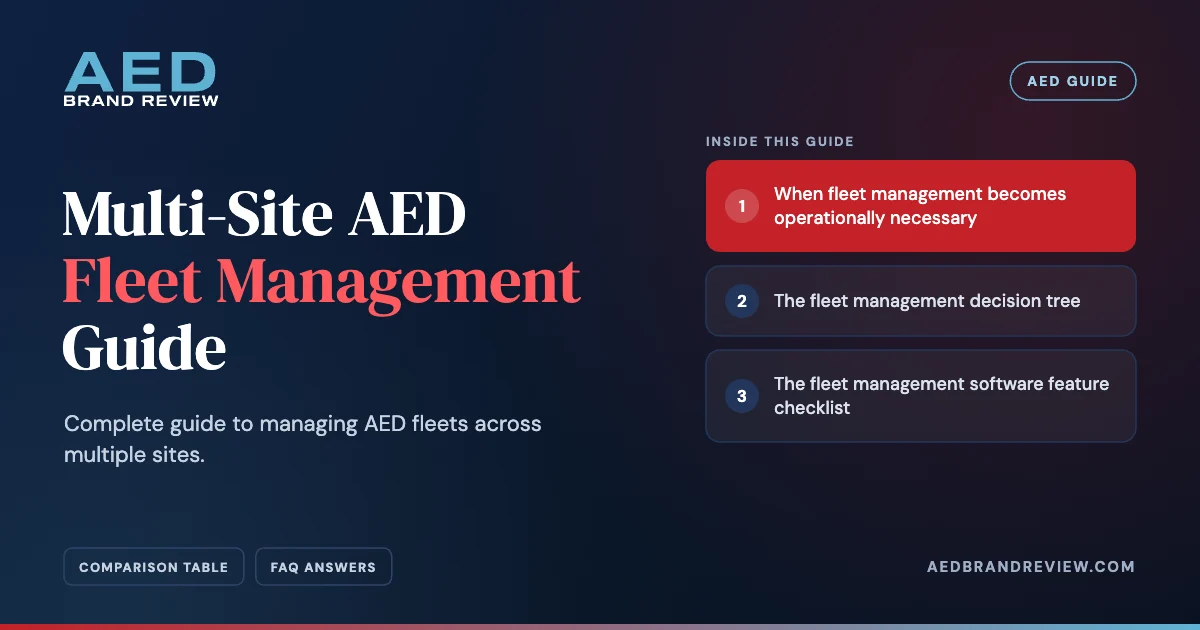
An AED fleet is the operational reality of any organization larger than a single building. School districts have AEDs across 5 to 30 schools. Hotel chains have them across 20 to 200 properties. Hospital systems have them across emergency departments, clinics, urgent care, and ambulatory sites. Manufacturing operators have them across plants, warehouses, and distribution centers. Once an organization exceeds 5 deployed devices across 2+ locations, the spreadsheet-and-calendar approach starts to break down , missed expirations, inconsistent registration, untracked training, and audit-day surprises become structurally inevitable. This guide is the enterprise-grade framework for managing AED fleets at scale: software platforms, organizational models, standardization rules, procurement, and the compliance reporting that holds it together.
When fleet management becomes operationally necessary
| Org size | Approach | Time investment |
|---|---|---|
| 1 to 4 AEDs · single site | Spreadsheet + binder + calendar | ~30 min/month |
| 5 to 15 AEDs · 1 to 3 sites | Shared-drive spreadsheet + dedicated owner | ~2 to 4 hours/month |
| 15 to 50 AEDs · 3 to 10 sites | Dedicated fleet management software | ~4 to 8 hours/month |
| 50 to 250 AEDs · 10 to 40 sites | Enterprise fleet software + dedicated program coordinator | ~8 to 20 hours/month |
| 250+ AEDs · 40+ sites | Enterprise platform + dedicated AED program team | ~30+ hours/month |
The fleet management decision tree
Decision 1, Centralized vs distributed program structure
Centralized model
- One corporate AED program owner
- Standardized devices & consumables across all sites
- Bulk procurement (15 to 25% savings)
- Unified compliance dashboard
- Best for: hotel chains, retail, restaurants, healthcare systems
Distributed model
- Each site owns its program locally
- Local responsiveness, local relationships
- Site-level autonomy
- Risk: inconsistent compliance, missed batching savings
- Best for: highly autonomous franchises, religious organizations, very small portfolios
Most enterprise AED fleets benefit from a hybrid model: centralized policy + procurement + software platform, with site-level operational ownership (named site contacts handling monthly inspection + training scheduling).
Decision 2, Software platform selection
| Platform | Best for | Key features |
|---|---|---|
| AEDTS | Multi-site enterprises 20 to 500+ AEDs | Centralized dashboard, automated expiration tracking, training records, audit reports, and CERP storage |
| Atrus (AED Link) | Public access programs, EMS-integrated communities | 911 dispatch integration, public access map, registration sync |
| AED Sentinel | Mid-size to large fleets | Monitoring sensors, automated readiness verification |
| Manufacturer-specific (Philips, LIFEPAK) | Single-brand fleets | Brand-locked but deep integration with device telemetry |
| Custom spreadsheet/database | Small fleets, tight budget | Free, fully customizable, manual |
Decision 3, Standardization rules
Standardization is the single highest-leverage decision in fleet management. A fleet running 4 different AED brands across 30 sites has 4× the consumable SKUs to track, 4× the training nuances, and 4× the recall risk. Standardize on:
- One AED brand across all sites (Philips, ZOLL, HeartSine, Defibtech, etc.)
- One model (or at most 2, typically one indoor + one outdoor-rated)
- One pad SKU + one battery SKU per model
- One training provider across the enterprise (AHA, ARC, or specific national partner like AED Leader)
- One signage standard (ISO 7010 E010 + ADA-compliant heights)
- One cabinet model (alarmed surface-mount as default)
Standardization reduces complexity, captures volume discounts, simplifies training, and enables centralized procurement. For new fleet builds, lock standardization at procurement. For existing fleets with brand sprawl, plan to consolidate during natural replacement cycles.
The fleet management software feature checklist
Whatever platform you evaluate, it should cover:
- Device inventory (make, model, serial, location, install date)
- Consumable expiration tracking with automated reminders (90/60/30/7 days)
- Training records (responder name, certification, expiration, provider)
- Registration status (state DPH, PulsePoint, manufacturer)
- Inspection log (digital monthly logs with photo upload)
- Incident reporting (deployment events with outcomes)
- CERP document storage
- Drill scheduling and outcomes
- Compliance dashboard (% readiness per site, per device)
- Audit-ready exportable reports (PDF or CSV)
- Multi-user access with role-based permissions
- Mobile app for site-level inspections
Standardized site-level operations
Even in a centralized fleet, day-to-day operations happen at the site. Define a standard playbook for every named site contact:
| Cadence | Site-level task | Reports to |
|---|---|---|
| Daily | 30-second visual status check | Internal, no upload |
| Monthly | Documented inspection with photo upload | Fleet management software |
| Quarterly | Tabletop CERP walkthrough | Site report to the corporate |
| Semi-annually | Live drill | Site report to the corporate |
| Annually | Full site audit using corporate template | Corporate AED program lead |
| Post-deployment | Incident report within 5 business days | Corporate + state EMS where required |
Multi-site procurement
One of the biggest financial wins in fleet management is consolidated procurement. Manufacturers and authorized resellers offer tiered pricing:
| Order volume (pads/batteries) | Typical discount vs. single-set MSRP |
|---|---|
| 2 to 5 sets | 0 to 5% |
| 6 to 10 sets | 5 to 10% |
| 11 to 25 sets | 10 to 15% |
| 26+ sets (fleet) | 15 to 25% |
| 100+ sets (enterprise) | 20 to 30% + custom contract |
For a 50-AED fleet replacing pads every 2 years (25 sets per year), consolidated annual orders capture a 15 to 25% discount = about $400 to $1,500/year saved versus individual site procurement.
Compliance reporting structure
Enterprise AED programs report compliance status up through risk management, EHS leadership, or corporate safety committees. A standard quarterly compliance report should include:
- Total AEDs in service/count by site
- % of devices with current pads and batteries
- % of designated responders with current certification
- % of sites with registered AEDs
- % of sites with current CERP
- Drill completion rate
- Any incidents in the period (number, outcomes)
- Identified risks and remediation plans
- Budget actuals vs. forecast
Risk management integration
For organizations with formal risk management functions (most enterprises with 250+ employees), the AED program should integrate into:
- Annual enterprise risk register
- Workers’ compensation insurance program review
- General liability insurance program review
- Property insurance discount eligibility
- Crisis management and business continuity plans
Insurance broker conversations should occur at least annually. Document everything for premium credit eligibility (typically 1 to 3% on commercial property and general liability per AED insurance coverage norms).
Real-world fleet management patterns
Healthcare system case
Multi-site hospital system with 200+ AEDs
Regional healthcare systems operating 5 to 20 facilities (acute care + ambulatory + clinics) commonly run 200+ AEDs across the enterprise. Standardization on a single brand (often LIFEPAK or ZOLL for clinical-grade) + centralized procurement + dedicated AED program coordinator under the risk management or patient safety function. Annual program costs $150,000, $300,000, including software, training, consumables, and full-time staffing.
Hospitality case
National hotel chain with 50 to 500 properties
National hotel operators typically run one AED per property (some with multiple in pool deck + lobby + gym). Centralized fleet management under corporate risk management, with property GMs as site contacts. Standardization typically on Philips HeartStart OnSite or HeartSine PAD 350P for cost efficiency. Annual per-property AED program costs $300, $500, plus enterprise platform cost.
Replacing your AED pads or battery
AED pads and batteries expire on a fixed schedule whether the device is ever used or not, and they are the single most common reason an AED fails when it is needed. In the largest published analysis of FDA-reported AED events, 40,787 cases, batteries accounted for 23.2 per cent of failures and pads and connectors for 23.7 per cent, so 46.9 per cent of all AED failures are consumables (DeLuca et al., Annals of Emergency Medicine, 2012, PMID 21872969). Below is every current replacement part with its price and service life, verified against seller product data on 12 September 2026.
| Model | Adult pads | Battery | Pediatric option | 10 year consumable cost |
|---|---|---|---|---|
| Philips HeartStart OnSite | M5071A $99.00, 2 years | M5070A $249.00, 4 years | Separate M5072A cartridge, prescription only | About $894 |
| Philips HeartStart FRx | SMART Pads II 989803139261 $89.00, 2 years | M5070A $249.00, 4 years | Infant/Child Key $139.00, reusable | About $854 |
| ZOLL AED Plus | CPR-D Padz 8900-0800-01 $230.00, 5 years | Lithium set of 10 $100.00, 5 years | Pedi-padz II $155.00, 2 years | About $330, the lowest we track |
| ZOLL AED 3 | CPR Uni-padz 8900-000280-01 $234.00, 5 years | 8000-000696 $201.00, 5 years | None needed, Uni-padz cover children | About $435 |
| Defibtech Lifeline | DDP-100 $75.15 | DBP-1400, part DCF-200 $229.10 | DDP-200P $130.25 | About $530 |
| Defibtech Lifeline VIEW | DDP-2001 $83.05 | DCF-2003 $240.45 | DDP-2002 $136.40 | About $813 |
| HeartSine Samaritan PAD | Pad-Pak-01 $236.00, pads and battery in one cartridge | Included in the Pad-Pak, there is no separate battery | Pediatric Pad-Pak PAD-PAK-02 $279.00 | About $472 |
| Cardiac Science Powerheart G5 | XELAED001C $88.00 | XBTAED001A $495.00, 4 years | XELAED003C $127.00 | About $1,342, the highest we track |
| Physio-Control LIFEPAK CR2 | Quik-Step 11101-000021 $196.00, adult and child in one set | LIFEPAK CR2 lithium battery $341.00, about 4 years | None needed, the Quik-Step set covers children | Not published per part |
Prices verified against the public product data of AED Leader on 30 September 2026. Service life is the manufacturer figure where one is published; where it is not, check the expiry date printed on the part itself. Ten year consumable cost is our own calculation from those part prices and service lives.
Three things owners get wrong
- Buying the wrong Philips pad. The FRx uses SMART Pads II, part 989803139261. SMART Pads III belong to the FR3, a different device. The OnSite uses M5071A and the two are not interchangeable.
- Assuming the pediatric part is optional. On a ZOLL AED Plus, Pedi-padz II cost $155.00 and last two years, which is about $775 across a ten year life. On a ZOLL AED 3 or a LIFEPAK CR2 the pads already cover children and that cost is zero.
- Tracking the wrong date. HeartSine combines the pads and battery into one Pad-Pak cartridge, so there is a single expiry to track. Every other model here has two parts on two separate clocks.
Full replacement schedule by model is on our AED pads and batteries page. If you are still choosing a device, the ten year running cost is usually a bigger number than the discount you are negotiating: see every AED brand ranked by price and ten year cost.
Recertified prices across all seven models
Recertified units are the same models under the same FDA premarket approvals, restored, tested and sold with a minimum three year warranty.
| Model | New | Recertified | You keep | Buy |
|---|---|---|---|---|
| Philips HeartStart OnSite | $1,589 | $875 | $714 (45%) | AED Leader or Response Ready |
| Philips HeartStart FRx | $2,099 | $875 | $1,224 (58%) | AED Leader or Response Ready |
| ZOLL AED Plus | $2,082 | $875 | $1,207 (58%) | AED Leader or Response Ready |
| ZOLL AED 3 | $2,399 | $1,150 | $1,249 (52%) | AED Leader or Response Ready |
| HeartSine Samaritan PAD 350P | $1,411 | $875 | $536 (38%) | AED Leader or Response Ready |
| HeartSine Samaritan PAD 450P | $1,761 | $875 | $886 (50%) | AED Leader or Response Ready |
| Cardiac Science Powerheart G5 | $2,157 | $1,225 | $932 (43%) | AED Leader or Response Ready |
Prices verified 30 September 2026 against the public product data of both stores. Both list identical recertified prices, so buy from whichever fits your order size: AED Leader for one to four units, Response Ready for five or more and for compliance and fleet programmes. New prices are the AED Leader list price on the same date.
The honest risk. A recertified AED is a used device. The three year minimum warranty is what makes the saving worth taking. Read recertified versus new and how to choose a refurbished AED before you decide.
Education case
Statewide university system with 100+ AEDs
State university systems across multiple campuses standardize through state procurement contracts. Typical model: centralized purchasing, distributed operations (each campus has an AED program coordinator under campus safety or athletics). Common platform: Atrus or AEDTS integration with state EMS dispatch. Annual program costs $80,000, $200,000, depending on campus count.
Frequently Asked Questions
When should we adopt AED fleet management software?
Generally, around 15 or more deployed AEDs, or any time spreadsheet maintenance becomes a recurring source of missed expirations. Software typically pays for itself by eliminating non-compliance costs and reducing administrative overhead.
Should our enterprise standardize on one AED brand?
Yes, strongly. Standardization captures volume discounts (15 to 25%), simplifies consumable SKU management, streamlines training, and reduces recall response complexity. For new fleet builds, lock standardization at procurement. For existing brand sprawl, plan consolidation during natural replacement cycles.
What’s the difference between AEDTS, Atrus, and AED Sentinel?
AEDTS focuses on multi-site enterprise fleet management with comprehensive dashboards. Atrus emphasizes public access and 911 dispatch integration. AED Sentinel adds physical monitoring sensors for automated readiness verification. Choose based on whether your priority is corporate compliance reporting (AEDTS), community/public access integration (Atrus), or physical monitoring (AED Sentinel).
How much does AED fleet management software cost?
Typically $5 to $20 per AED per month subscription, depending on platform and feature set. For a 50-AED fleet, expect $3,000 to $12,000 annual platform cost. Enterprise contracts (250+ AEDs) often have custom pricing.
How do we structure responsibility across multi-site fleets?
Most enterprises use a hybrid model: centralized corporate AED program lead (policy + procurement + software + reporting) + site-level named contacts (daily/monthly operations + drills + local training coordination). Sites report up; corporate sets standards.
Can fleet management software replace the AED program owner role?
No. Software automates tracking and reporting but cannot make decisions, manage incidents, communicate with stakeholders, or interpret regulatory changes. A named human program owner remains essential, software is the leverage that lets one owner manage a fleet that would otherwise require a team.
How do we capture volume discounts at fleet scale?
Consolidate procurement through a single corporate contract. Authorized resellers offer tiered pricing, 50+ AEDs typically qualify for a 15 to 25% discount on consumables. Annual blanket POs versus site-by-site ordering capture maximum discount and synchronize expiration tracking.
Get hands-on AED training in under 3 hours.
Sources & References
- OSHA, AEDs in the Workplace Best Practices Guide
- AHA, Public Access Defibrillation Resources
- FDA, Automated External Defibrillators
- Industry fleet management platform documentation (AEDTS, Atrus, AED Sentinel)
Disclaimer: Software vendor selection should include direct evaluation of current platform features, pricing, and integration capabilities. This article is informational and not a vendor recommendation.