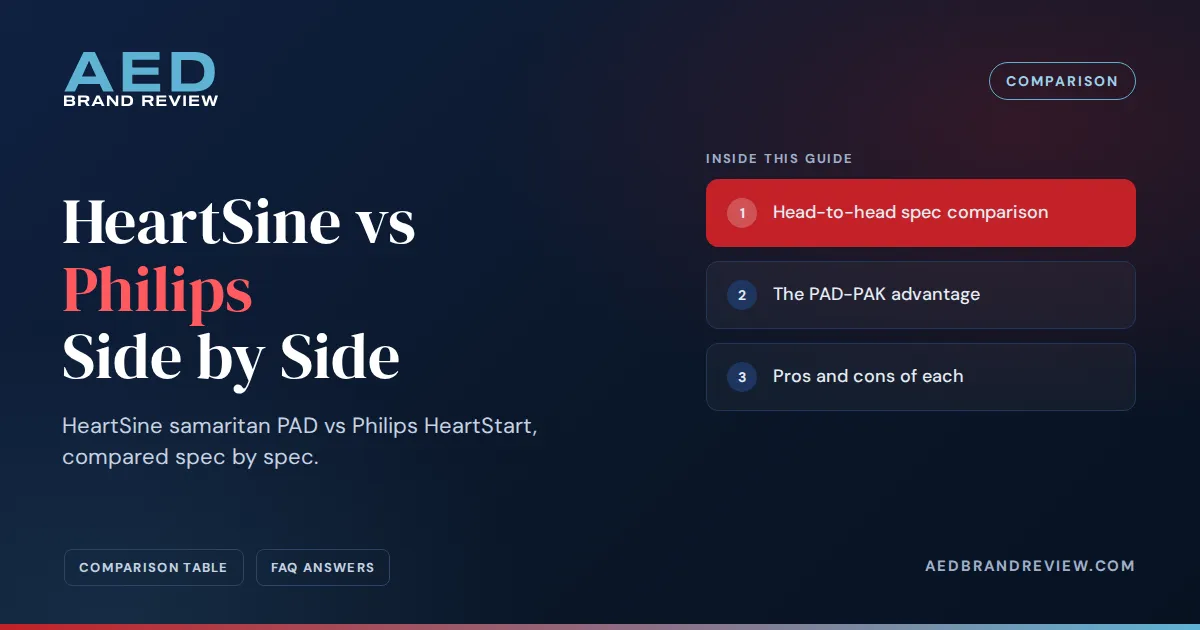
HeartSine and Philips compete most directly at the budget tier, small businesses, churches, daycares, and homes shopping for AEDs at the $1,411 to $1,589 price point. Both deliver an FDA-approved, fully-functional device at that range. The decision comes down to maintenance philosophy: HeartSine’s PAD-PAK is one cartridge to replace every 4 years; Philips uses separate pads (every 2 years) and battery (every 4 years). Over 10 years, the math favors HeartSine.
Head-to-head spec comparison
| Spec | HeartSine PAD 350P | Philips HeartStart OnSite |
|---|---|---|
| Price range, both models (AED Leader) | $1,411 to $1,589 | $1,411 to $1,589 |
| Warranty | 10 years | 8 years |
| Weight | 2.4 lb | 3.3 lb |
| IP rating | IP56 | IP21 (indoor only) |
| Consumable system | Single PAD-PAK cartridge (pads + battery) | Separate pads + battery |
| Replacement cycle | Every 4 years (one part) | Pads every 2 yrs · battery every 4 yrs |
| Per-cycle cost | $236 (PAD-PAK) | $99 pads · $249 battery |
| 10-year device + consumables | $1,883 | $2,483 |
The PAD-PAK advantage
HeartSine’s PAD-PAK consolidates pads + battery into a single sealed cartridge. Replace once every 4 years. One purchase order, one expiration date, one inventory SKU. For organizations without dedicated facilities maintenance, such as small businesses, churches, daycare, this maintenance simplification is the single biggest operational difference. Philips users juggle two separate expiration calendars across the same period.
Verdict by use case
Best for small business · church · daycare
HeartSine PAD 350P
Lightest unit (2.4 lb), 8-year warranty, single-cartridge maintenance, IP56 for any environment. Lower 10-year TCO. Best value at the budget tier.
Best for the general workplace · familiar brand
Philips HeartStart OnSite
Largest U.S. install base. Clearest voice prompts. EMS familiarity. Cheaper per pad change ($99 pads), but two parts to track. Indoor only (IP21).
Pros and cons
HeartSine wins on
- 10-year warranty
- Single PAD-PAK cartridge
- IP56 outdoor capable
- 2.4 lb lightest in category
- Lowest 10-year TCO
Recertified prices across all seven models
Recertified units are the same models under the same FDA premarket approvals, restored, tested and sold with a minimum three year warranty.
| Model | New | Recertified | You keep | Buy |
|---|---|---|---|---|
| Philips HeartStart OnSite | $1,589 | $875 | $714 (45%) | AED Leader or Response Ready |
| Philips HeartStart FRx | $2,099 | $875 | $1,224 (58%) | AED Leader or Response Ready |
| ZOLL AED Plus | $2,082 | $875 | $1,207 (58%) | AED Leader or Response Ready |
| ZOLL AED 3 | $2,399 | $1,150 | $1,249 (52%) | AED Leader or Response Ready |
| HeartSine Samaritan PAD 350P | $1,411 | $875 | $536 (38%) | AED Leader or Response Ready |
| HeartSine Samaritan PAD 450P | $1,761 | $875 | $886 (50%) | AED Leader or Response Ready |
| Cardiac Science Powerheart G5 | $2,157 | $1,225 | $932 (43%) | AED Leader or Response Ready |
Prices verified 30 September 2026 against the public product data of both stores. Both list identical recertified prices, so buy from whichever fits your order size: AED Leader for one to four units, Response Ready for five or more and for compliance and fleet programmes. New prices are the AED Leader list price on the same date.
The honest risk. A recertified AED is a used device. The three year minimum warranty is what makes the saving worth taking. Read recertified versus new and how to choose a refurbished AED before you decide.
Philips wins on
- Largest U.S. install base
- Clearer voice prompts
- Lower cost per pad change
- EMS familiarity
When Philips makes more sense than HeartSine
Three scenarios where Philips OnSite is the better pick: (1) your organization has standardized on Philips across multiple sites; (2) your insurance broker or facility GC specifies Philips; (3) you have an existing supply relationship with Philips-authorized distributors at preferential pricing.
Buying for a house rather than a workplace? Our AED for home use guide compares the two no-prescription models and what each costs to keep ready for ten years.
Frequently Asked Questions
Is HeartSine cheaper than Philips long-term?
Yes. HeartSine device plus ten years of consumables runs about $1,883 vs Philips at $2,483, driven by the single-cartridge PAD-PAK system.
What’s the difference between HeartSine 350P and Philips OnSite?
HeartSine uses one combined PAD-PAK cartridge (4-year cycle); Philips uses separate pads (2-yr) and battery (4-yr). HeartSine has an IP56 outdoor rating; Philips has an IP21 indoor only.
Does Philips have a 10-year warranty option?
No, Philips standard is 8 years. HeartSine also offers 8 years across its Samaritan PAD line.
Can I use HeartSine outdoors?
Yes, IP56 rating handles direct rain. Philips OnSite at IP21 is indoor only; the Philips FRx (IP55) is the outdoor equivalent at a higher cost.
Which is easier for a non-technical office manager?
HeartSine, one replacement cartridge to track every 4 years. Philips requires tracking two separate expirations.
Both models, priced today
Prices checked 30 September 2026 at AED Leader. Each link opens our full review with the buy path.
- HeartSine Samaritan PAD 350P review and price$1,411New, 8-year manufacturer warranty
- Philips HeartStart OnSite (M5066A) review and price$1,589 to $1,819New, 8-year manufacturer warranty
Get your team certified the easy way.
Sources & References
- Manufacturer specs: HeartSine Samaritan PAD 350P, Philips HeartStart OnSite
- FDA, AED Regulation
Disclaimer: AED Leader store prices checked September 2026.