Both models, priced today
Prices checked 30 September 2026 at AED Leader. Each link opens our full review with the buy path.
- ZOLL AED 3 review and price$2,399New, 6-year warranty (8 with ZOLL registration)
- LIFEPAK CR2 review and price$2,256 to $2,681New, 8-year manufacturer warranty
The verdict, in one line
What actually separates these two brands
Quick answer
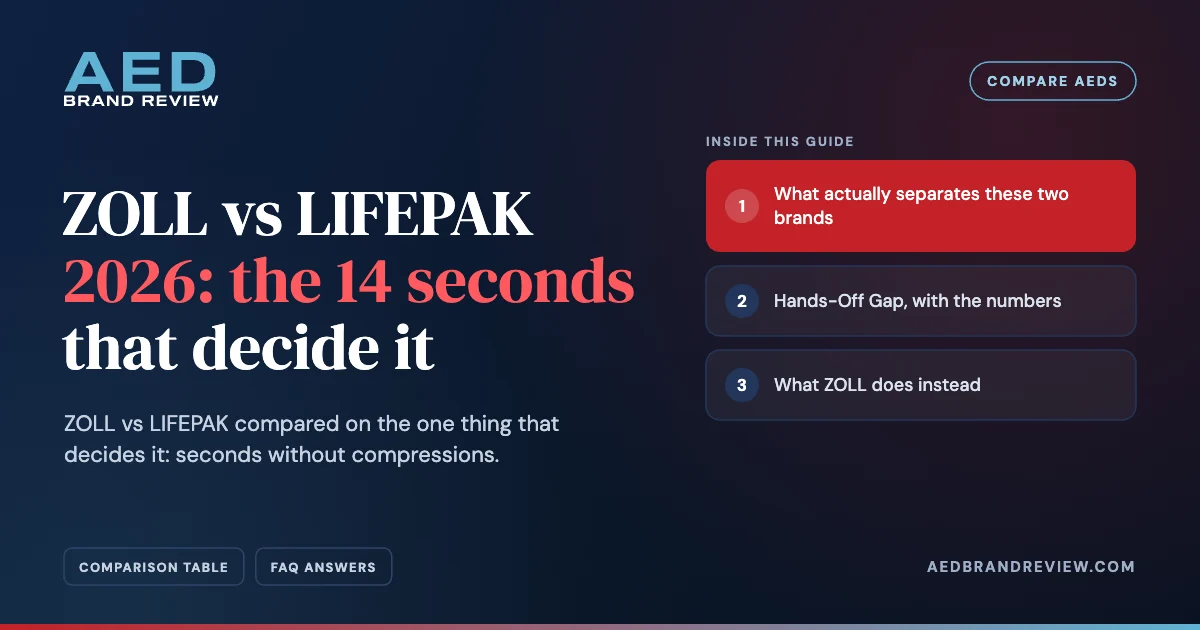
Every comparison of these brands you will find lists specifications side by side and leaves you to guess which ones matter. Almost none of them mention the only variable with published outcome data attached, which is chest compression fraction: the share of the rescue during which compressions are actually happening. Survival tracks it. Pauses destroy it.
The two manufacturers attack that problem from opposite directions, and once you see it that way the choice becomes simple. One brand makes your compressions better. The other makes there be more of them.
The Hands-Off Gap, with the numbers
Quick answer
| cprINSIGHT measure | Result | Comparison |
|---|---|---|
| Pre-shock pause | 8 seconds | 22 seconds average, conventional AED |
| Chest compression fraction | 86% | 80%, conventional AED |
| Decision reached during compressions | 70% of cases | 0% by definition on a conventional AED |
| Shockable rhythm sensitivity | 95.5% | |
| Non-shockable specificity | 98.2% | |
| Validated population | Adults and children one year and older | |
14 sec
What ZOLL does instead
Quick answer
This is the correction almost every comparison page gets wrong, including two currently ranking for this query. Real CPR Help is not exclusive to the AED 3. Both ZOLL models measure compression depth, which matters because untrained and even trained rescuers routinely compress too shallow under stress.
The trade is clean and worth stating plainly. LIFEPAK reduces the time your hands are off the chest. ZOLL improves what happens while your hands are on it. If your responders are trained and drilled, the LIFEPAK argument is stronger. If your AED will most likely be picked up by whoever is nearest, the ZOLL argument is stronger, because a shallow compression repeated for two minutes is a far bigger problem than a 14-second pause. Full detail in our ZOLL AED Plus review and ZOLL AED 3 review.
Verified prices, September 2026
Quick answer
| Model | New price | Recertified | Warranty | Source, date |
|---|---|---|---|---|
| ZOLL AED Plus | $2,082 | $875 | 5 yr | AED Leader, 27 Sep 2026 |
| ZOLL AED 3 | $2,399 | $1,150 to $1,295 | 5 yr | AED Leader, 27 Sep 2026 |
| LIFEPAK CR2 | $2,256 to $2,681 | check availability | 8 yr | AED Leader, 27 Sep 2026 |
| LIFEPAK CR2 Value Package | $2,379.10 to $2,743.70 | n/a | 8 yr | AED Leader, 27 Sep 2026 |
| LIFEPAK CR Plus | DISCONTINUED from production. Do not buy new. | |||
The 14-Second Question: what those seconds cost
Quick answer
| Model | Pads (price, life) | Battery (price, life) | 10-yr consumables | Cost per covered year, new |
|---|---|---|---|---|
| ZOLL AED Plus | CPR-D-padz $230, 5 yr | 10x 123A lithium ~$100, 5 yr | ~$330 | $241 |
| ZOLL AED 3 | Uni-padz $234, 5 yr (adult + child) | $201, 5 yr | ~$435 | $283 |
| LIFEPAK CR2 | Quik-Step $196, 4 yr (adult + child) | $341, 4 yr | ~$1,074 | $333 to $376 |
Our calculation. Replacements needed across ten years: CR2 pads at years 4 and 8 plus batteries at years 4 and 8. ZOLL pads and battery at year 5. All prices from AED Leader, 30 September 2026, including the CR2 battery at $341, part 11141-000165. Cost per covered year = (purchase + 10-year consumables) divided by 10.
The driver is the replacement clock. ZOLL’s CPR-D-padz last five years and the AED 3’s Uni-padz do the same, so one set of pads and one battery cover the decade; the CR2’s Quik-Step pads and battery run on a four-year clock, so you buy each twice, and the $341 battery is the largest single line. This is the number that should decide a fleet purchase, and it is absent from every other page ranking for this comparison. The full cross-brand table is in our AED pads and batteries guide, with brand-specific detail in the ZOLL AED Plus parts guide and the Philips parts guide.
Worth crediting to LIFEPAK: the CR2’s Quik-Step pads cover adults and children in a single set, so there is no separate pediatric purchase. ZOLL matches that on the AED 3 with Uni-padz but not on the AED Plus, which needs Pedi-padz II at about $155 every two years, roughly $775 per decade. If children are in scope, that roughly closes the gap between the CR2 and the AED Plus. Our schools guide works this through at institutional scale.
Head to head on the specifications that matter
| ZOLL AED Plus | ZOLL AED 3 | LIFEPAK CR2 | |
|---|---|---|---|
| CPR feedback | Real CPR Help, depth and rate | Real CPR Help + CPR Dashboard | Metronome, no depth measurement |
| Analysis during compressions | No | No | Yes, cprINSIGHT |
| Pediatric | Pedi-padz II, separate, 2 yr | Uni-padz, included | Quik-Step, included |
| Connectivity | Optional | Wi-Fi available | Wi-Fi to LIFELINKcentral |
| Ingress rating | IP55 | IP55 | IP55 |
| Warranty | 5 yr | 5 yr | 8 yr |
| FDA PMA | P160015 | P160015 | P170018 |
| 10-yr consumables | ~$330 | ~$435 | ~$1,074 |
Which one should you actually buy
Quick answer
| Your situation | Buy | Why |
|---|---|---|
| Home or small office | ZOLL AED Plus, recertified $875 | Cheapest decade at roughly $1,205 all in, and depth coaching for an untrained rescuer |
| Gym or fitness facility | ZOLL AED 3 | Free pediatric coverage, CPR Dashboard, IP55. See our gym guide |
| School | ZOLL AED 3 or LIFEPAK CR2 | Both include pediatric. CR2 wins if trained staff respond, AED 3 wins on cost |
| Corporate fleet with a program manager | LIFEPAK CR2 | Wi-Fi readiness reporting and 8-year warranty reduce admin burden across many units |
| Trained medical or security responders | LIFEPAK CR2 | cprINSIGHT pays off most when the operator is competent enough to exploit the shorter pause |
| Lowest possible total cost | ZOLL AED Plus, recertified | $875 plus $330 per decade beats every alternative here |
Why consumables decide more rescues than features do
Quick answer
The one-line decision
ZOLL vs LIFEPAK FAQ
Which is better, ZOLL or LIFEPAK?
What is cprINSIGHT and does it matter?
How much does a LIFEPAK CR2 cost?
Is the LIFEPAK CR Plus still available?
Do both brands cover children?
Does the ZOLL AED 3 have better CPR feedback than the AED Plus?
Which AED has the longest warranty?
References
- Stryker, LIFEPAK CR2 cprINSIGHT technology whitepaper (US), citing an Amsterdam study published January 2021: pre-shock pause 8 seconds versus 22 seconds average, chest compression fraction 86% versus 80%, decision during compressions in 70% of cases, shockable sensitivity 95.5%, non-shockable specificity 98.2%, validated for adults and children one year and older. Manufacturer-published data.
- FDA Premarket Approval database: P160015 (ZOLL AED Plus and public-access ZOLL AED 3), P170018 (LIFEPAK CR2). AEDs are FDA-approved via Premarket Approval (PMA).
- DeLuca LA et al. Analysis of automated external defibrillator device failures reported to the Food and Drug Administration. Ann Emerg Med. 2012 (PMID 21872969): 40,787 reported events, batteries 23.2%, pads and connectors 23.7%.
- American Heart Association: survival from ventricular fibrillation declines approximately 10% per minute without defibrillation.
- Prices: AED Leader product and category pages, checked 30 September 2026, including the LIFEPAK CR2 replacement battery at $341, part 11141-000165.