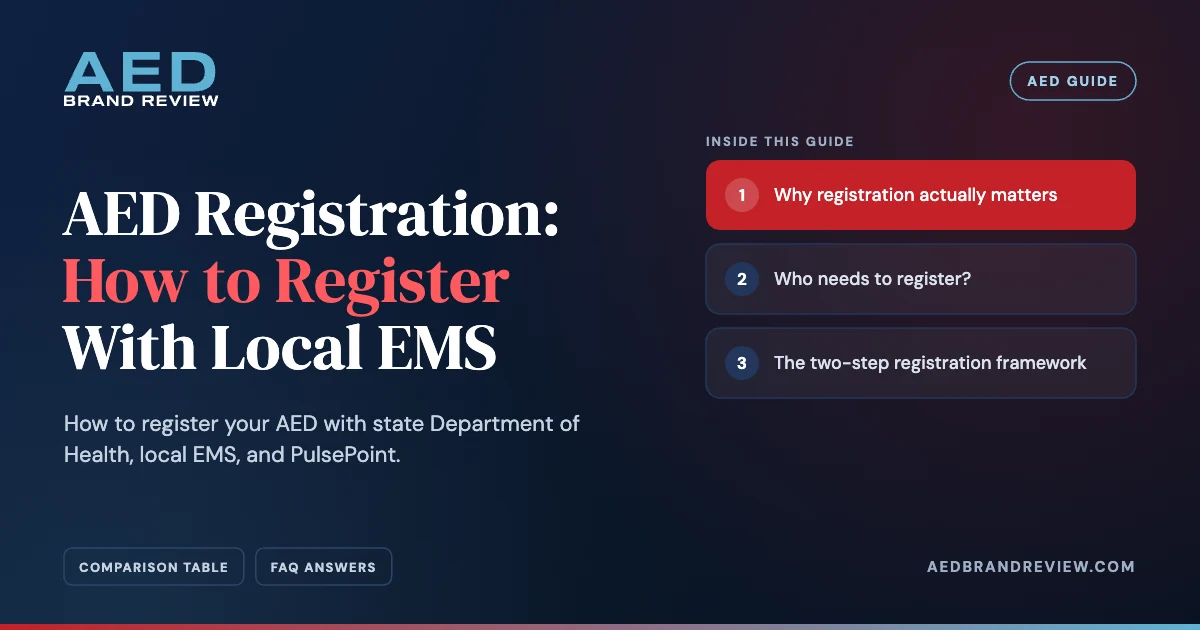
The day your AED arrives, pads installed, battery in, mounted in its cabinet, there is one more box to check before it counts as a real public-access defibrillator: register it. AED registration is the administrative step that puts your device on the local EMS dispatch map, which means a 911 caller anywhere near your facility can be directed to it within seconds. It also satisfies a legal requirement in many states and, in a small number, conditions Good Samaritan immunity. Yet a meaningful share of U.S. AEDs are never registered at all.
This guide walks through who needs to register, which authorities to register with, the typical step-by-step process, the major third-party registries (PulsePoint, HeartHero, RescueOne), and the renewal cadence that keeps your registration active.
Why registration actually matters
1. 911 dispatcher routing
When someone calls 911 about a cardiac arrest near your facility, the dispatcher (in EMS jurisdictions with AED-integrated CAD systems) can immediately tell the caller where the nearest registered AED is located, sometimes within feet. An unregistered AED is invisible to dispatch.
2. Legal compliance
Most state public access defibrillation statutes include registration language. The penalty for non-registration is rarely a direct fine, but in states that tie Good Samaritan immunity to registration, skipping it can weaken that protection. Check your state law or ask counsel.
3. Maintenance reminders
Several state registries send automatic email reminders before pad and battery expiration. For organizations without dedicated facilities staff, this can be the difference between a working AED and an expired-pad failure.
4. Crowdsourced emergency apps
Third-party apps like PulsePoint AED notify CPR-trained nearby citizens of cardiac events and direct them to registered AEDs in real time. Registration on PulsePoint can put your AED into a community life-saving network.
Who needs to register?
| Owner type | Registration requirement |
|---|---|
| K-12 schools (mandate states) | Required in most mandate states |
| Fitness facilities (mandate states) | Required |
| Dental offices (sedation states) | Required |
| Workplaces with more than 50 employees | Strongly recommended |
| Houses of worship | Recommended |
| Home AEDs (private) | Optional in most states |
| Commercial buildings (public-access) | Required in many states |
The two-step registration framework
Step 1, Register with your state authority
Most U.S. states route AED registration through one of:
- State Department of Health (most common path)
- State Emergency Medical Services Office
- State Department of Education (for K-12 school AEDs in some states)
- Local EMS/county health authority (in decentralized states)
Find your state’s registration portal by searching: "[your state] AED registration" + visiting the state DPH website.
Step 2, Register with crowdsourced AED databases (optional but recommended)
Three major U.S. registries pull from state data and crowdsource locations:
- PulsePoint AED Registry, integrates with 911 dispatch in 4,000+ communities
- HeartHero National Registry, national AED location database
- RescueOne / 911 Saves Lives, local-EMS integrated
Step-by-step: how to register
Search "[state name] AED registration" or visit health.[state].gov and search “AED.”
Most state portals ask for:
- AED make, model, and serial number
- Physical placement address & suite/floor
- Specific location within the building (lobby wall, gym entrance, etc.)
- Owner organization name + contact
- 24/7 emergency contact phone number
- Prescribing physician name (if your AED needed a prescription)
- Date placed in service
- Pad and battery expiration dates
- Trained responder names (some states)
Most state portals are online forms. Upload the physician’s prescription if requested. Submit.
You’ll typically receive a confirmation email within 1 to 7 business days. Save it in your AED program file.
Visit pulsepoint.org/aed. Same data as state registration. Free.
Most states require annual or biennial renewal, usually a simple “still active” confirmation. Calendar the reminder.
State-by-state renewal patterns
Replacing your AED pads or battery
AED pads and batteries expire on a fixed schedule whether the device is ever used or not, and they are the single most common reason an AED fails when it is needed. In the largest published analysis of FDA-reported AED events, 40,787 cases, batteries accounted for 23.2 per cent of failures and pads and connectors for 23.7 per cent, so 46.9 per cent of all AED failures are consumables (DeLuca et al., Annals of Emergency Medicine, 2012, PMID 21872969). Below is every current replacement part with its price and service life, verified against seller product data on 12 September 2026.
| Model | Adult pads | Battery | Pediatric option | 10 year consumable cost |
|---|---|---|---|---|
| Philips HeartStart OnSite | M5071A $99.00, 2 years | M5070A $249.00, 4 years | Separate M5072A cartridge, prescription only | About $894 |
| Philips HeartStart FRx | SMART Pads II 989803139261 $89.00, 2 years | M5070A $249.00, 4 years | Infant/Child Key $139.00, reusable | About $854 |
| ZOLL AED Plus | CPR-D Padz 8900-0800-01 $230.00, 5 years | Lithium set of 10 $100.00, 5 years | Pedi-padz II $155.00, 2 years | About $330, the lowest we track |
| ZOLL AED 3 | CPR Uni-padz 8900-000280-01 $234.00, 5 years | 8000-000696 $201.00, 5 years | None needed, Uni-padz cover children | About $435 |
| Defibtech Lifeline | DDP-100 $75.15 | DBP-1400, part DCF-200 $229.10 | DDP-200P $130.25 | About $530 |
| Defibtech Lifeline VIEW | DDP-2001 $83.05 | DCF-2003 $240.45 | DDP-2002 $136.40 | About $813 |
| HeartSine Samaritan PAD | Pad-Pak-01 $236.00, pads and battery in one cartridge | Included in the Pad-Pak, there is no separate battery | Pediatric Pad-Pak PAD-PAK-02 $279.00 | About $472 |
| Cardiac Science Powerheart G5 | XELAED001C $88.00 | XBTAED001A $495.00, 4 years | XELAED003C $127.00 | About $1,342, the highest we track |
| Physio-Control LIFEPAK CR2 | Quik-Step 11101-000021 $196.00, adult and child in one set | LIFEPAK CR2 lithium battery $341.00, about 4 years | None needed, the Quik-Step set covers children | Not published per part |
Prices verified against the public product data of AED Leader on 30 September 2026. Service life is the manufacturer figure where one is published; where it is not, check the expiry date printed on the part itself. Ten year consumable cost is our own calculation from those part prices and service lives.
Three things owners get wrong
- Buying the wrong Philips pad. The FRx uses SMART Pads II, part 989803139261. SMART Pads III belong to the FR3, a different device. The OnSite uses M5071A and the two are not interchangeable.
- Assuming the pediatric part is optional. On a ZOLL AED Plus, Pedi-padz II cost $155.00 and last two years, which is about $775 across a ten year life. On a ZOLL AED 3 or a LIFEPAK CR2 the pads already cover children and that cost is zero.
- Tracking the wrong date. HeartSine combines the pads and battery into one Pad-Pak cartridge, so there is a single expiry to track. Every other model here has two parts on two separate clocks.
Full replacement schedule by model is on our AED pads and batteries page. If you are still choosing a device, the ten year running cost is usually a bigger number than the discount you are negotiating: see every AED brand ranked by price and ten year cost.
| Renewal cadence | State pattern (examples) |
|---|---|
| One-time registration, no renewal | Several states |
| Annual renewal (data accuracy) | NY, NJ, PA, others |
| Biennial renewal | Several states |
| Renewal on pad/battery replacement | Many state portals prompt an update |
What gets reported when your AED is used
Some states require a brief post-use report when an AED is used on a patient. Deadlines vary, so check your state statute. The report usually includes:
- Date and time of use
- Patient outcome (return of spontaneous circulation, EMS transport, etc.)
- Number of shocks delivered
- Identity of trained responder (if applicable)
- Replacement pad/battery installation date
This reporting is part of state-level cardiac arrest surveillance and ultimately feeds into national datasets that improve AED placement strategy.
PulsePoint AED: the community-based registry
PulsePoint is a nonprofit foundation that operates two interconnected services:
- PulsePoint Respond , notifies CPR-trained nearby users of cardiac events
- PulsePoint AED , crowdsourced map of registered AED locations
Registration on PulsePoint AED is free, takes about 5 minutes, and places your AED in the same map citizens see in over 4,000 U.S. communities. For high-foot-traffic venues (schools, gyms, churches, public buildings), PulsePoint registration meaningfully increases the chance your AED gets used in a community emergency.
Special case: home AEDs
Most states do not require registration of private home AEDs. However, several emergency-response apps (PulsePoint, HeartHero) allow voluntary registration of home AEDs for community use. If you live in an apartment building, condo complex, or rural area where EMS response is slow, voluntary home AED registration can help your neighbors.
What happens if you move or sell the AED?
Most state registries require update or deregistration when:
- The AED is relocated to a different building or address
- Ownership transfers
- The AED is retired from service
- Pad/battery has been replaced (some states require notification)
Updates are typically the same online portal as registration. Failure to update can void state-level compliance and Good Samaritan protection.
Frequently Asked Questions
Do I have to register my AED with the state?
In most U.S. states, yes, particularly if the AED is in a public-access location. Schools, gyms, dental offices, and workplaces in mandated states are required. Registration is typically free and takes 10 to 15 minutes.
How do I register my AED?
Search “[your state] AED registration” and follow the state Department of Health or EMS Office portal instructions. You’ll need the AED make/model/serial, physical placement address, prescribing physician info, and trained responder list (in some states).
What is PulsePoint AED?
PulsePoint AED is a free national registry that integrates with 911 dispatch in 4,000+ U.S. communities. Registering on PulsePoint helps dispatchers and CPR-trained bystanders locate your AED during cardiac emergencies.
How often do I need to renew AED registration?
It varies by state. Some states require one-time registration; others require annual or biennial renewal. Many state portals also prompt updates whenever pads or batteries are replaced.
What happens if my AED is used in a cardiac event?
Most state registries require a brief deployment report within 5 to 10 business days of use, covering date/time, patient outcome, shocks delivered, and replacement of consumables. This data feeds into state and national cardiac arrest surveillance programs.
Do home AEDs need to be registered?
Most states don’t require home AED registration. Voluntary registration with PulsePoint or similar registries is recommended if you want to make the AED available to neighbors in a community emergency.
What if I move my AED to a different location?
Update your state registration to reflect the new placement. Most state portals allow online updates. Failure to update can void compliance status and Good Samaritan protection.
Get your team certified the easy way.
Sources & References
- American Heart Association, AED Laws by State
- PulsePoint Foundation, AED Registry
- FDA, Automated External Defibrillators
- NIH, National Heart, Lung, and Blood Institute: What is cardiac arrest?
- State Department of Health AED program documentation
Disclaimer: State registration rules change periodically. Verify current requirements with your state Department of Health or local EMS authority. This article is informational and not a compliance certification.