OnSite Value Package at AED Leader, $1,581.80
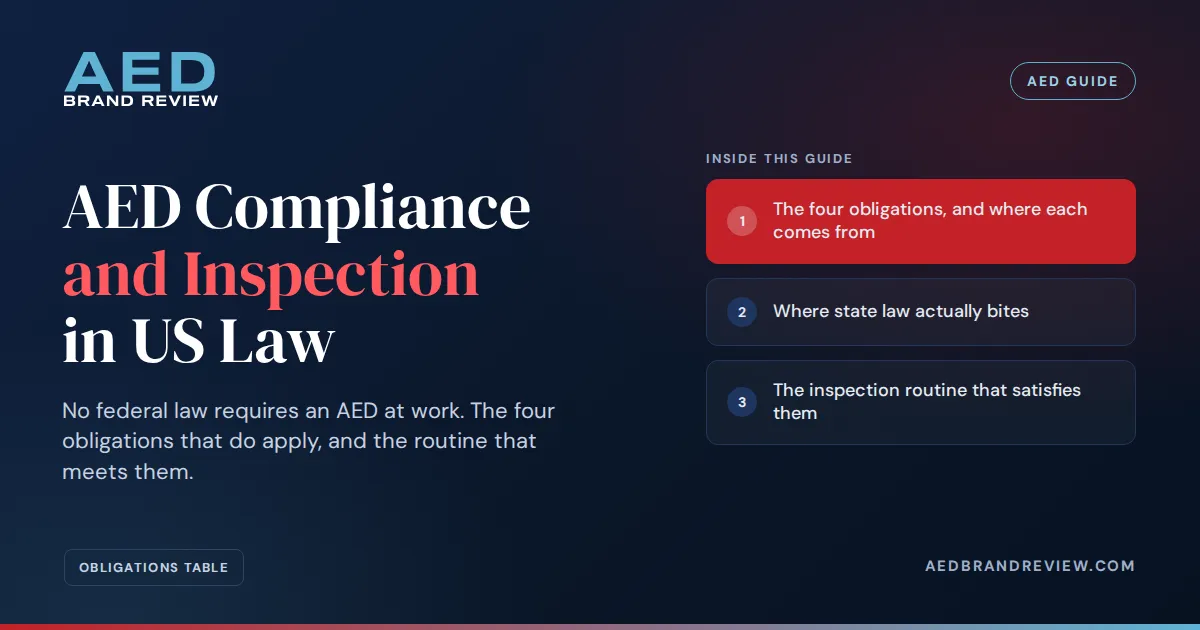
The four obligations, and where each one comes from
| Obligation | Where it comes from | Binding on you? | Our page |
|---|---|---|---|
| Acquire and place the device | State statute for gyms, schools and some public buildings. Otherwise voluntary. | Depends on state and facility type | AED laws by state |
| Register with local EMS | State or county requirement in many jurisdictions, so responders know the device exists | Depends on jurisdiction | AED registration with EMS |
| Maintain on a documented schedule | Manufacturer instructions for use, plus state statute where one exists. OSHA expects a documented program where the hazard is recognised. | Yes in practice, everywhere | AED inspection checklist |
| Train designated responders | State statute in several states. Illinois 210 ILCS 74/15 and New York GBL 627-a both require trained staff. | Depends on state | AED training requirements by state |
| Write it into an emergency action plan | OSHA 29 CFR 1910.38 for employers who must have an EAP, and AHA guidance for schools | Yes where an EAP is required | Workplace emergency action plan |
The federal picture, stated plainly
- OSHA has no AED-specific standard. None of 29 CFR Parts 1910, 1915, 1917, 1918 or 1926 contains one. The enforcement hook is the General Duty Clause, 29 USC 654 5(a)(1), for recognised hazards not covered by a specific standard. Full detail on our OSHA AED requirements page.
- 29 CFR 1910.151 and 1926.50 require the ready availability of medical personnel, or a person trained to render first aid where no infirmary is near. They do not name an AED.
- OSHA guidance recommends AEDs for workplaces with 50 or more employees, or where EMS response exceeds five minutes. Recommendation, not regulation.
- The HEARTS Act, December 2024, is an HHS grant programme for school AEDs. It is funding, not a mandate. Grant routes are on our AED grants page.
- No FDA or AHA rule mandates replacing expired pads. The obligation comes from the manufacturer instructions for use and from your own documented programme. Anyone citing a federal pad-replacement rule is wrong.
- AEDs are FDA approved through premarket approval, a PMA number. PMA is the only FDA route for an AED. A seller naming another pathway has it wrong, and that is a reliable signal about the rest of their information.
Where state law actually bites
Gyms and health clubs: 14 states. Arkansas, California, Connecticut, Illinois, Indiana, Louisiana, Massachusetts, Michigan, New Jersey, New York, Oregon, Pennsylvania, Rhode Island and Virginia. Vendor pages commonly claim 16 or 17; we could not verify those counts and do not publish them. Illinois 210 ILCS 74/15 and New York General Business Law 627-a, which applies at 50 or more members, both require trained staff on site, not just a device on a wall.
K-12 schools: 26 states by direct mandate, and 10 more through a required emergency plan, per our October 2026 check of state statutes. Detail by state on our K-12 school requirements page and fitness facility requirements page.
Good Samaritan protection is universal but conditional. All 50 states have a statute, and the conditions differ: acting in good faith, acting within your training, and not accepting payment are the common tests. Our 50-state Good Samaritan guide sets out the per-state wording.
The routine that satisfies almost every requirement
Regulators and plaintiff lawyers ask the same question after an incident: can you produce a record. The record is the programme.
- Monthly visual check of the status indicator, recorded and signed. Use our printable maintenance log template.
- Track two expiry dates per device, pads and battery, except HeartSine where the Pad-Pak combines both into one. Schedule by model on our pad replacement schedule.
- Check the recall status at least annually. Live tracker on our AED recall tracker.
- Re-certify responders on the cycle your state or your training provider requires.
- Review the plan annually and after any use. Template on our cardiac emergency response plan template.
What actually fails, and it is not the device
In the largest published analysis of FDA-reported AED events, 40,787 cases, batteries accounted for 23.2 per cent of failures and pads and connectors for 23.7 per cent. 46.9 per cent of all AED failures are consumables (DeLuca et al., Annals of Emergency Medicine, 2012, PMID 21872969). A compliance programme that tracks paperwork but not part expiry dates is protecting the wrong thing. Current part numbers and prices are on our pads and batteries page.
The timing argument is the reason any of this exists: sudden cardiac arrest kills more than 356,000 people a year outside hospital in the United States, and survival falls roughly 10 per cent for every minute without defibrillation (American Heart Association). The AHA standard for schools is a three minute retrieve-and-deliver round trip, and survival is 74 per cent when the shock lands inside three minutes.
Your compliance stack
| If you need to | Read this |
|---|---|
| Know what your state requires | AED laws by state |
| Run the monthly check | AED inspection checklist |
| Document it | AED maintenance log template |
| Satisfy an employer audit | Workplace AED compliance checklist |
| Understand OSHA exposure | OSHA AED requirements |
| Register the device | AED registration with EMS |
| Train your responders | AED training requirements by state |
| Mount it legally | Mounting heights, cabinets and signage |
| Place it correctly in a school | AED placement for schools |
| Run more than one site | Multi-site AED fleet management |
| Build the annual programme | AED program management |
| Set up a public access programme | Public access defibrillation programme |
| Understand your liability | Good Samaritan laws and AED use |
| Budget the running cost | Battery replacement cost by brand |
| Dispose of an old battery | AED battery disposal |
| Buy the right device in the first place | Every AED brand ranked by price and ten year cost |
Every statute count on this page is one we verified against the statute or a named review. Where a figure is commonly published but we could not verify it, we say so rather than repeating it. Last verified 12 September 2026.
No federal law requires one. There is no OSHA standard naming AEDs. Requirements come from state law, and they attach to facility types rather than to employers generally: 14 states regulate gyms and health clubs, and 26 states require AEDs in K-12 schools by direct mandate, with 10 more requiring them through an emergency response plan. OSHA guidance recommends an AED where there are 50 or more employees or EMS response exceeds five minutes, which is a recommendation, not a regulation.
Monthly visual inspection of the status indicator is the standard expectation, recorded and signed. The legal source is the manufacturer instructions for use plus state statute where one exists, not a single federal rule. The record matters as much as the check, because after an incident the question is whether you can produce one.
No FDA or American Heart Association rule mandates it. The obligation comes from the manufacturer instructions for use and from your own documented maintenance programme. It is also the practical answer: 46.9 per cent of reported AED failures are consumables, batteries at 23.2 per cent and pads and connectors at 23.7 per cent, across 40,787 FDA-reported events.
Fourteen: Arkansas, California, Connecticut, Illinois, Indiana, Louisiana, Massachusetts, Michigan, New Jersey, New York, Oregon, Pennsylvania, Rhode Island and Virginia. Illinois and New York also require trained staff on site. Counts of 16 or 17 circulate on vendor sites and we could not verify them.
No. The HEARTS Act, passed December 2024, is a Health and Human Services grant programme for school AEDs. It is funding, not a mandate.
Approved. Every AED sold in the United States goes through premarket approval and carries a PMA number, for example P160029 for the Philips HeartStart OnSite and P160015 for ZOLL. PMA is the only FDA route for an AED. A seller naming another pathway has the regulatory basis wrong.
This page is a plain-language summary of published law and guidance, not legal advice. Verify your own obligations against your state statute.