FDA medical device recalls follow a strict protocol, manufacturers identify a defect, notify the FDA, classify severity (Class I, II, or III), and communicate remedy instructions to affected owners. For AED owners, the gap between a recall notice being issued and the owner actually finding out can be weeks or months, especially for organizations that didn’t register the device at purchase. Missing a recall response is one of the few uncontrollable failure modes that turns into an owner-side compliance problem.
This page is a continuously updated reference for U.S. AED recalls, active recalls organized by brand and class, historical context for major past recall events, the process to check your specific device, and what to do if your AED is affected. The most authoritative source for any recall is always the FDA Medical Device Recall Database. This page synthesizes and contextualizes that data with an AED-specific organization.
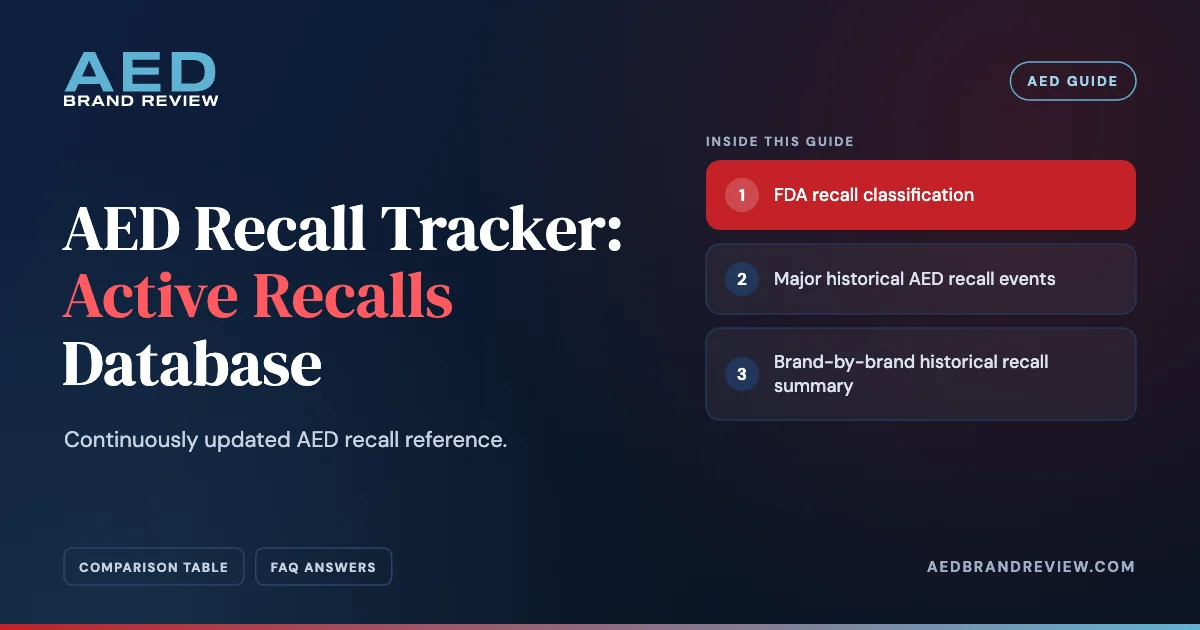
FDA recall classification
The FDA classifies medical device recalls by severity:
| Class | Severity | Description | AED examples |
|---|---|---|---|
| Class I | Highest, life-threatening | Reasonable probability of serious adverse health consequences or death | Critical AED defect; device cannot deliver therapy |
| Class II | Moderate | May cause temporary or reversible health consequences | Diminished therapy reliability; software issue |
| Class III | Lowest | Not likely to cause health consequences; technical or labeling issue | Documentation or labeling errors |
Major historical AED recall events
Cardiac Science Powerheart G3 (2009 to 2012)
One of the most significant AED recalls in U.S. history. Field reports identified component-level issues in Powerheart G3 devices that could fail to deliver therapy or unexpected device behavior. Multiple FDA Class I and Class II recall actions were issued between 2009 and 2012. The recall reshaped Cardiac Science’s product line and preceded the brand’s acquisition by ZOLL Medical in August 2019. Current Cardiac Science models (G5 generation) have addressed historical issues and operate under updated quality systems.
Philips FR2 & FRx series (2017 to 2022)
Philips conducted notable recall actions on its FR2 series and certain FRx-series devices between 2017 and 2022, addressing component issues that could affect device readiness or therapy delivery. Most recall actions are now closed per FDA closure letters, but owners of affected units in this era should verify their serial numbers against the FDA database.
Other historical recall events
Smaller component-level recalls have affected various brands over the past 15 years, typically addressing pad lot issues, software firmware updates, cabinet defects, or labeling corrections. Most are Class II or III with no immediate health-consequence risk and routine remedy paths.
Brand-by-brand historical recall summary
| Brand | Notable historical recalls | Severity range | Current status |
|---|---|---|---|
| Philips HeartStart | FR2, FRx, related component actions (2017 to 2022) | Class I & II | Most actions closed; current generation operates under updated quality systems |
| ZOLL AED | Limited; minor lot-level pad actions historically | Class II & III | Low historical recall volume |
| LIFEPAK (Physio-Control / Stryker) | Limited; clinical-grade focus | Class II | Now operating under Stryker quality systems |
| HeartSine | Limited; some pad lot actions | Class II & III | Low historical recall volume |
| Defibtech | Limited; minor component actions | Class II | Low historical recall volume |
| Cardiac Science | Powerheart G3 (2009 to 2012) | Class I & II | Resolved; current G5 line under ZOLL, which acquired Cardiac Science in 2019 |
For a deeper brand reliability context that incorporates recall history, warranty data, and field deployment evidence, see our AED Brand Reliability Rankings.
How to check your specific AED
- Locate your AED’s identifying information. You’ll need the manufacturer name, model number, and serial number (typically printed on the back of the device or inside the battery compartment).
- Search the FDA Medical Device Recall Database. Visit the FDA recall database and search by manufacturer. Filter to your model.
- Cross-check the manufacturer’s recall page. Each AED manufacturer maintains a recall / service-bulletin page on their corporate website. Search “[manufacturer name] AED recall” for the current page.
- Sign up for manufacturer notifications. Register your device with the manufacturer at purchase (and re-register if you bought used or inherited). Manufacturers email registered owners when recalls affect their specific lot.
- Document your recall check. Note the check date in your AED maintenance log, annual recall verification is best practice.
What to do if your AED is recalled
Replacing your AED pads or battery
AED pads and batteries expire on a fixed schedule whether the device is ever used or not, and they are the single most common reason an AED fails when it is needed. In the largest published analysis of FDA-reported AED events, 40,787 cases, batteries accounted for 23.2 per cent of failures and pads and connectors for 23.7 per cent, so 46.9 per cent of all AED failures are consumables (DeLuca et al., Annals of Emergency Medicine, 2012, PMID 21872969). Below is every current replacement part with its price and service life, verified against seller product data on 12 September 2026.
| Model | Adult pads | Battery | Pediatric option | 10 year consumable cost |
|---|---|---|---|---|
| Philips HeartStart OnSite | M5071A $99.00, 2 years | M5070A $249.00, 4 years | Separate M5072A cartridge, prescription only | About $894 |
| Philips HeartStart FRx | SMART Pads II 989803139261 $89.00, 2 years | M5070A $249.00, 4 years | Infant/Child Key $139.00, reusable | About $854 |
| ZOLL AED Plus | CPR-D Padz 8900-0800-01 $230.00, 5 years | Lithium set of 10 $100.00, 5 years | Pedi-padz II $155.00, 2 years | About $330, the lowest we track |
| ZOLL AED 3 | CPR Uni-padz 8900-000280-01 $234.00, 5 years | 8000-000696 $201.00, 5 years | None needed, Uni-padz cover children | About $435 |
| Defibtech Lifeline | DDP-100 $75.15 | DBP-1400 $229.10 | DDP-200P $130.25 | About $530 |
| Defibtech Lifeline VIEW | DDP-2001 $83.05 | DCF-2003 $240.45 | DDP-2002 $136.40 | About $813 |
| HeartSine Samaritan PAD | Pad-Pak-01 $236.00, pads and battery in one cartridge | Included in the Pad-Pak, there is no separate battery | Pediatric Pad-Pak PAD-PAK-02 $279.00 | About $472 |
| Cardiac Science Powerheart G5 | XELAED001C $88.00 | XBTAED001A $495.00, 4 years | XELAED003C $127.00 | About $1,342, the highest we track |
| Physio-Control LIFEPAK CR2 | Quik-Step 11101-000021 $196.00, adult and child in one set | LIFEPAK CR2 lithium battery $341.00, about 4 years | None needed, the Quik-Step set covers children | Not published per part |
Prices verified against the public product data of AED Leader on 30 September 2026. Service life is the manufacturer figure where one is published; where it is not, check the expiry date printed on the part itself. Ten year consumable cost is our own calculation from those part prices and service lives: the replacement parts bought within ten years, after the first set that comes with the device.
Three things owners get wrong
- Buying the wrong Philips pad. The FRx uses SMART Pads II, part 989803139261. SMART Pads III belong to the FR3, a different device. The OnSite uses M5071A and the two are not interchangeable.
- Assuming the pediatric part is optional. On a ZOLL AED Plus, Pedi-padz II cost $155.00 and last two years, which is about $775 across a ten year life. On a ZOLL AED 3 or a LIFEPAK CR2 the pads already cover children and that cost is zero.
- Tracking the wrong date. HeartSine combines the pads and battery into one Pad-Pak cartridge, so there is a single expiry to track. Every other model here has two parts on two separate clocks.
Full replacement schedule by model is on our AED pads and batteries page. If you are still choosing a device, the ten year running cost is usually a bigger number than the discount you are negotiating: see every AED brand ranked by price and ten year cost.
Recertified prices across all seven models
Recertified units are the same models under the same FDA premarket approvals, restored, tested and sold with a minimum three year warranty.
| Model | New | Recertified | You keep | Buy |
|---|---|---|---|---|
| Philips HeartStart OnSite | $1,589 | $875 | $714 (45%) | AED Leader or Response Ready |
| Philips HeartStart FRx | $2,099 | $875 | $1,224 (58%) | AED Leader or Response Ready |
| ZOLL AED Plus | $2,082 | $875 | $1,207 (58%) | AED Leader or Response Ready |
| ZOLL AED 3 | $2,399 | $1,150 | $1,249 (52%) | AED Leader or Response Ready |
| HeartSine Samaritan PAD 350P | $1,411 | $875 | $536 (38%) | AED Leader or Response Ready |
| HeartSine Samaritan PAD 450P | $1,761 | $875 | $886 (50%) | AED Leader or Response Ready |
| Cardiac Science Powerheart G5 | $2,157 | $1,225 | $932 (43%) | AED Leader or Response Ready |
Prices verified 30 September 2026 against the public product data of both stores. Both list identical recertified prices, so buy from whichever fits your order size: AED Leader for one to four units, Response Ready for five or more and for compliance and fleet programmes. New prices are the AED Leader list price on the same date.
The honest risk. A recertified AED is a used device. The three year minimum warranty is what makes the saving worth taking. Read recertified versus new and how to choose a refurbished AED before you decide.
Recall response workflow
- Read the recall notice carefully, Class I, II, or III determines urgency
- Follow the manufacturer’s specific remedy instructions (return, repair, software update, label update)
- Take the AED out of service if instructed; mount a replacement or backup if available
- Document the recall response in your maintenance log
- Notify trained responders that the device is out of service
- If the remedy is a software update, apply promptly and document the version
- If the remedy is a device return, retain the shipping confirmation for the compliance file
- Once remedied, confirm the device shows green status and update the log
The “registered device” advantage
Owners who register their AED with the manufacturer at purchase receive direct email notification when recalls affect their lot. Owners who never registered, particularly second-owners, refurbished-AED buyers, and inheritor organizations, often miss recall notices entirely.
Registration takes 10 minutes and is the single most effective protection against missing a future recall. If you bought your AED used, refurbished, or inherited it during an acquisition, register your serial number with the manufacturer today.
Subscription to FDA recall updates
The FDA offers a free email subscription to medical device safety communications, including recall announcements. Subscribe at fda.gov/safety/recalls-market-withdrawals-safety-alerts. Filter to “medical devices” for AED-relevant notifications.
What recall data doesn’t tell you?
A high recall count doesn’t automatically mean a brand is unreliable, sometimes it reflects active manufacturer monitoring and transparency. A low recall count doesn’t automatically mean reliability, it can reflect a smaller installed base. Read recall data alongside warranty length, customer-reported field reliability, and independent third-party reviews. See our Brand Reliability Rankings for that integrated view.
If your unit is affected, this is the current model and price
Most recalls are remedied free by the manufacturer; replacement is needed only when the manufacturer ends support or the remedy is removal. These are the current models and today's verified prices, plus the recertified price where one exists.
| Current model | New price | Recertified | Where to buy |
|---|---|---|---|
| Philips HeartStart OnSite M5066A | $1,589.00 to $1,819.00 | $875.00 | Check price at AED Leader or Response Ready |
| Philips HeartStart FRx 861304 | $2,099.00 to $2,199.00 | $875.00 | Check price at AED Leader or Response Ready |
| ZOLL AED Plus | $2,082.00 | $875.00 | Check price at AED Leader or Response Ready |
| ZOLL AED 3 | $2,399.00 | $1,150.00 | Check price at AED Leader or Response Ready |
| HeartSine samaritan 350P | $1,411.00 | $875.00 | Check price at AED Leader or Response Ready |
Check the pads and battery dates on any replacement unit the day it arrives, because the clock on those parts starts at manufacture, not at purchase.
Frequently Asked Questions
How do I check if my AED has been recalled?
Search the FDA Medical Device Recall Database by manufacturer and model. Also, check the manufacturer’s official recall page. Most reliable: Register your device with the manufacturer at purchase to receive direct recall notification.
What is an FDA Class I AED recall?
The highest-severity recall classification. Class I means there is a reasonable probability that use of the device will cause serious adverse health consequences or death. Class I recalls typically require taking the device out of service immediately and following manufacturer’s remedy instructions.
Have any AED brands been recalled?
Yes , most major U.S. AED brands have issued recall actions at some point in their history. Notable historical events include Cardiac Science Powerheart G3 (2009 to 2012) and Philips FR2 / FRx (2017 to 2022). Most actions are now closed. Always verify the current status with the FDA.
What do I do if my AED is recalled?
Follow the manufacturer’s specific remedy instructions in the recall notice. This typically involves device return, repair, software update, or label update. Document the action in your maintenance log. Take the device out of service if instructed.
How can I get notified about future AED recalls?
Register your AED with the manufacturer at purchase. Subscribe to FDA safety communication emails at fda.gov/safety. Bookmark this AED Recall Tracker page.
Are refurbished AEDs at higher risk of being recalled?
Refurbished AEDs from FDA-registered refurbishers receive any applicable updates during refurbishment and carry the same recall status as new units. Owners of refurbished units should register with the manufacturer to receive future recall notifications.
Where do I report a suspected AED defect?
Report suspected device defects through the FDA’s MedWatch program and to the manufacturer directly. Reports feed the MAUDE database that supports future recall decisions.
Get hands-on AED training in under 3 hours.
Sources & References
- FDA, Medical Device Recall Database
- FDA, MAUDE Database
- FDA, Safety Communications & Recall Subscription
- FDA MedWatch, Adverse Event Reporting
- FDA, Automated External Defibrillators
Disclaimer: This tracker synthesizes publicly available FDA recall data and is updated periodically. For real-time, authoritative recall information, always consult the FDA Medical Device Recall Database directly. AED Brand Review is not affiliated with any AED manufacturer or the FDA; our buy links go to AED Leader and Response Ready, stores in our own network.