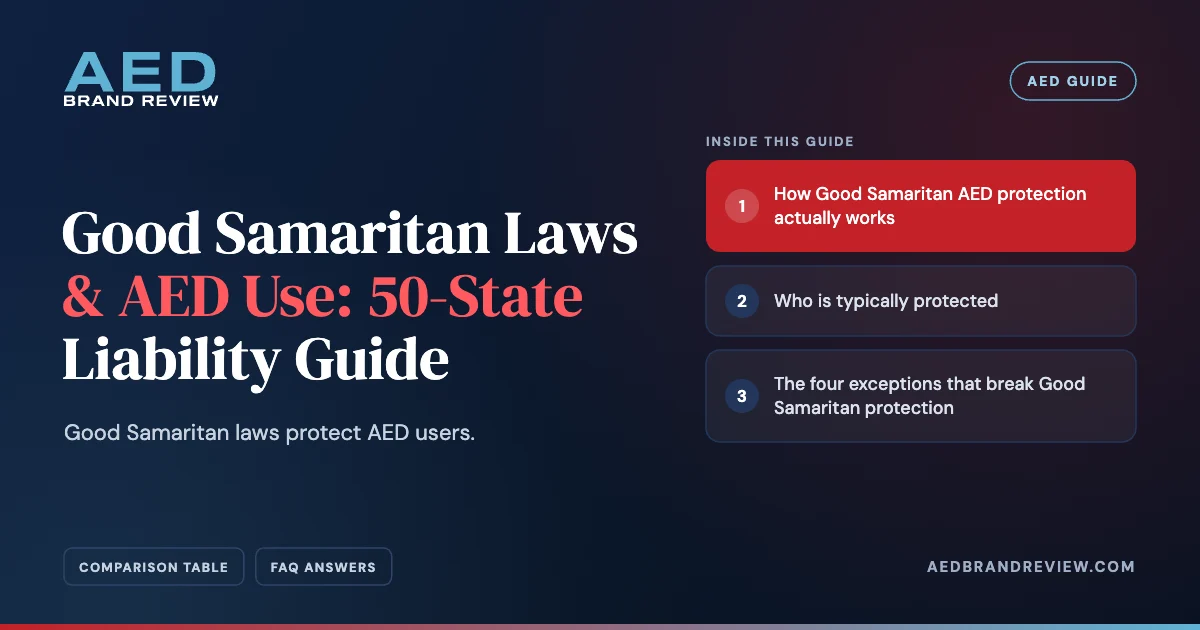
The number-one objection a CPR/AED instructor hears in workplace and community training: “What if I do it wrong and get sued?” The answer in every U.S. state is essentially the same, bystanders acting in good faith to use an AED in a cardiac emergency are protected from civil liability by state-level Good Samaritan laws. But that answer carries asterisks, and the asterisks are where misunderstandings cause real legal harm to organizations and responders.
Philips HeartStart OnSite at AED Leader, $1,589
How Good Samaritan AED protection actually works
Good Samaritan laws are state laws, there is no single federal Good Samaritan statute. Every U.S. state has enacted some form of AED-specific Good Samaritan protection (separate from general first aid Good Samaritan laws), typically as part of broader public access defibrillation legislation passed between 1995 and 2010.
The legal mechanism in every state shares four elements:
- Civil immunity, protection from being sued for the act of attempting to help
- “In good faith” standard, the responder must act with honest intent to help
- “Reasonably believed” emergency, the responder must reasonably believe the person needs AED therapy
- Within the scope of training, for trained responders, immunity covers acts within trained competence
Who is typically protected
| Person/entity | Typical protection | State variation |
|---|---|---|
| Bystander using the AED | Strong immunity | All states, with conditions that vary |
| Building owner/organization placing an AED | Strong immunity | Universal, usually part of the same statute |
| Trained employee responder | Strong immunity | Universal; some states require certification |
| Off-duty healthcare professional | Strong immunity | Some states require acting within scope |
| The physician who prescribed the AED for the site | Strong immunity | Universal |
| AED manufacturer | Limited, product liability still applies | Not covered by Good Samaritan |
| Paid emergency responders (EMS) | Different framework | EMS-specific immunity statutes apply |
The four exceptions that break Good Samaritan protection
1. Willful or wanton misconduct
If the responder deliberately misuses the AED to harm the patient (vanishingly rare in practice), Good Samaritan protection doesn’t apply. The standard isn’t “did the responder make a mistake”, it’s “did the responder intentionally do something they knew was wrong.”
2. Gross negligence
Some states (not all) carve out “gross negligence”, conduct so reckless it shocks the conscience. Standard negligence (ordinary mistakes) is protected; gross negligence is not.
3. Compensation for emergency response
Good Samaritan laws were written for unpaid bystanders. A responder who receives payment specifically to provide emergency medical response (paid EMTs, contract security with EMS duties) is typically covered by separate professional immunity statutes, not Good Samaritan laws.
4. Improperly maintained equipment (some states)
This is the exception most organizations underestimate. A handful of state Good Samaritan AED statutes condition immunity on the AED being maintained according to manufacturer specifications. Examples of states with this conditional language:
- Several states require a documented monthly inspection
- Some require pads and a battery within the manufacturer’s expiration date
- Some require registration with local EMS
When immunity is conditioned on maintenance, an organization deploying an AED with expired pads or a dead battery may face civil exposure regardless of how good-faith the responder’s actions were.
Real-world litigation patterns
Three patterns appear repeatedly in U.S. AED-related civil cases:
Pattern A, Responder protected, organization protected
A bystander uses the AED in good faith on a patient in cardiac arrest. The patient survives or does not survive; the family does not sue. This is the overwhelming statistical majority of AED deployments. Good Samaritan immunity is rarely tested in court because most events don’t generate litigation.
Pattern B, No AED on site, organization sued
An SCA event occurs at a workplace, fitness facility, school, or public venue. There was no AED on-site, or the AED was missing/inaccessible. The family sues for negligent failure to provide a foreseeable safety measure. Good Samaritan immunity does not apply because no AED was deployed. Settlement amounts vary by case.
Pattern C, AED present but unmaintained
An SCA event occurs; an AED is deployed but fails (expired pads, dead battery, or missing). The family sues for negligent maintenance. In states with maintenance-conditioned Good Samaritan language, immunity can be defeated at trial. Outcomes depend on the state statute and the facts of the case.
State-by-state Good Samaritan snapshot
| State category | Description | States (examples) |
|---|---|---|
| Standard Good Samaritan + AED-specific | Bystander, building owner, trained responder, all protected; standard willful misconduct / gross negligence exceptions | Most U.S. states (35+) |
| Conditional on maintenance | Immunity conditioned on documented AED maintenance per manufacturer specs | Several states (varies by year, verify current statute) |
| Conditional on registration | Immunity conditioned on AED registration with local EMS | Smaller subset of states |
| Conditional on training | Some statutes condition immunity on the responder having received specified training | A few states still require training; most have eliminated this |
| “Lay rescuer” broadest protection | Extends explicit immunity to anyone who reasonably believes the emergency exists | Most states under post-2010 updates |
Cross-reference with our AED Laws by State guide for current statutory text and the AHA’s state-by-state database.
What Good Samaritan does NOT protect against
- Criminal liability (rare in good-faith AED use)
- Manufacturer product-liability claims (different legal framework)
- Workers’ compensation claims by injured rescuers (separate system)
- OSHA citations for unrelated workplace hazards
- Patient’s family’s separate medical-malpractice claims against EMS or treating hospital
The practical takeaways for organizations
To keep Good Samaritan protection intact
- Maintain a documented monthly inspection log for every deployed AED
- Replace pads and battery on or before the manufacturer’s expiration date
- Register the AED with the state Department of Health or local EMS, where applicable
- Provide voluntary CPR/AED training; document who’s trained
- Display the AED in an accessible, signed location
- Include the AED in your written safety/emergency plan
- Review program annually with insurance broker and legal counsel
The practical takeaways for individuals
Replacing your AED pads or battery
AED pads and batteries expire on a fixed schedule whether the device is ever used or not, and they are the single most common reason an AED fails when it is needed. In the largest published analysis of FDA-reported AED events, 40,787 cases, batteries accounted for 23.2 per cent of failures and pads and connectors for 23.7 per cent, so 46.9 per cent of all AED failures are consumables (DeLuca et al., Annals of Emergency Medicine, 2012, PMID 21872969). Below is every current replacement part with its price and service life, verified against seller product data on 12 September 2026.
| Model | Adult pads | Battery | Pediatric option | 10 year consumable cost |
|---|---|---|---|---|
| Philips HeartStart OnSite | M5071A $99.00, 2 years | M5070A $249.00, 4 years | Separate M5072A cartridge, prescription only | About $894 |
| Philips HeartStart FRx | SMART Pads II 989803139261 $89.00, 2 years | M5070A $249.00, 4 years | Infant/Child Key $139.00, reusable | About $854 |
| ZOLL AED Plus | CPR-D Padz 8900-0800-01 $230.00, 5 years | Lithium set of 10 $100.00, 5 years | Pedi-padz II $155.00, 2 years | About $330, the lowest we track |
| ZOLL AED 3 | CPR Uni-padz 8900-000280-01 $234.00, 5 years | 8000-000696 $201.00, 5 years | None needed, Uni-padz cover children | About $435 |
| Defibtech Lifeline | DDP-100 $75.15 | DBP-1400 $229.10 | DDP-200P $130.25 | About $530 |
| Defibtech Lifeline VIEW | DDP-2001 $83.05 | DCF-2003 $240.45 | DDP-2002 $136.40 | About $813 |
| HeartSine Samaritan PAD | Pad-Pak-01 $236.00, pads and battery in one cartridge | Included in the Pad-Pak, there is no separate battery | Pediatric Pad-Pak PAD-PAK-02 $279.00 | About $472 |
| Cardiac Science Powerheart G5 | XELAED001C $88.00 | XBTAED001A $495.00, 4 years | XELAED003C $127.00 | About $1,342, the highest we track |
| Physio-Control LIFEPAK CR2 | Quik-Step 11101-000021 $196.00, adult and child in one set | LIFEPAK CR2 lithium battery $341.00, about 4 years | None needed, the Quik-Step set covers children | Not published per part |
Prices verified against the public product data of AED Leader on 30 September 2026. Service life is the manufacturer figure where one is published; where it is not, check the expiry date printed on the part itself. Ten year consumable cost is our own calculation from those part prices and service lives.
Three things owners get wrong
- Buying the wrong Philips pad. The FRx uses SMART Pads II, part 989803139261. SMART Pads III belong to the FR3, a different device. The OnSite uses M5071A and the two are not interchangeable.
- Assuming the pediatric part is optional. On a ZOLL AED Plus, Pedi-padz II cost $155.00 and last two years, which is about $775 across a ten year life. On a ZOLL AED 3 or a LIFEPAK CR2 the pads already cover children and that cost is zero.
- Tracking the wrong date. HeartSine combines the pads and battery into one Pad-Pak cartridge, so there is a single expiry to track. Every other model here has two parts on two separate clocks.
Full replacement schedule by model is on our AED pads and batteries page. If you are still choosing a device, the ten year running cost is usually a bigger number than the discount you are negotiating: see every AED brand ranked by price and ten year cost.
Recertified prices across all seven models
Recertified units are the same models under the same FDA premarket approvals, restored, tested and sold with a minimum three year warranty.
| Model | New | Recertified | You keep | Buy |
|---|---|---|---|---|
| Philips HeartStart OnSite | $1,589 | $875 | $714 (45%) | AED Leader or Response Ready |
| Philips HeartStart FRx | $2,099 | $875 | $1,224 (58%) | AED Leader or Response Ready |
| ZOLL AED Plus | $2,082 | $875 | $1,207 (58%) | AED Leader or Response Ready |
| ZOLL AED 3 | $2,399 | $1,150 | $1,249 (52%) | AED Leader or Response Ready |
| HeartSine Samaritan PAD 350P | $1,411 | $875 | $536 (38%) | AED Leader or Response Ready |
| HeartSine Samaritan PAD 450P | $1,761 | $875 | $886 (50%) | AED Leader or Response Ready |
| Cardiac Science Powerheart G5 | $2,157 | $1,225 | $932 (43%) | AED Leader or Response Ready |
Prices verified 30 September 2026 against the public product data of both stores. Both list identical recertified prices, so buy from whichever fits your order size: AED Leader for one to four units, Response Ready for five or more and for compliance and fleet programmes. New prices are the AED Leader list price on the same date.
The honest risk. A recertified AED is a used device. The three year minimum warranty is what makes the saving worth taking. Read recertified versus new and how to choose a refurbished AED before you decide.
If you’re a bystander facing an SCA event
- Call 911 first (or have someone call)
- Begin CPR if trained
- Retrieve the nearest AED and follow voice prompts
- Continue until EMS arrives
- Your state’s Good Samaritan law generally protects good-faith AED use; conditions vary by state
- You do not need to be certified to use an AED legally
Equipping a fitness centre or health club? Our AED for gyms guide covers state requirements, the models that coach CPR and what a package should include.
Frequently Asked Questions
Am I protected from being sued if I use an AED on someone?
Every U.S. state provides some Good Samaritan protection for good-faith AED use, but conditions vary: a few states tie immunity to training, maintenance or registration. Check your state’s law.
Does Good Samaritan protection apply to organizations that place AEDs?
Yes, typically. Most state statutes explicitly extend immunity to the building owner, organization, or facility that places an AED. The standard exceptions (willful misconduct, gross negligence) still apply.
What can void Good Samaritan AED protection?
Four common exceptions: (1) willful or wanton misconduct, (2) gross negligence, (3) receipt of compensation specifically for emergency response, and (4) in some states, use of improperly maintained equipment, such as expired pads or a dead battery.
Do I need to be CPR-certified to use an AED legally?
No. Every modern FDA-approved AED is designed for use by an untrained bystander, and Good Samaritan laws in most states extend protection to lay rescuers acting in good faith. A few states still tie immunity to training, so check your state’s law.
Can a family sue me if their loved one didn’t survive?
They can file a claim, but Good Samaritan immunity typically results in early dismissal when the responder acted in good faith. Outcomes (survival or not) do not determine whether immunity applies, only the responder’s conduct does.
What about off-duty doctors or nurses?
Most state Good Samaritan laws explicitly extend protection to off-duty healthcare professionals acting voluntarily. Some states require the act to be within the scope of normal practice.
Does Good Samaritan protect the AED manufacturer?
No. Manufacturers face product-liability law, not Good Samaritan protection. If the device itself is defective and that defect causes harm, the manufacturer can be sued separately.
Get hands-on AED training in under 3 hours.
Sources & References
- American Heart Association, AED Laws by State Database
- FDA, AED Regulation
- NIH, National Heart, Lung, and Blood Institute: What is cardiac arrest?
- American Red Cross, CPR & AED Resources
- State legislative records and AED-specific Good Samaritan statutes (last verified 2024; check your state’s current statute)
Disclaimer: This article is informational and not legal advice. State Good Samaritan laws vary in detail and are updated periodically. Consult licensed counsel in your jurisdiction for case-specific advice.