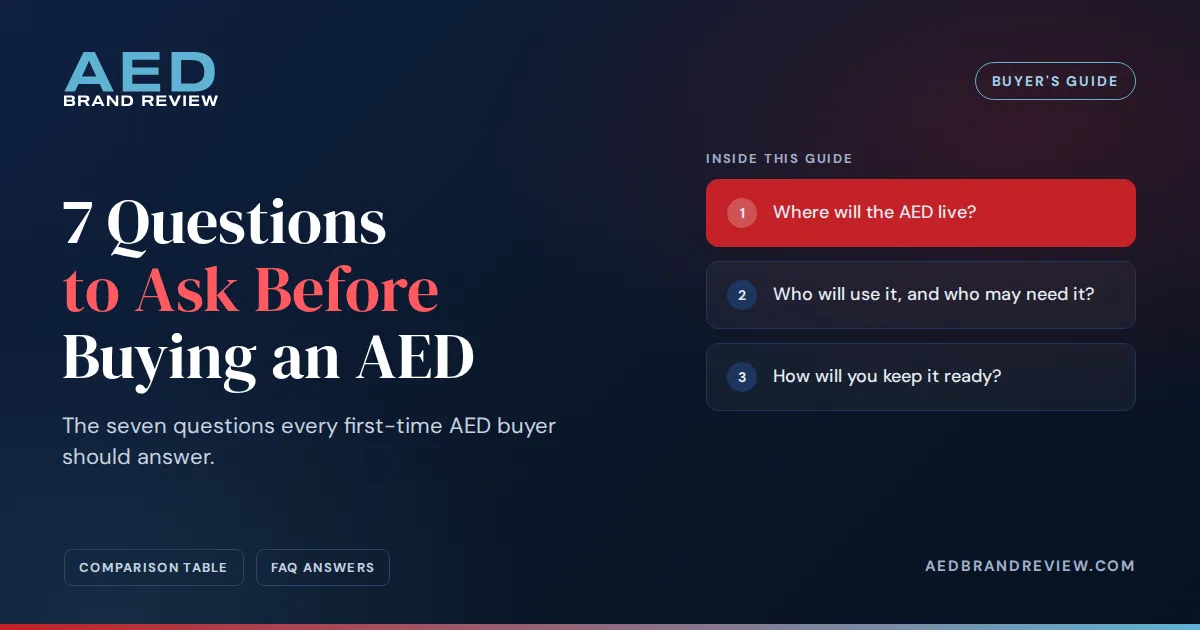
Most first-time AED buyers don’t know which questions to ask, and as a result, end up with the wrong device, expensive surprise consumable costs, or a missing pediatric pad set when a child collapses. These seven questions cover the decision space and force every important trade-off to the surface before purchase, not after.
Recertified prices across all seven models
Recertified units are the same models under the same FDA premarket approvals, restored, tested and sold with a minimum three year warranty.
| Model | New | Recertified | You keep | Buy |
|---|---|---|---|---|
| Philips HeartStart OnSite | $1,589 | $875 | $714 (45%) | AED Leader or Response Ready |
| Philips HeartStart FRx | $2,099 | $875 | $1,224 (58%) | AED Leader or Response Ready |
| ZOLL AED Plus | $2,082 | $875 | $1,207 (58%) | AED Leader or Response Ready |
| ZOLL AED 3 | $2,399 | $1,150 | $1,249 (52%) | AED Leader or Response Ready |
| HeartSine Samaritan PAD 350P | $1,411 | $875 | $536 (38%) | AED Leader or Response Ready |
| HeartSine Samaritan PAD 450P | $1,761 | $875 | $886 (50%) | AED Leader or Response Ready |
| Cardiac Science Powerheart G5 | $2,157 | $1,225 | $932 (43%) | AED Leader or Response Ready |
Prices verified 30 September 2026 against the public product data of both stores. Both list identical recertified prices, so buy from whichever fits your order size: AED Leader for one to four units, Response Ready for five or more and for compliance and fleet programmes. New prices are the AED Leader list price on the same date.
The honest risk. A recertified AED is a used device. The three year minimum warranty is what makes the saving worth taking. Read recertified versus new and how to choose a refurbished AED before you decide.
Question 1, Indoor or outdoor?
The single biggest device-selection variable. Indoor (offices, schools, indoor zones, retail) works fine with IP21-rated units like Philips HeartStart OnSite. Outdoor (athletic fields, pool decks, marinas, construction trailers) requires IP55+, Philips FRx (IP55), HeartSine PAD 350P/360P/450P (IP56), ZOLL AED Plus (IP55). Mixed-environment buyers should default to IP55+ for flexibility.
Question 2, Who will respond?
Trained workplace staff respond differently from panic-likely homeowners. Trained: semi-automatic AEDs work fine (button press = bystander clearance). Untrained-likely: fully-automatic (HeartSine 360P) eliminates a freeze-prone decision. Healthcare clinics with BLS-certified responders should consider clinical-grade (LIFEPAK CR2, Philips FR3).
Question 3, Pediatric population?
For schools, daycare, family-serving facilities: pediatric pads or pediatric-mode capability required. The simplest pathway is Philips FRx with the Infant/Child Key (single pad set + key). HeartSine offers pediatric PAD-PAK. ZOLL Pedi-Padz II works on AED Plus.
Question 4 to 10-year TCO, not just upfront
Sticker price is half the story. A $1,478.80 Defibtech Lifeline with 2-year pads keeps a smaller lead over 10 years against a $2,082 ZOLL AED Plus with 5-year pads: about $2,009 against $2,412 for device and consumables. Use the AED Cost Calculator to model full ownership. For benchmarks, see our 10-Year Cost article.
Question 5, State compliance?
Twenty-one states mandate AEDs in K-12 schools. Twenty-four require them in fitness facilities. Twenty-six in dental offices with sedation. Verify with AED Laws by State before purchase, compliance can dictate model class.
Question 6, Who maintains it?
If you don’t have a facilities team, choose maintenance-simplest. HeartSine PAD-PAK = one cartridge every 4 years. ZOLL AED Plus = 5-year pads. Avoid 2-year pad models (Philips OnSite, Defibtech Lifeline) unless you have someone tracking calendars.
Question 7, Insurance broker position?
Many commercial insurers offer a 1 to 3% property/liability premium discount for documented AED programs. Ask before purchase, the discount can fund pads + battery + training for the life of the program. See AED Insurance Coverage.
Frequently Asked Questions
What’s the most important question before buying an AED?
Where it’ll be deployed, indoor or outdoor. That single answer eliminates 50% of the device universe.
Should I ask about pediatric pads if no kids are in my workplace?
Yes, visitor children, family events, and clients with kids count. Pediatric pad capability is cheap insurance.
How much should my AED budget be?
Plan $2,500 to $4,500 over 10 years per device, including consumables, training, and cabinet. See the Cost Calculator.
Should I ask my insurance broker before or after purchase?
Before, confirm the premium-discount program requirements so your documentation meets them.
Do I need to involve my state Board of Health?
For schools, dental, daycare, and fitness facilities in mandated states, yes. For general workplaces, registration with local EMS is usually sufficient.
Get hands-on AED training in under 3 hours.
Sources & References
Disclaimer: Pre-purchase guidance only. State and facility-specific compliance must be verified separately.