Small business owners weigh every capital expenditure against payroll, rent, and growth. An AED feels easy to push down the list, until you remember that sudden cardiac arrest kills more Americans annually than breast cancer, prostate cancer, lung cancer, and AIDS combined (CDC). About 70% of out-of-hospital cardiac arrests happen at home (AHA); workplaces account for a smaller but preventable share.
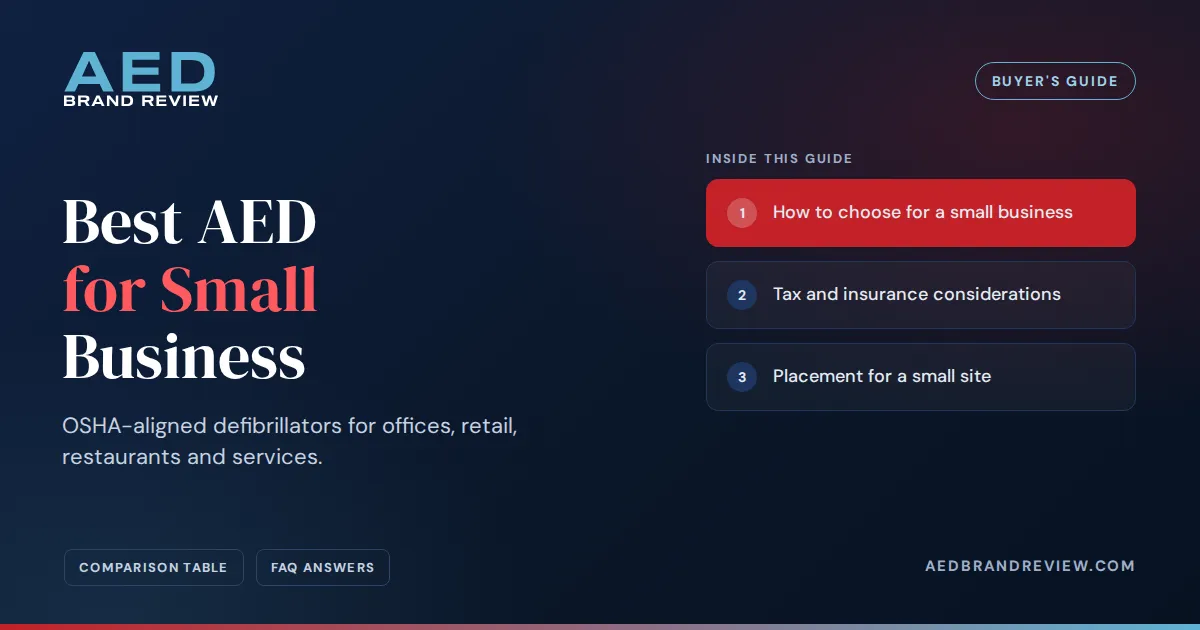
The good news: a complete, FDA-approved, OSHA-aligned AED program for a small business now starts at $1,411 for the device (HeartSine 350P at AED Leader), and it typically qualifies for a Section 179 deduction the year you buy it. This guide ranks the 5 best AEDs for small businesses in 2026 with full ownership costs mapped out.
How to choose for a small business
Five things to prioritize:
1. Total cost of ownership, not sticker price
An $1,300 AED with 2-year pads and 2-year battery costs more across 8 years than a $1,800 AED with 5-year pads. Always model the 8-year cost. Use the AED Cost Calculator.
2. Single-cartridge maintenance (or not)
HeartSine PAD-PAK consolidates pad + battery into one cartridge, replace one item every 4 years. Other brands require tracking two separate expirations. For a small business with no dedicated facilities manager, single-cartridge is dramatically simpler.
3. Tax deduction eligibility
Under IRS Section 179, AEDs purchased for business use are generally deductible as a Section 179 expense the year purchased, up to the annual limit. Confirm with your CPA, but this typically applies.
4. Warranty length
HeartSine, Philips and LIFEPAK offer 8 years; ZOLL offers 5 to 8 years depending on model and registration. Across 8 years of ownership, a longer warranty often covers one full replacement cycle.
5. Voice prompt clarity
Your rescuer will likely be the office manager, a barista, a receptionist, or a colleague, never a paramedic. Voice prompts must be clear, slow, and unambiguous.
Top 5 AEDs for Small Business (From $1,411)
| Rank | Model | Price | Warranty | Best for |
|---|---|---|---|---|
| 1 Top Pick | HeartSine Samaritan PAD 350P | $1,411 | 8 years | Solo offices & small retail |
| 2 | Philips HeartStart OnSite | $1,589 to $1,819 | 8 years | Most-trusted brand for general use |
| 3 | ZOLL AED Plus | $2,082 | 7 years | Restaurants & gyms |
| 4 | HeartSine Samaritan PAD 360P | $1,651 | 8 years | Fully-automatic preference |
| 5 | Defibtech Lifeline AED | $1,478.80 to $1,659.15 | 8 years | Budget-conscious startups |
1. HeartSine samaritan PAD 350P, Best Overall for Small Business
For a small business, the HeartSine 350P wins on simplicity, warranty, and cost. One PAD-PAK cartridge ($236) replaces pad + battery every 4 years. The 8-year device warranty matches Philips and LIFEPAK. IP56 ingress rating handles retail back rooms, restaurant kitchens, and warehouse spaces. At 2.4 lb it’s the lightest unit you can mount on a wall.
2. Philips HeartStart OnSite, Best Trusted Brand
The Philips HeartStart OnSite is the most-deployed AED in U.S. workplaces. If you want zero brand risk and a unit your insurance carrier already knows, this is it. Voice prompts are the clearest in the category. 8-year warranty. Read our HeartStart OnSite review.
3. ZOLL AED Plus, Best With CPR Feedback
The ZOLL AED Plus at $2,082 offers real-time compression-depth feedback. Restaurants and small gyms see disproportionate SCA events , the CPR feedback measurably improves outcomes.
4. HeartSine 360P, Fully-Automatic for Untrained Responders
The HeartSine 360P delivers shock automatically when V-fib is confirmed, no button press. For a small business where no employee is CPR-certified, removing one decision point from the workflow is meaningful.
5. Defibtech Lifeline AED, American-Made Value
The Defibtech Lifeline starts at $1,478.80 at AED Leader; the HeartSine 350P ($1,411) is the lowest-priced new unit here. American-made, FDA-approved, 8-year warranty. Solid choice for a single-location startup that needs an AED on the books but won’t have heavy foot traffic.
Total cost of ownership comparison
Recertified prices across all seven models
Recertified units are the same models under the same FDA premarket approvals, restored, tested and sold with a minimum three year warranty.
| Model | New | Recertified | You keep | Buy |
|---|---|---|---|---|
| Philips HeartStart OnSite | $1,589 | $875 | $714 (45%) | AED Leader or Response Ready |
| Philips HeartStart FRx | $2,099 | $875 | $1,224 (58%) | AED Leader or Response Ready |
| ZOLL AED Plus | $2,082 | $875 | $1,207 (58%) | AED Leader or Response Ready |
| ZOLL AED 3 | $2,399 | $1,150 | $1,249 (52%) | AED Leader or Response Ready |
| HeartSine Samaritan PAD 350P | $1,411 | $875 | $536 (38%) | AED Leader or Response Ready |
| HeartSine Samaritan PAD 450P | $1,761 | $875 | $886 (50%) | AED Leader or Response Ready |
| Cardiac Science Powerheart G5 | $2,157 | $1,225 | $932 (43%) | AED Leader or Response Ready |
Prices verified 30 September 2026 against the public product data of both stores. Both list identical recertified prices, so buy from whichever fits your order size: AED Leader for one to four units, Response Ready for five or more and for compliance and fleet programmes. New prices are the AED Leader list price on the same date.
The honest risk. A recertified AED is a used device. The three year minimum warranty is what makes the saving worth taking. Read recertified versus new and how to choose a refurbished AED before you decide.
| Model | Device | Pad/battery 8yr | Training (2 ppl × 2 cycles) | 8-year total |
|---|---|---|---|---|
| HeartSine 350P | $1,411 | $472 (2× PAD-PAK) | $320 | $2,203 |
| Philips OnSite | $1,589 | $894 (4× pads + 2× batt) | $320 | $2,803 |
| ZOLL AED Plus | $2,082 | $560 (2× CPR-D + 1× batt) | $320 | $2,962 |
| HeartSine 360P | $1,651 | $472 (2× PAD-PAK) | $320 | $2,443 |
| Defibtech Lifeline | $1,478.80 | $758.80 (4× pads + 2× batt) | $320 | $2,557.60 |
Run your exact numbers with the Cost Calculator.
Tax + insurance considerations
Three financial details most small business owners miss:
- Section 179 deduction: AEDs typically qualify as Section 179 property. The full cost is generally deductible the year of purchase (verify with your CPA).
- Property insurance discount: Some insurers may offer a discount when an AED is on-site. Ask your broker.
- Workers’ comp exposure: An AED on-site reduces potential exposure if a covered employee suffers SCA at work. For background, see OSHA’s guidance page.
Frequently Asked Questions
Is an AED tax-deductible for my small business?
In most cases, yes, under IRS Section 179. The full purchase price is typically deductible the year of purchase. Confirm with your CPA for your specific situation.
Will an AED lower my business insurance premium?
Sometimes. Some insurers may offer a discount for having an AED on-site. Ask your broker before purchase.
Do I need a prescription to buy an AED for my business?
Yes , for most models. The Philips HeartStart OnSite and HeartSine 350P are FDA-approved for over-the-counter sale. Reputable sellers (including AED Leader) provide the physician’s prescription at no extra cost.
Does my employee need CPR training to use the AED?
No, every AED on this list is designed for untrained bystander use. Training is recommended but not legally required.
Are AEDs required by law for small businesses?
Federal: no. State-by-state: varies, some states require AEDs in certain facility types (gyms, dentist offices, daycare). See AED Laws by State.
What we recommend for a small business
Prices checked 30 September 2026 at AED Leader. Each link opens our full review with the buy path.
- Defibtech Lifeline AED review and price$1,478.80 to $1,659.15New, 8-year manufacturer warranty
- Recertified Philips HeartStart OnSite review and price$875Save 45%Recertified, 3-year warrantyBuy at AED Leader
- LIFEPAK CR2 review and price$2,256 to $2,681New, 8-year manufacturer warranty
Get your team certified the easy way.
Sources & References
Disclaimer: For informational purposes. Tax claims must be verified with a licensed CPA. An AED purchase usually requires a physician’s prescription (the Philips OnSite and HeartSine 350P are sold over the counter).