An AED that doesn’t deliver a shock when needed is worse than no AED at all, it gives bystanders a false sense of security. AED malfunctions, including failures at the moment of use, are reported to the FDA MAUDE database. Many failures trace back to dead batteries, expired pads, and skipped self-tests, but a meaningful share are device-level defects that vary by brand.
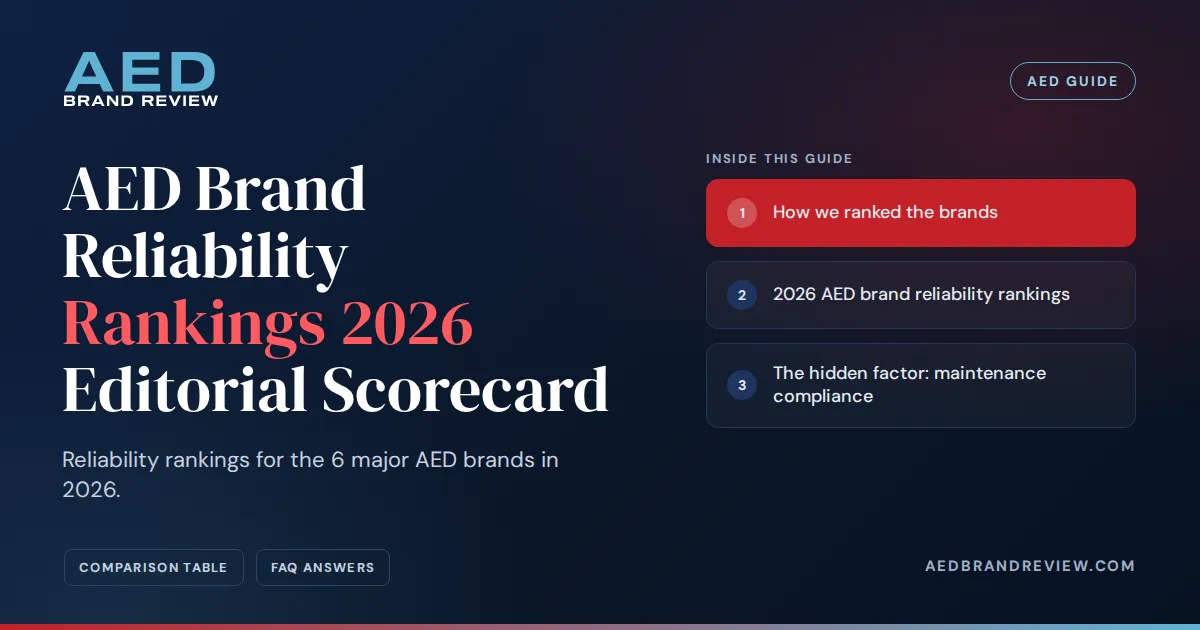
This ranking compares the 6 major AED brands sold in the U.S. across recall history, self-test design, warranty length, and average customer-reported field reliability. This is not a clinical efficacy study , every brand below is FDA-approved and clinically equivalent in shock delivery. Reliability differences are about manufacturing consistency, maintenance burden, and field deployability.
How we ranked the brands
Each brand was scored on five criteria, weighted 20% each:
- Recall history (2015 to 2025): Number, severity, and customer impact of FDA recalls
- Self-test pass rate: Self-test design and reported self-test issues (editorial assessment)
- Warranty length: Device warranty offered by the manufacturer
- Maintenance burden: Pad + battery replacement complexity
- Customer-reported reliability: AED Brand Review’s compiled review data + B2B buyer feedback
Score range: 0 to 100. Sources include the FDA MAUDE database, the FDA Class I/II recall notices 2015 to 2025, and AED Brand Review’s review methodology.
2026 AED Brand Reliability Rankings
| Rank | Brand | Warranty | Notable recall events | Maintenance simplicity | Score |
|---|---|---|---|---|---|
| 1 Top Pick | HeartSine | 8 years | Limited; minor pad lot recalls | Highest (PAD-PAK) | 92/100 |
| 2 | ZOLL | 7 years | Limited; software updates | High (5-yr pads) | 89/100 |
| 3 | Philips | 8 years | Notable FR2 / FRx legacy recalls | Moderate | 85/100 |
| 4 | Defibtech | 8 years | Limited | Moderate | 83/100 |
| 5 | Physio-Control / LIFEPAK | 8 years | Limited (clinical use) | Moderate | 82/100 |
| 6 | Cardiac Science | 7 years | Major 2009 to 2012 Powerheart recall; resolved | Moderate | 78/100 |
Important: every brand below is currently FDA-approved and clinically acceptable. The score reflects long-term ownership friction and historical track record, not current shock-delivery efficacy.
1. HeartSine, Highest Reliability Score
Strengths: 8-year device warranty, single PAD-PAK cartridge simplifies maintenance, IP56 ingress rating on all current models. Low historical recall volume. Lightweight (2.4 lb) reduces installation friction.
Weaknesses: Pediatric PAD-PAK rated for ages 1+ (not infants under 1). Smaller U.S. service network than Philips or ZOLL.
Best for: Small businesses, homes, schools, dental, and daycare. View HeartSine brand page.
2. ZOLL, Best Real-Time CPR Feedback
Strengths: Real-time CPR depth + rate feedback via CPR-D pads. Longest pad life in the industry (5 years). 6-year warranty on the AED 3, 8 with ZOLL registration. Strong clinical adoption.
Weaknesses: Larger footprint than HeartSine. Slightly heavier (6.7 lb).
Best for: Gyms, restaurants, hospitals, EMS, and healthcare settings. View the ZOLL brand page.
3. Philips, Most Trusted Legacy Brand
Strengths: Largest installed base in U.S. workplaces. Clearest voice prompts. 8-year warranty. HeartStart series engineered for non-medical responders.
Weaknesses: Philips has issued notable HeartStart FR2, FRx and OnSite recalls and safety notices; check current status in the FDA recall database. HeartStart OnSite IP21 limits humid environments.
Best for: Offices, public access, schools, large commercial deployments. View Philips brand page.
4. Defibtech, Best American-Made Budget
Strengths: American-manufactured. Lifeline VIEW includes built-in video coaching. 8-year warranty. Limited recall history.
Weaknesses: Smaller U.S. brand presence. Defibtech VIEW IP54 limits direct rain exposure.
Best for: Budget-conscious workplaces, single-location businesses, contractor jobsites. View Defibtech brand page.
5. Physio-Control / LIFEPAK, Best Clinical-Grade
Strengths: Hospital-grade engineering. cprINSIGHT analyzes during compressions (uninterrupted CPR). Wireless fleet monitoring. 8-year warranty.
Weaknesses: Higher price ($2,256 to $2,681 for the CR2 at AED Leader). Heavier than competitors. Now owned by Stryker; service handled through the Stryker network.
Best for: Hospitals, urgent care, EMS, athletic clubs, and large multi-site programs. View the LIFEPAK brand page.
6. Cardiac Science, Legacy Brand With Recovery
Strengths: Intellisense CPR feedback. Strong international install base. Now owned and serviced by ZOLL, which acquired Cardiac Science in 2019.
Weaknesses: Major Powerheart G3 recall events between 2009 to 2012 damaged the brand’s reputation. The current G5 generation has resolved historical issues, but the brand still carries that legacy in some buyer perception.
Best for: Healthcare clinics, dental practices, organizations with existing Cardiac Science deployments. View Cardiac Science brand page.
The hidden reliability factor: maintenance compliance
The single biggest reliability variable is not the manufacturer, it’s whether the owner follows maintenance schedules. A 2012 review of FDA device reports (DeLuca et al.) found that about 47% of AED failures involved consumables: expired pads, dead batteries, skipped self-test verification.
To minimize owner-caused failure regardless of brand:
- Set a 2-year (or 4-year for HeartSine) calendar reminder the day you install
- Assign one named person (not “the team”) responsible for the monthly visual check
- Photograph the status indicator weekly and archive it
- Pre-order replacement pads/battery 30 days before expiration
Pricing across brands (2026)
| Brand | Entry model | Mid-tier | Premium |
|---|---|---|---|
| HeartSine | 350P: $1,411 | 360P: $1,651 | 450P: $1,761 |
| ZOLL | AED Plus: $2,082 | AED 3: $2,399 | AED Pro (clinical): not priced here |
| Philips | OnSite: $1,589 | FRx: $2,099 | FR3 (clinical): not priced here |
| Defibtech | Lifeline: $1,478.80 | VIEW: $2,024.95 | ECG: $2,885.40 |
| LIFEPAK | CR2 USB: $1,411 | CR2: $2,256 | 1000 (clinical): not priced here |
| Cardiac Science | n/a | Powerheart G5: $2,157 | n/a |
New-unit prices at AED Leader, checked 30 September 2026. Clinical models are listed for context and are not priced here. Prices change, so confirm on the AED Leader product page or in our AED listings before purchase.
Replacing your AED pads or battery
AED pads and batteries expire on a fixed schedule whether the device is ever used or not, and they are the single most common reason an AED fails when it is needed. In the largest published analysis of FDA-reported AED events, 40,787 cases, batteries accounted for 23.2 per cent of failures and pads and connectors for 23.7 per cent, so 46.9 per cent of all AED failures are consumables (DeLuca et al., Annals of Emergency Medicine, 2012, PMID 21872969). Below is every current replacement part with its price and service life, verified against seller product data on 12 September 2026.
| Model | Adult pads | Battery | Pediatric option | 10 year consumable cost |
|---|---|---|---|---|
| Philips HeartStart OnSite | M5071A $99.00, 2 years | M5070A $249.00, 4 years | Separate M5072A cartridge, prescription only | About $894 |
| Philips HeartStart FRx | SMART Pads II 989803139261 $89.00, 2 years | M5070A $249.00, 4 years | Infant/Child Key $139.00, reusable | About $854 |
| ZOLL AED Plus | CPR-D Padz 8900-0800-01 $230.00, 5 years | Lithium set of 10 $100.00, 5 years | Pedi-padz II $155.00, 2 years | About $330, the lowest we track |
| ZOLL AED 3 | CPR Uni-padz 8900-000280-01 $234.00, 5 years | 8000-000696 $201.00, 5 years | None needed, Uni-padz cover children | About $435 |
| Defibtech Lifeline | DDP-100 $75.15 | DBP-1400 $229.10 | DDP-200P $130.25 | About $530 |
| Defibtech Lifeline VIEW | DDP-2001 $83.05 | DCF-2003 $240.45 | DDP-2002 $136.40 | About $813 |
| HeartSine Samaritan PAD | Pad-Pak-01 $236.00, pads and battery in one cartridge | Included in the Pad-Pak, there is no separate battery | Pediatric Pad-Pak PAD-PAK-02 $279.00 | About $472 |
| Cardiac Science Powerheart G5 | XELAED001C $88.00 | XBTAED001A $495.00, 4 years | XELAED003C $127.00 | About $1,342, the highest we track |
| Physio-Control LIFEPAK CR2 | Quik-Step 11101-000021 $196.00, adult and child in one set | LIFEPAK CR2 lithium battery $341.00, about 4 years | None needed, the Quik-Step set covers children | Not published per part |
Prices verified against the public product data of AED Leader on 30 September 2026. Service life is the manufacturer figure where one is published; where it is not, check the expiry date printed on the part itself. Ten year consumable cost is our own calculation from those part prices and service lives.
Three things owners get wrong
- Buying the wrong Philips pad. The FRx uses SMART Pads II, part 989803139261. SMART Pads III belong to the FR3, a different device. The OnSite uses M5071A and the two are not interchangeable.
- Assuming the pediatric part is optional. On a ZOLL AED Plus, Pedi-padz II cost $155.00 and last two years, which is about $775 across a ten year life. On a ZOLL AED 3 or a LIFEPAK CR2 the pads already cover children and that cost is zero.
- Tracking the wrong date. HeartSine combines the pads and battery into one Pad-Pak cartridge, so there is a single expiry to track. Every other model here has two parts on two separate clocks.
Full replacement schedule by model is on our AED pads and batteries page. If you are still choosing a device, the ten year running cost is usually a bigger number than the discount you are negotiating: see every AED brand ranked by price and ten year cost.
Frequently Asked Questions
Which AED brand is the most reliable?
By our 2026 scorecard, HeartSine ranks #1 on combined warranty, maintenance simplicity, and low recall history. ZOLL and Philips are close behind with different strengths.
Have any AED brands been recalled?
Yes, multiple brands have issued recalls over the past 15 years, most notably the Cardiac Science Powerheart G3 (2009 to 2012) and Philips HeartStart FR2, FRx and OnSite units. Search the FDA recall database for the current status.
How do AEDs fail in the field?
Many field failures involved consumables (expired pads, dead batteries, missed self-tests) rather than device defects. Manufacturer-level failures are rare and usually caught by the daily self-test cycle.
Does brand affect shock effectiveness?
No. Every FDA-approved AED is required to meet the same clinical efficacy standard. Differences between brands are about user experience, maintenance, and durability, not whether the shock works.
How do I check my AED brand’s recall status?
Search the FDA medical device recall database by manufacturer name. Or read our AED recall guide.
The models behind these rankings
Prices checked 30 September 2026 at AED Leader. Each link opens our full review with the buy path.
- Philips HeartStart OnSite (M5066A) review and price$1,589 to $1,819New, 8-year manufacturer warranty
- ZOLL AED 3 review and price$2,399New, 6-year warranty (8 with ZOLL registration)
- LIFEPAK CR2 review and price$2,256 to $2,681New, 8-year manufacturer warranty
- HeartSine Samaritan PAD 350P review and price$1,411New, 8-year manufacturer warranty
- Defibtech Lifeline AED review and price$1,478.80 to $1,659.15New, 8-year manufacturer warranty
Get your team certified the easy way.
Sources & References
- FDA MAUDE, Manufacturer & User Facility Device Experience Database
- FDA, Medical Device Recall Database
- AED Brand Review, Review Methodology
- Manufacturer warranty documentation: HeartSine, ZOLL, Philips, Defibtech, Physio-Control, Cardiac Science
Disclaimer: This ranking reflects independent editorial judgment by AED Brand Review and is not endorsed by any AED manufacturer. AED Brand Review is not affiliated with any manufacturer reviewed. Verify current recall status with the FDA before purchase.