Roughly 356,000 Americans experience cardiac arrest outside hospitals each year, and survival is under 12% (AHA Heart Disease and Stroke Statistics), largely because too few bystanders intervene. The single biggest barrier isn’t access to AEDs (they’re everywhere now) or laws (every state has Good Samaritan or AED immunity laws). It’s hesitation. People who could save a life freeze because they’re afraid of doing it wrong. This guide is for the people who want to be the person who acts, not the person who watches, and walks through exactly what training a lay responder needs (much less than people assume), how much time it takes, and how to build the confidence to step forward when it matters.
~356
KU.S. out-of-hospital cardiac arrests per yearSource: AHA, 2024
70%
Of OOH cardiac arrests happen at homeSource: AHA
~46%
Of victims receive bystander CPRSource: AHA OHCA statistics
What lay responder actually mean
“Lay responder” is the AHA term for a non-medical bystander, anyone who might be the first person to reach someone in cardiac arrest. It includes:
- Family members at home (where 70% of OHCAs happen)
- Coworkers in any workplace
- Customers in any business
- Members at gyms, churches, and schools
- Athletes’ parents in the stands
- Strangers in any public space
The lay responder is the most important link in the AHA Chain of Survival because they are the only person who can act in the first 1 to 3 minutes. EMS averages 7 to 14 minutes. Brain cells start dying at 4 to 6 minutes. The lay responder closes that gap, or no one does.
The truth about whether you need training
Legally, no
Every U.S. state has a Good Samaritan law or AED immunity law that protects lay rescuers who use an AED in good faith in most cases. The details vary by state and gross negligence is usually excluded, so check your state’s law. You do not need a certification card.
Technically, no
Modern AEDs are explicitly designed for untrained bystander use. The device powers on, talks you through every step, analyzes the heart rhythm itself, decides whether to shock, and either delivers automatically or prompts you to press a button. A panicked, untrained bystander can absolutely save a life with one.
Practically, yes
Here’s the part that the “you don’t need training” answer leaves out: under stress, most untrained bystanders don’t act. They freeze, they wait for someone else, they call 911, and stand back. Training doesn’t make you legally allowed to help, it makes you psychologically willing to. That difference is the entire game.
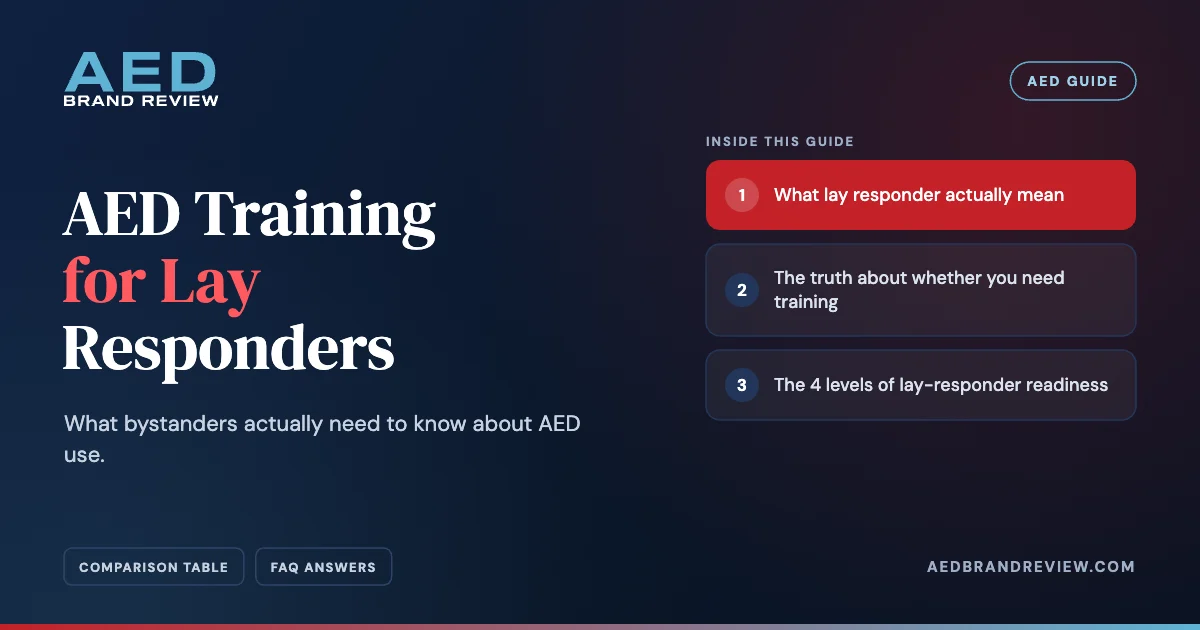
The 4 levels of lay-responder readiness
| Level | What it includes | Time investment | Cost |
|---|---|---|---|
| 0, Aware | Know AEDs exist, know to call 911 | 0 minutes | Free |
| 1, Hands-Only CPR taught | 10-minute video on chest compressions only; no AED training | 10 minutes | Free |
| 2, Heartsaver CPR/AED certified | Adult/child/infant CPR, AED operation, choking | 2.5 to 3 hours | $45 to $110 |
| 3, Heartsaver Pediatric + First Aid | Adds pediatric-specific scenarios + general first aid | 4 to 5 hours | $95 to $140 |
For most lay responders, Level 2 is the right target , a one-time 2.5-hour investment that covers everything you’d encounter in the most likely emergencies. Renewed every 2 years.
Hands-Only CPR, the free entry point
If a full certification course is a barrier, the AHA’s Hands-Only CPR approach is the minimum-viable lay responder skill. It’s free, takes 10 minutes to learn from a video, and is endorsed by the AHA as appropriate for any adult cardiac arrest victim (not for children or drowning, where rescue breaths still matter).
The protocol is two steps:
- Call 911
- Push hard and fast in the center of the chest at 100 to 120 compressions per minute
That’s it. The Bee Gees’ “Stayin’ Alive” famously has the right beat. AHA’s Hands-Only CPR video covers it in 90 seconds.
Hands-Only CPR is not a substitute for full certification, it doesn’t cover AED use, infant/child resuscitation, choking, or first aid. But it’s the smallest unit of training that meaningfully shifts a bystander from spectator to actor.
What full Heartsaver CPR/AED actually teaches you
The 2.5 to 3 hour AHA Heartsaver course covers:
- How to recognize cardiac arrest (not just “they fell down”)
- The Chain of Survival framework
- Adult, child, and infant CPR, including correct depth, rate, and hand position
- Mouth-to-mouth rescue breaths (optional in adult-only Hands-Only context)
- AED operation, turning it on, pad placement, voice prompt interpretation, special cases
- Choking response, Heimlich maneuver, infant back blows
- Hands-on practice on adult, child, and infant CPR manikins
- Psychomotor skills evaluation
The course costs $45 to $110. The card is valid for 2 years. For most lay responders, this is the most useful safety skill you’ll ever acquire, and the cheapest insurance you’ll ever buy.
Skills retention, the uncomfortable truth
CPR/AED skills decay measurably within months of certification. Studies in the American Heart Association journal Circulation have documented that compression depth, rate, and hand position degrade within 3 to 6 months in lay rescuers without practice.
This is why annual refresh (vs. 2-year cycle) is often recommended even though the card is technically valid. Practical strategies for retention:
- Practice on a foam pillow or rolled towel, 30 compressions at 100 to 120/min, every few months
- Re-watch the AHA Hands-Only video once or twice a year
- Recertify every 1 year instead of every 2 years
- Mental rehearsal, picture yourself at the gym, the church, the office, walking through the steps
Where to find free or low-cost training
| Source | Cost | Format |
|---|---|---|
| Local fire department community classes | Free to $70 | In-person · scheduled monthly or quarterly |
| American Red Cross community events | Free to $80 | In-person · varies by chapter |
| YMCA, community center | $55 to $90 | In-person · open enrollment |
| Workplace employer-sponsored | Free (employer pays) | On-site · ask HR |
| Church or community organization sponsorship | Often free | Periodic · community partnership |
| AHA Hands-Only CPR video | Free | 10 minutes online · no certification |
The “I’m afraid I’ll hurt them” concern
This is the most common reason untrained bystanders hesitate. Three facts that address it:
1. The AED won’t shock unless needed
AEDs analyze the rhythm before delivering any shock. If the heart is in a non-shockable rhythm, including a normal one, the device will say “no shock advised” and not deliver therapy. The AED only shocks rhythms it identifies as shockable, so it will not shock a normal heartbeat.
2. CPR can break ribs, that’s normal
Chest compressions deep enough to be effective sometimes crack ribs or cartilage in older patients. This sounds horrifying but is medically acceptable and far preferable to under-compressing. Healed ribs are not a tragedy; a dead patient is.
3. The patient cannot get worse
A person in cardiac arrest is, clinically, dying. There is no state worse than that. Anything you do that’s not deliberately harmful can only help or have no effect. The downside of acting is zero; the downside of not acting is everything.
Real-world bystander outcomes
Real-world impact
The “see something, do something” pattern
Communities that systematically train lay responders see measurably higher cardiac arrest survival rates. Seattle, Washington, one of the most heavily CPR-trained U.S. cities, with decades of public Hands-Only CPR campaigns, has reported out-of-hospital cardiac arrest survival rates roughly 2 to 3× the national average. The difference is bystander intervention.
Personal stakes
Why this matters at home
If 70% of cardiac arrests happen at home, the person you’re most likely to save with these skills is your spouse, your parent, your child, or your roommate. Workplace CPR/AED skills serve coworkers. Home skills serve the family. The training is the same.
The action checklist for lay responders
Today (10 minutes, free)
- Watch the AHA Hands-Only CPR video
- Locate the AED nearest your home, workplace, and gym
- Save the local emergency number (911 in the U.S., variable internationally) in speed dial
This month (2.5 hours, $45 to $110)
- Book a Heartsaver CPR/AED course through AED Leader, your local fire department, or the American Red Cross
- Complete the in-person skills evaluation
- Save the digital card and set a 2-year renewal reminder
Every year (free or low cost)
- Re-watch the Hands-Only CPR video
- Practice compressions on a pillow once
- Mentally walk through the 8-step protocol
- Schedule recertification 60 days before card expiration
Frequently Asked Questions
Do bystanders legally need CPR/AED training to use an AED?
No. Every U.S. state’s Good Samaritan law protects bystanders using an AED in good faith in most cases, though the details vary by state. No certification is required to act. The AED is designed for untrained bystander use.
Why should I bother with CPR training if it’s not required?
Because training is what makes the difference between freezing and acting. Untrained bystanders look around to see if someone else will help. Trained bystanders know they are someone else. Survival depends on someone moving in the first 60 to 90 seconds.
What’s the difference between Hands-Only CPR and full CPR?
Hands-Only CPR is chest compressions only, no rescue breaths. It’s the AHA’s recommended approach for untrained or partially trained bystanders responding to adult cardiac arrest. Full CPR adds rescue breaths and is recommended for child and infant cardiac arrest or drowning. Both are taught in Heartsaver CPR/AED.
Can I take CPR/AED training online for free?
The AHA’s Hands-Only CPR video is free but does not include certification. Free legitimate certification is rare, your best free option is community fire department classes, which often charge nothing. Online-only paid certification is generally not accepted by employers or state boards.
How long does CPR/AED training take?
Hands-Only CPR awareness: 10 minutes. Full Heartsaver CPR/AED certification: 2.5 to 3 hours, including hands-on practice and skills check. Blended online + skills format can split this into ~90 minutes of self-paced online + ~1 hour in-person.
How often should I refresh my CPR skills?
The certification card lasts 2 years, but skills measurably decay within 3 to 6 months without practice. Best practice: re-watch the Hands-Only video and mentally walk through the protocol every 6 months. Recertify every 1 to 2 years.
What if I freeze in a real emergency?
It’s normal, and one of the biggest values of training is reducing it. If you do freeze, even calling 911 and giving compressions is a massive help. Imperfect action beats no action every time. Modern AEDs literally talk you through the rest if you can get to one.
Get hands-on AED training in under 3 hours.
Sources & References
- American Heart Association, Hands-Only CPR
- American Heart Association, 2020 CPR & ECC Guidelines
- American Heart Association, Cardiac Arrest Statistics
- American Red Cross, CPR & AED
- NIH, National Heart, Lung, and Blood Institute: What is cardiac arrest?
- Circulation, AHA Journal (skills retention research)
Disclaimer: This article is informational. In a real emergency, call 911. AED Brand Review is not a medical provider. Training is recommended but never legally required to use an AED on a bystander in cardiac arrest.