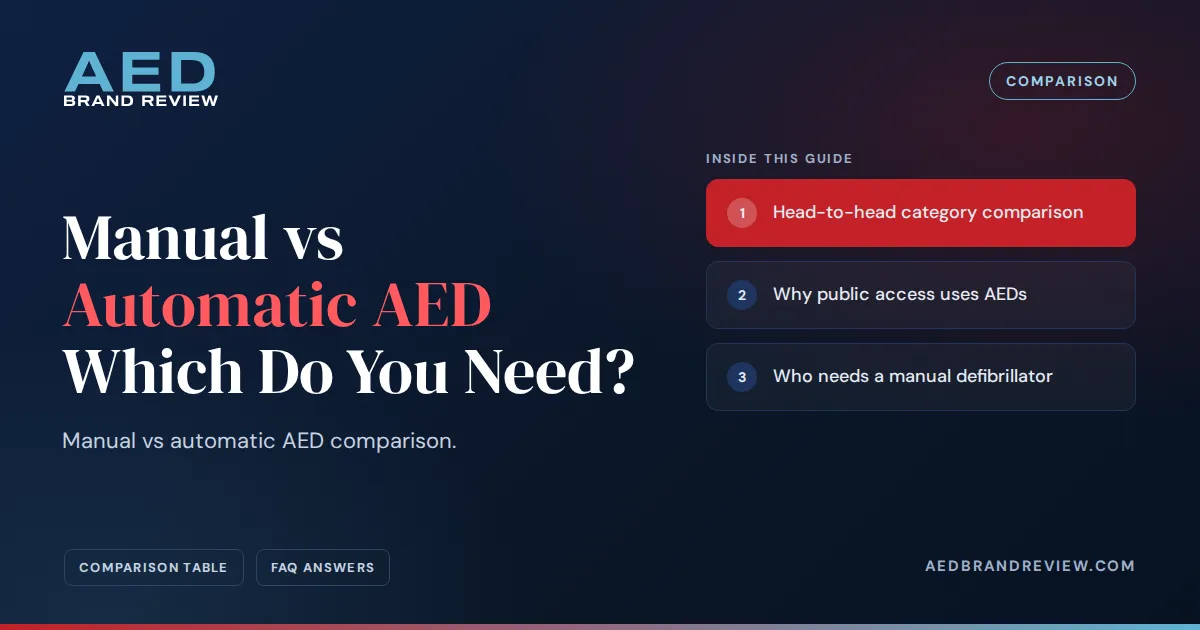
“Manual vs automatic” is a category-level decision, not a model-level one. Manual defibrillators are clinical equipment used by trained healthcare providers, physicians, paramedics, EMTs. The provider interprets the ECG and decides when to shock. AEDs (Automated External Defibrillators) are public-access devices that analyze the rhythm and decide when to shock automatically. For 99% of U.S. workplaces, schools, and public access settings, the answer is AED, not manual.
Head-to-head category comparison
Recertified prices across all seven models
Recertified units are the same models under the same FDA premarket approvals, restored, tested and sold with a minimum three year warranty.
| Model | New | Recertified | You keep | Buy |
|---|---|---|---|---|
| Philips HeartStart OnSite | $1,589 | $875 | $714 (45%) | AED Leader or Response Ready |
| Philips HeartStart FRx | $2,099 | $875 | $1,224 (58%) | AED Leader or Response Ready |
| ZOLL AED Plus | $2,082 | $875 | $1,207 (58%) | AED Leader or Response Ready |
| ZOLL AED 3 | $2,399 | $1,150 | $1,249 (52%) | AED Leader or Response Ready |
| HeartSine Samaritan PAD 350P | $1,411 | $875 | $536 (38%) | AED Leader or Response Ready |
| HeartSine Samaritan PAD 450P | $1,761 | $875 | $886 (50%) | AED Leader or Response Ready |
| Cardiac Science Powerheart G5 | $2,157 | $1,225 | $932 (43%) | AED Leader or Response Ready |
Prices verified 30 September 2026 against the public product data of both stores. Both list identical recertified prices, so buy from whichever fits your order size: AED Leader for one to four units, Response Ready for five or more and for compliance and fleet programmes. New prices are the AED Leader list price on the same date.
The honest risk. A recertified AED is a used device. The three year minimum warranty is what makes the saving worth taking. Read recertified versus new and how to choose a refurbished AED before you decide.
| Dimension | AED (Automated) | Manual Defibrillator |
|---|---|---|
| User | Lay rescuer or trained | Healthcare provider only |
| Decision to shock | Automatic (device decides) | Manual (provider decides) |
| ECG interpretation | Built-in algorithm | Provider interprets |
| Training required | Recommended; required for designated responders in some states | BLS/ACLS minimum |
| Typical environment | Public access, workplace | Hospital, EMS, clinic |
| Price range | $875 recertified; $1,411 to $3,701 new | $8,000 to $30,000+ |
| Voice prompts | Yes (guides user) | No |
Why public access uses AEDs, not manual
The AHA Chain of Survival depends on rapid defibrillation by a bystander, typically untrained. AEDs solve that with built-in rhythm analysis. Manual defibrillators require interpretation of complex ECG patterns (V-fib vs V-tach vs asystole vs PEA) that takes 100+ hours of clinical training to recognize reliably. Even Good Samaritan laws were written around AED use, not manual defibrillation.
Frequently Asked Questions
What’s the difference between manual and automatic defibrillation?
Automatic (AED): device analyzes rhythm and decides when to shock. Manual: trained provider interprets ECG and shocks at their discretion.
Should my office buy a manual defibrillator?
No. Manual defibrillators are clinical equipment for healthcare providers. Buy an AED.
Do paramedics carry AEDs or manual defibrillators?
Manual, Paramedics are trained to interpret ECG rhythms. Most modern paramedic units (LIFEPAK 15, ZOLL X Series) operate in both manual and automatic modes.
Can I use an AED on someone who already has a manual defibrillator attached?
Don’t stack them, let EMS continue with their manual unit when they arrive.
Is the LIFEPAK 1000 manual or automatic?
Both, it’s an AED with manual override mode for trained providers.
Models that come in both versions
Prices checked 30 September 2026 at AED Leader. Each link opens our full review with the buy path.
- ZOLL AED Plus review and price$2,082New, 5-year warranty (7 with ZOLL registration)
- LIFEPAK CR2 review and price$2,256 to $2,681New, 8-year manufacturer warranty
Get hands-on AED training in under 3 hours.
Sources & References
Disclaimer: Educational article only.