⚡ Sudden cardiac arrest kills 350,000 Americans every year — 70% survive when defibrillation happens within 3 min. Get CPR Trained →
Philips HeartStart pads and battery replacement: which part, what it costs, and when

Philips HeartStart pads and battery replacement: which part, what it costs, and when

Philips HeartStart pads and battery replacement which part, what it costs, and when | AED Brand Review

Quick answer

If you own a HeartStart OnSite (M5066A) or Home (M5068A): adult pads are M5071A, about $99, replace every 2 years. Battery is M5070A, about $249, replace every 4 years. If you own a HeartStart FRx (861304): your pads are SMART Pads II, part 989803139261, about $89, every 2 years, and they are not interchangeable with M5071A. Pediatric coverage differs by device and is covered below.

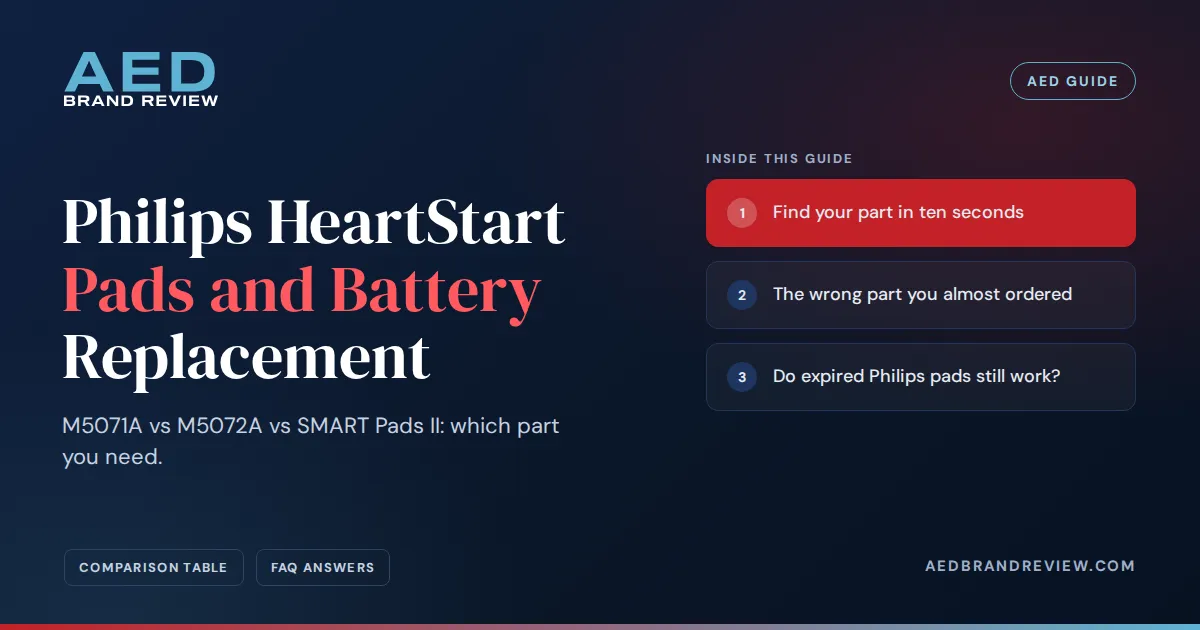
Find your part in ten seconds

Quick answer

Match the device on your unit’s label, not the shape of the pads. Philips sells three similar-looking cartridges that fit different machines.
Your deviceAdult padsPediatric optionBattery
HeartStart OnSite (M5066A)M5071A, ~$99, 2 yrM5072A Infant/Child cartridge (Rx only)M5070A, ~$249, 4 yr
HeartStart Home (M5068A)M5071A, ~$99, 2 yrM5072A Infant/Child cartridge (Rx only)M5070A, ~$249, 4 yr
HeartStart FRx (861304)SMART Pads II, 989803139261, ~$89, 2 yrInfant/Child Key 989803139311, ~$121 to $139, reusableM5070A, ~$249, 4 yr
HeartStart FR3SMART Pads III (different part, different device)Separate FR3 accessoryFR3 battery, not M5070A
Prices: AED Leader, August 2026. Intervals are the manufacturer’s stated shelf life from date of manufacture, so a cartridge that sat in a warehouse gives you less than the full window. Check the printed expiry the day it arrives and put that date in your phone, not the date you installed it.

The wrong part you almost ordered

Quick answer

Three Philips mistakes account for most wrong orders: buying M5071A for an FRx, buying SMART Pads III for an FRx, and assuming the infant/child cartridge ships as freely as the adult one. It does not.

Mistake 1: M5071A on an FRx. The OnSite and the FRx are both HeartStart devices with a cartridge slot, and the parts are not interchangeable. The FRx takes SMART Pads II, part 989803139261. If you own an FRx, that eleven-digit number is the only one that matters.

Mistake 2: SMART Pads III. SMART Pads III belong to the Philips FR3, a professional device that is not the FRx despite the one-letter difference. Ordering III for an FRx buys a part that will not serve. We published this error once ourselves and corrected it, which is exactly why it is worth flagging: even people who do this for a living mix these two up.

Mistake 3: assuming the pediatric cartridge ships like the adult one. The adult configuration of the OnSite and Home is approved for over-the-counter sale under the FDA-approved labeling on PMA P160029. The Infant/Child SMART Pads cartridge (M5072A) is Rx Only: federal law restricts its sale to the order of a physician. Established dealers handle that, but it is why a pediatric cartridge sometimes needs a phone call when the adult one does not. Full detail in our home AED prescription table.

What Philips consumables cost over ten years

Quick answer

An OnSite costs roughly $894 in consumables per decade (5 pad cycles at ~$99 plus 2 to 3 battery cycles at ~$249). An FRx runs about $854. Both are near the top of the market, which is the honest trade for Philips’ best-in-class voice coaching.
DevicePads (part, price, life)Battery (part, price, life)10-yr consumables
Philips OnSite / HomeM5071A, $99, 2 yrM5070A, $249, 4 yr~$894
Philips FRx989803139261, $89, 2 yrM5070A, $249, 4 yr~$854
ZOLL AED Plus (for contrast)CPR-D-padz, $230, 5 yrBattery set, ~$100, 5 yr~$330
HeartSine 350P (for contrast)Pad-Pak, $236, pads and battery in one cartridge~$472
Our calculation from dated part prices. Full cross-brand table in the AED pads and batteries pillar.
This is the number to weigh before your next AED purchase rather than after. A Philips costs roughly $560 more per decade to feed than a ZOLL AED Plus, which is a real consideration when buying a fleet and almost irrelevant when buying one unit for a home where coaching quality matters more. We break that trade down in the ZOLL AED Plus vs Philips OnSite comparison.

Do expired Philips pads still work?

Quick answer

Sometimes, and you should still replace them. No FDA or AHA rule mandates replacement, so anyone citing a regulation is inventing one. The real reason is physical: the conductive hydrogel dries out, adhesion weakens, and a pad that does not stick flat does not deliver its energy.

The scale of the risk is documented. In a review of 40,787 AED failures reported to the FDA, batteries accounted for 23.2% and pads or connectors for 23.7%, so roughly 46.9% of all reported AED failures traced to consumables (DeLuca et al., Annals of Emergency Medicine, 2012). The device almost never fails. The parts you were supposed to replace do.

Practical rule: expired pads stay in the case as a backup behind the in-date set, never as the primary. If an arrest happens and expired pads are all you have, use them. They are better than nothing by an enormous margin.

Pediatric: what Philips actually charges

Quick answer

The FRx uses a reusable Infant/Child Key (about $121 to $139, one-time, no published expiry) which is the cheapest pediatric solution Philips offers. The OnSite and Home need the M5072A cartridge, which is a consumable and is prescription-only.

This is where Philips’ two families diverge sharply. The FRx key is inserted into the device and converts the adult pads to pediatric energy, so there is nothing extra to expire or reorder. The OnSite family instead needs a separate pediatric cartridge on its own replacement clock. If children are a regular part of your setting, that difference is worth more than the sticker price gap between the two devices. Compare against the ZOLL AED 3, whose Uni-padz cover both populations at no extra cost, in our AED 3 review, and see the institutional version of the same math in the best AED for schools guide.

The AHA permits adult pads on a child when pediatric equipment is unavailable: place one pad on the chest and one on the back. No child should go unshocked because the pediatric part was not in the bag.

Fleet math: what pads cost across multiple units

Quick answer

Consumables scale linearly while devices do not. Ten Philips OnSite units cost about $8,940 to keep in service for a decade, which for most organisations exceeds the purchase price of the recertified devices themselves.
This is the calculation that decides fleet purchases and almost nobody runs it before signing. At roughly $894 per unit per decade, a ten-unit Philips fleet carries about $8,940 of consumable spend. The identical fleet on ZOLL AED Plus units carries about $3,300. Over a fifteen-year building life the gap widens further.
Fleet sizePhilips OnSite, 10-yr consumablesZOLL AED Plus, 10-yr consumablesDifference
1 unit$894$330$564
5 units$4,470$1,650$2,820
10 units$8,940$3,300$5,640
25 units$22,350$8,250$14,100
Our calculation from August 2026 part prices. None of this argues against Philips for a single home unit, where coaching quality dominates and $564 across ten years is noise. It argues for running the number deliberately at fleet scale. Organisations weighing this should read the schools guide, the gym guide, and the refurbished vs new cost analysis, then compare against the ZOLL AED Plus parts guide.

Recertified units: when your clock starts

Quick answer

A properly recertified Philips ships with new pads and a new battery, so your replacement clock starts on the purchase date rather than an unknown manufacture date. That is a genuine advantage of buying recertified that sellers rarely mention.

Recertified is the largest category across the network we track, and the Philips OnSite is its single biggest seller. A recertified OnSite at about $875 arrives with fresh consumables installed, which means the first pad replacement is two years out and the first battery four, both measured from a date you actually know. Buying a new device from a warehouse can hand you a cartridge already a year into its shelf life.

What to verify before buying: that new pads and battery are included rather than sold separately, that the warranty is stated in writing, and that the reconditioner documents serial history so you can check the unit against FDA recall listings. The full checklist is in how to choose a refurbished AED, with model detail in the recertified AED pillar, the recertified OnSite page, and the OnSite review. Owners comparing brands should also see the FRx review, the recertified HeartSine, and the 2026 rankings.

When to reorder, in practice

Three habits cover almost every failure mode. First, write the printed expiry date, not the install date, into a phone reminder set 60 days early, because a cartridge manufactured months before you bought it expires on the manufacturer’s clock. Second, replace the battery on schedule even if the status indicator looks fine, since the indicator confirms current charge rather than remaining service life. Third, keep the expiring set in the case as backup when you swap; two sets of pads in a case has never made anyone less safe.

If your device is a recertified unit, it shipped with new pads and battery, so your clock starts at the purchase date. The recertified OnSite breakdown covers what that includes, and the recertified FRx page does the same for the FRx.

Order the right part

OnSite or Home: M5071A pads and M5070A battery. FRx: SMART Pads II part 989803139261. Match the number on this page to the model on your device label before you buy.

Philips pads and battery FAQ

What pads does the Philips HeartStart OnSite use?

Adult SMART Pads cartridge M5071A, about $99, replaced every 2 years. The Infant/Child cartridge is M5072A and is prescription-only. The same parts fit the HeartStart Home (M5068A).

What pads does the Philips FRx use?

SMART Pads II, part 989803139261, about $89, every 2 years. FRx pads are not interchangeable with the OnSite’s M5071A. SMART Pads III belong to the Philips FR3, a different device.

How long does the M5070A battery last?

About 4 years of standby life, roughly $249. Replace on schedule rather than waiting for the status indicator, which reports current charge rather than remaining service life.

Do expired Philips AED pads still work?

They may, and they should still be replaced. No FDA or AHA rule mandates replacement; the reason is physical, since the conductive gel dries and adhesion degrades. FDA failure data shows roughly 46.9% of reported AED failures involve batteries or pads.

Do I need a prescription for Philips AED pads?

Not for the adult M5071A cartridge: the adult configuration of the OnSite and Home is over the counter under the FDA-approved labeling on PMA P160029. The Infant/Child cartridge M5072A is Rx Only, which dealers handle as part of the sale.

What is the cheapest way to keep a Philips AED in service?

Buy pads and battery together on the 4-year battery cycle to save a shipment, keep the expiring pads as backup, and set the reminder from the printed expiry date. Philips consumables run about $894 per decade for an OnSite, our calculation from August 2026 prices.

References

  1. FDA Premarket Approval database: P160029 (Philips HeartStart OnSite M5066A and Home M5068A, including SMART Pads M5071A and M5072A) and P180028 (HeartStart FRx 861304). FDA-approved labeling on P160029 designates the adult configuration for over-the-counter sale and restricts the Infant/Child cartridge M5072A to prescription.
  2. DeLuca LA et al. Analysis of automated external defibrillator device failures reported to the Food and Drug Administration. Ann Emerg Med. 2012 (PMID 21872969): 40,787 reported events, batteries 23.2%, pads and connectors 23.7%.
  3. American Heart Association guidance permitting adult pads on a child when pediatric pads are unavailable.
  4. Seller prices and part numbers: AED Leader product and accessory pages, checked August 2026.
Updated August 2026. Part numbers and prices re-verified on the date shown; tell us if a seller has since moved a price.
Picture of ayaan
ayaan
In the last 27 years, I have worked as a first responder. For 20 of those years, I focused on instruction and training. I’ve collaborated with teams in nonprofits, businesses, government, healthcare, and aquatic fields. I help them improve their readiness for many emergency situations. I have helped organizations adopt effective emergency response strategies. I’ve combined hands-on experience with practical education. This lets me use lifesaving tools, such as automated defibrillators, in daily operations.
Related Articles
ZOLL AED Plus pads and battery the parts, the prices, and why this AED is the cheapest to keep alive | AED Brand Review

ZOLL AED Plus pads and battery: the parts, the prices, and why this AED is the cheapest to keep alive

Quick answer The ZOLL AED Plus takes one pad part, CPR-D-padz (8900-0800-01), about $230, replaced every 5 years. Its power comes
Best AED for Home Use 2026 — Family Safety Comparison | AED Brand Review

Best AED for home 2026: what you can actually buy, and what it costs to keep alive

Quick answer For most homes the Philips HeartStart OnSite is the best AED: it is sold over the counter, its voice coaching

Table of Contents

Shop AEDs Now
Best prices on all devices reviewed in this article — authorised dealers, full warranty, expert support.
🛒 AED Leader

aedleader.com →

⚡ Response Ready

responseready.com →

Top Pick in This Guide

Editor's Pick
Philips HeartStart FRx AED 861304
Philips HeartStart FRx Review — Specs, Pediatric Key & Price
★★★★★ (127 reviews)

Mode

Semi-Automatic

IP Rating

IP55

Weight

3.5 lbs / 1.6 kg
$1,944.00 – $2,038.00

🎓

Not CPR Trained Yet?
Training raises AED effectiveness by 40%. AHA-certified courses available nationwide — group pricing for organisations.

📋

Own 5+ AEDs?
AEDTS manages compliance, inspection schedules, and fleet tracking across all your devices.
Scroll to Top