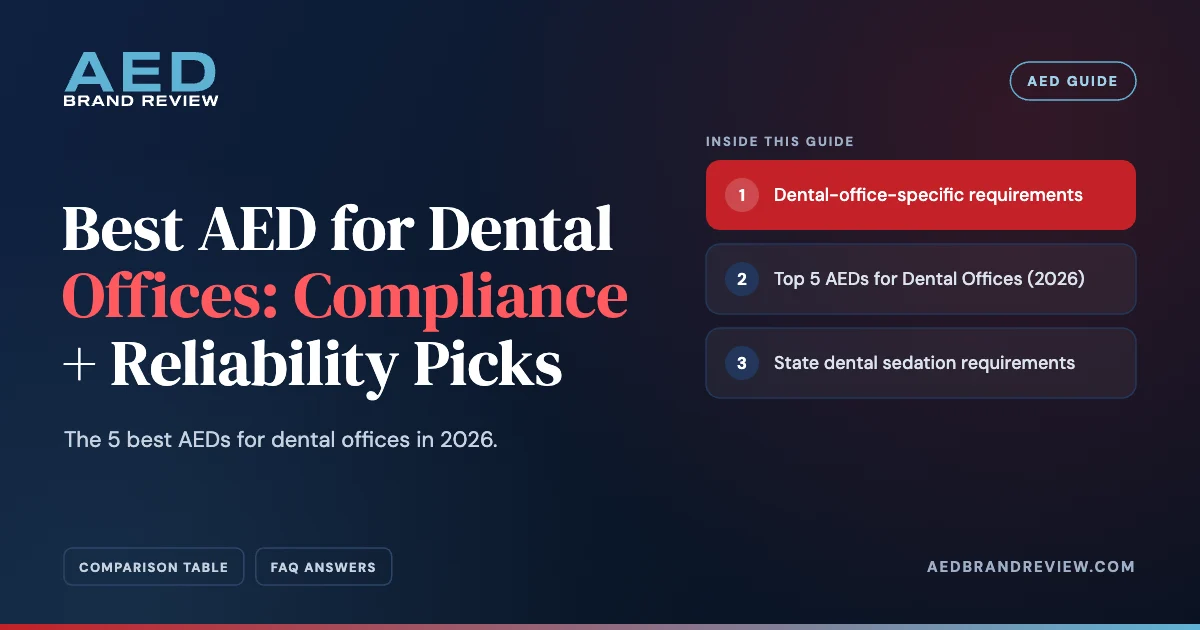
Dental offices occupy a unique risk category. Procedures involve sedation, supine positioning, anxiety-induced arrhythmias, and an older adult patient population, the combined risk profile is higher than a typical retail or office environment. The American Dental Association and the AAOMS both strongly recommend AEDs in every dental practice. Many U.S. states currently require AEDs in dental offices that administer moderate or deeper sedation.
This guide ranks the 5 best AEDs for dental practices in 2026 with attention to sedation-related risk, compliance for permit holders, and integration with chairside emergency protocols.
Dental-office-specific requirements
Five priorities for dental practices:
1. Speed-to-shock
Sedation reactions and anaphylaxis can progress to V-fib within seconds. Choose units with the fastest analysis-to-shock time (typically <30 seconds).
2. Pad compatibility with chairside positioning
Patients are usually reclined or supine. Pad placement is unaffected, but cable length matters when reaching across a dental chair.
3. State permit alignment
If you hold a moderate, deep, or general anesthesia permit, your state board likely requires an AED on-site. Verify with your state Board of Dentistry.
4. OSAP Best Practices alignment
The Organization for Safety, Asepsis, and Prevention (OSAP) recommends AEDs in every dental practice regardless of sedation level.
5. Voice prompts that fit a dental team
Most dental rescuers are dentists, hygienists, or front-desk staff , all trained healthcare workers, but not paramedics. Voice prompts must be clear without being condescending.
Top 5 AEDs for Dental Offices (2026)
| Rank | Model | Analysis-to-shock time | Sedation suitability | Price |
|---|---|---|---|---|
| 1 Top Pick | Philips HeartStart FRx | ~8 seconds | All sedation levels | $2,099 to $2,199 |
| 2 | ZOLL AED Plus | ~10 seconds | Moderate to deep sedation | $2,082 |
| 3 | LIFEPAK CR2 | ~8 seconds + cprINSIGHT | General anesthesia practices | $2,256 to $2,681 |
| 4 | HeartSine Samaritan PAD 360P | ~8 seconds (auto-shock) | Minimal to moderate sedation | $1,651 |
| 5 | Cardiac Science Powerheart G5 | ~10 seconds | Pediatric dental practices | $2,157 |
1. Philips HeartStart FRx, Best Overall for Dental
The Philips HeartStart FRx is the AED most frequently specified by dental insurance and state dental board permitting. Voice prompts are paced for a clinical team, the SMART Pads II self-detect adult vs. pediatric (via Infant/Child Key for under 8), and the unit is light enough (3.5 lb) to be carried between operatories.
2. ZOLL AED Plus, Best CPR Coaching for Dental Teams
The ZOLL AED Plus coaches chest compressions in real time, critical for a hygienist or assistant who hasn’t done compressions on an adult since BLS recertification. 5-year pad life keeps maintenance simple in busy practices.
3. LIFEPAK CR2, Best for General Anesthesia Practices
The LIFEPAK CR2 includes cprINSIGHT, analyzes the rhythm during ongoing compressions, reducing shock-to-shock interruptions. For practices performing general anesthesia, this clinical-grade unit is the closest to hospital ER equipment.
4. HeartSine 360P, Best Fully-Automatic for Sedation Emergencies
The HeartSine 360P delivers shock without a button press, useful when the dentist is starting CPR and the assistant is operating the AED simultaneously. Removes one cognitive load.
5. Cardiac Science Powerheart G5, Best for Pediatric Dental
The Powerheart G5 automatically adjusts shock energy based on patient impedance and offers pediatric pads for offices serving primarily children.
State dental sedation requirements
If you hold any dental anesthesia or moderate sedation permit in the U.S., your state board likely requires an AED. Verify with your state Board of Dentistry. Examples:
- California: AED required at any office providing moderate sedation, deep sedation, or general anesthesia.
- New York: AED required in all NY dental offices providing any sedation under state regulations.
- Florida: AED required for any permit holder with any level of sedation.
- Texas: AED required for moderate/deep sedation permits.
Cross-reference with our AED Laws by State guide and your state dental board’s current rules.
Recertified prices across all seven models
Recertified units are the same models under the same FDA premarket approvals, restored, tested and sold with a minimum three year warranty.
| Model | New | Recertified | You keep | Buy |
|---|---|---|---|---|
| Philips HeartStart OnSite | $1,589 | $875 | $714 (45%) | AED Leader or Response Ready |
| Philips HeartStart FRx | $2,099 | $875 | $1,224 (58%) | AED Leader or Response Ready |
| ZOLL AED Plus | $2,082 | $875 | $1,207 (58%) | AED Leader or Response Ready |
| ZOLL AED 3 | $2,399 | $1,150 | $1,249 (52%) | AED Leader or Response Ready |
| HeartSine Samaritan PAD 350P | $1,411 | $875 | $536 (38%) | AED Leader or Response Ready |
| HeartSine Samaritan PAD 450P | $1,761 | $875 | $886 (50%) | AED Leader or Response Ready |
| Cardiac Science Powerheart G5 | $2,157 | $1,225 | $932 (43%) | AED Leader or Response Ready |
Prices verified 30 September 2026 against the public product data of both stores. Both list identical recertified prices, so buy from whichever fits your order size: AED Leader for one to four units, Response Ready for five or more and for compliance and fleet programmes. New prices are the AED Leader list price on the same date.
The honest risk. A recertified AED is a used device. The three year minimum warranty is what makes the saving worth taking. Read recertified versus new and how to choose a refurbished AED before you decide.
Frequently Asked Questions
Is an AED required in dental offices?
In many U.S. states, yes, typically tied to sedation permits. The ADA recommends AEDs in all dental practices regardless of sedation level.
How often do dental offices need to inspect their AEDs?
Daily self-test indicator check is best practice. Visual inspection of pads and battery monthly. Replace pads and battery per the manufacturer’s schedule.
What’s the most common dental emergency requiring AED use?
Sedation-related cardiac events, anaphylaxis (from local anesthetic or latex), and acute coronary syndromes in older patients. All can progress to V-fib requiring defibrillation.
Does my dental team need ACLS or just BLS?
BLS is the minimum for all dental staff. Practices providing moderate or deeper sedation often require at least one ACLS-certified provider on site, check state board rules.
Can the same AED be used on children and adults in pediatric dentistry?
Yes, every AED in this list supports pediatric pads or pediatric mode. Stock both pad sets if you treat patients across age groups.
What we recommend for a dental office
Prices checked 30 September 2026 at AED Leader. Each link opens our full review with the buy path.
- Recertified Philips HeartStart OnSite review and price$875Save 45%Recertified, 3-year warrantyBuy at AED Leader
- Defibtech Lifeline AED review and price$1,478.80 to $1,659.15New, 8-year manufacturer warranty
- HeartSine Samaritan PAD 350P review and price$1,411New, 8-year manufacturer warranty
Get hands-on AED training in under 3 hours.
Sources & References
Disclaimer: Verify the state Board of Dentistry rules for your permit level. This article is informational and not a substitute for a legal compliance review.