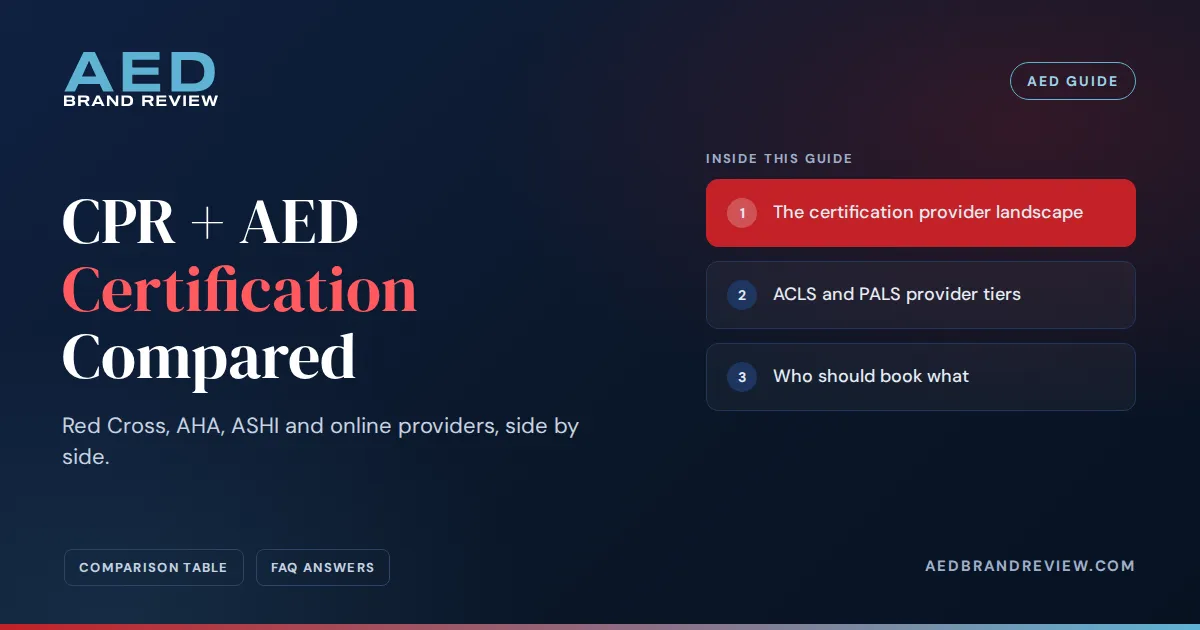
The CPR/AED certification market in the U.S. is competitive but uneven. A Heartsaver CPR/AED card costs anywhere from $45 at a community fire department course to $160+ through a premium hospital program, same card, same legal acceptance, 3.5× price spread. Online-only courses advertised at $15 exist, but most aren’t accepted by state boards or employers. This guide is the complete pricing landscape across every major provider, what you actually get at each price point, and the hidden costs that surface after the first invoice.
The certification provider landscape
| Provider | Type | Course catalog | Acceptance |
|---|---|---|---|
| American Heart Association (AHA) | Nonprofit | Heartsaver · BLS · ACLS · PALS | Universal, every state, every employer |
| American Red Cross (ARC) | Nonprofit | Adult CPR/AED · BLS · Pediatric · Lifeguard | Universal , every state, every employer |
| ASHI / MEDIC First Aid | Private | Basic Plus · CPR PRO · BLS Renewal | Most states verify for healthcare-licensed roles |
| National Safety Council (NSC) | Nonprofit | CPR & AED · First Aid | Most workplace contexts |
| EMS Safety Services | Private | CPR/AED for Lay Rescuer | Most workplace contexts |
| Local fire department/community programs | Public | Heartsaver or equivalent (often AHA-affiliated) | Universal |
| Online-only providers | Private | “Certificate”, knowledge only, no skills check | Limited, varies by employer; not accepted by most state-licensed boards |
Training is one cost. Keeping the AED usable is the other.
A certified rescuer and an AED with expired pads is still a failed rescue. Here is what each model costs to keep rescue-ready.
All models: pads and battery costs · Philips parts · ZOLL parts
Heartsaver CPR/AED cost comparison (the most common course)
| Channel | Format | Typical cost | Best for |
|---|---|---|---|
| Local fire department | In-person classroom | $45 to $70 | Individuals, community members |
| Community college continuing ed | In-person classroom | $55 to $85 | Individuals, small groups |
| YMCA / community center | In-person classroom | $55 to $90 | Individuals |
| Independent training center (Red Cross authorized) | Blended (online + skills check) | $70 to $110 | Working adults, flexible scheduling |
| Independent training center (AHA authorized) | Blended (online + skills check) | $75 to $120 | Working adults, flexible scheduling |
| National training partner (e.g., AED Leader) | Blended or on-site | $80 to $120 (group rate) | Businesses, school districts, and group training |
| Hospital-based program | In-person classroom | $100 to $160 | Healthcare workers |
| Workplace on-site (instructor travels to you) | In-person on-site | $80 to $140 per person (10+) | Multi-employee batch training |
BLS for Healthcare Providers cost comparison
BLS is the healthcare-provider tier required by most nursing, dental hygiene, EMS, and certain dental boards. It’s a longer course (3 to 4 hours vs ~2.5) and covers 2-rescuer CPR and bag-mask ventilation, skills Heartsaver does not cover.
| Channel | Format | Typical cost |
|---|---|---|
| Local fire department/community | In-person classroom | $55 to $80 |
| Independent AHA-authorized center | Blended (online + skills) | $75 to $130 |
| Hospital-based program | In-person classroom | $95 to $150 |
| National training partner (group) | Blended or on-site | $95 to $130 per person (10+) |
| BLS renewal (challenge exam) | Skills check only | $45 to $80 |
ACLS & PALS, advanced provider tiers
| Course | Audience | Initial cost | Renewal cost |
|---|---|---|---|
| ACLS (Advanced Cardiac Life Support) | Physicians, RNs, paramedics, and anesthesia | $200 to $350 | $150 to $250 (renewal/challenge) |
| PALS (Pediatric Advanced Life Support) | Pediatric providers, ER staff | $200 to $350 | $150 to $250 (renewal/challenge) |
| NRP (Neonatal Resuscitation Program) | OB, neonatal staff | $80 to $200 | $45 to $120 (renewal) |
Format comparison, what each option actually delivers
| Format | Pros | Cons | Acceptance |
|---|---|---|---|
| In-person classroom | Hands-on the entire time · best for first-time learners · instructor Q&A | Highest cost · least scheduling flexibility · time-intensive | Universal |
| Blended (online module + in-person skills) | Self-paced online · in-person skills check (1 hour vs 2.5) · same card | Requires both online completion + in-person scheduling | Universal (most popular format) |
| On-site (instructor travels to workplace) | No employee travel time · batch efficiency · custom scenarios | Minimum group size (typically 8 to 10) · scheduling coordination | Universal · best for employers |
| Online-only | Lowest cost · instant convenience · self-paced | NO in-person skills check · NOT accepted by most state boards or healthcare employers | Limited |
The hidden costs most buyers miss
1. Recertification cycle
Certifications expire in 2 years (sometimes annually by employer policy). Multiply your initial cost by ~5 cycles over a 10-year career. A $95 initial AHA Heartsaver card = $475 over 10 years in recertifications.
2. Skills check fee (for blended)
Some online providers charge separately for the in-person skills evaluation. Verify the total cost includes both modules before booking.
3. Card replacement fees
Lost cards typically cost $10 to $25 to replace. AHA and ARC now offer e-cards by default that don’t get lost.
4. Travel + paid employee time
For employers, the cost of paid employee time during training can add 50 to 100 per cent on top of the course cost. A $100 Heartsaver course for a $30/hour employee adds ~$75 in paid time (2.5 hr) = effective $175 total cost per employee.
5. Test failure remediation
Most providers allow a single retake at no charge. Multiple failures require re-enrollment. Rare but worth knowing.
Group pricing economics
| Group size | Typical discount vs individual | Best format |
|---|---|---|
| 1 to 5 people | 0 to 5% | Open a public class |
| 6 to 15 people | 10 to 15% | On-site instructor or scheduled group class |
| 16 to 30 people | 15 to 25% | On-site batch (employer pays instructor day-rate) |
| 30+ people (multi-day) | 20 to 35% | Multi-day on-site with rotating cohorts |
For a school district training 100 staff annually, group rates can drop per-person cost from $95 to $70, saving $2,500/year. Most national training partners (including AED Leader) offer fleet pricing structures.
The “free CPR certification” reality
Some sources advertise free CPR training:
- Local fire department community classes, Free or low-cost ($0 to $30). Limited scheduling. Often AHA-aligned.
- American Red Cross community days, Occasional free or sponsored events.
- Hands-Only CPR training (10-minute videos), Truly free, but does NOT include certification or AED training. Useful awareness, not job-eligible certification.
Truly free, accredited, AED-inclusive certification is rare. If your employer requires it, expect to budget.
Recommendation matrix, who should buy what
Individuals (self-paying)
- Heartsaver CPR/AED, blended format, AHA or ARC, $70 to $100
- Local fire department in-person class if you prefer, fully in-person and low cost, $45 to $70
Small businesses (under 25 employees)
- Heartsaver CPR/AED, on-site instructor (8 to 15 employees), $85 to $110 per person
- Or send employees to public classes individually with reimbursement
Mid-size organizations (25 to 250 employees)
- National training partner with annual batch contract, $75 to $95 per person
- Consider in-house instructor certification if >500 employee certifications/year
School districts
- Pre-school-year batch training contract (July, August), $70 to $95 per person
- Consider Project ADAM integration for funded community programs
Replacing your AED pads or battery
AED pads and batteries expire on a fixed schedule whether the device is ever used or not, and they are the single most common reason an AED fails when it is needed. In the largest published analysis of FDA-reported AED events, 40,787 cases, batteries accounted for 23.2 per cent of failures and pads and connectors for 23.7 per cent, so 46.9 per cent of all AED failures are consumables (DeLuca et al., Annals of Emergency Medicine, 2012, PMID 21872969). Below is every current replacement part with its price and service life, verified against seller product data on 12 September 2026.
| Model | Adult pads | Battery | Pediatric option | 10 year consumable cost |
|---|---|---|---|---|
| Philips HeartStart OnSite | M5071A $99.00, 2 years | M5070A $249.00, 4 years | Separate M5072A cartridge, prescription only | About $894 |
| Philips HeartStart FRx | SMART Pads II 989803139261 $89.00, 2 years | M5070A $249.00, 4 years | Infant/Child Key $139.00, reusable | About $854 |
| ZOLL AED Plus | CPR-D Padz 8900-0800-01 $230.00, 5 years | Lithium set of 10 $100.00, 5 years | Pedi-padz II $155.00, 2 years | About $330, the lowest we track |
| ZOLL AED 3 | CPR Uni-padz 8900-000280-01 $234.00, 5 years | 8000-000696 $201.00, 5 years | None needed, Uni-padz cover children | About $435 |
| Defibtech Lifeline | DDP-100 $75.15 | DBP-1400, part DCF-200 $229.10 | DDP-200P $130.25 | About $530 |
| Defibtech Lifeline VIEW | DDP-2001 $83.05 | DCF-2003 $240.45 | DDP-2002 $136.40 | About $813 |
| HeartSine Samaritan PAD | Pad-Pak-01 $236.00, pads and battery in one cartridge | Included in the Pad-Pak, there is no separate battery | Pediatric Pad-Pak PAD-PAK-02 $279.00 | About $472 |
| Cardiac Science Powerheart G5 | XELAED001C $88.00 | XBTAED001A $495.00, 4 years | XELAED003C $127.00 | About $1,342, the highest we track |
| Physio-Control LIFEPAK CR2 | Quik-Step 11101-000021 $196.00, adult and child in one set | LIFEPAK CR2 lithium battery $341.00, about 4 years | None needed, the Quik-Step set covers children | Not published per part |
Prices verified against the public product data of AED Leader on 30 September 2026. Service life is the manufacturer figure where one is published; where it is not, check the expiry date printed on the part itself. Ten year consumable cost is our own calculation from those part prices and service lives.
Three things owners get wrong
- Buying the wrong Philips pad. The FRx uses SMART Pads II, part 989803139261. SMART Pads III belong to the FR3, a different device. The OnSite uses M5071A and the two are not interchangeable.
- Assuming the pediatric part is optional. On a ZOLL AED Plus, Pedi-padz II cost $155.00 and last two years, which is about $775 across a ten year life. On a ZOLL AED 3 or a LIFEPAK CR2 the pads already cover children and that cost is zero.
- Tracking the wrong date. HeartSine combines the pads and battery into one Pad-Pak cartridge, so there is a single expiry to track. Every other model here has two parts on two separate clocks.
Full replacement schedule by model is on our AED pads and batteries page. If you are still choosing a device, the ten year running cost is usually a bigger number than the discount you are negotiating: see every AED brand ranked by price and ten year cost.
Recertified prices across all seven models
Recertified units are the same models under the same FDA premarket approvals, restored, tested and sold with a minimum three year warranty.
| Model | New | Recertified | You keep | Buy |
|---|---|---|---|---|
| Philips HeartStart OnSite | $1,589 | $875 | $714 (45%) | AED Leader or Response Ready |
| Philips HeartStart FRx | $2,099 | $875 | $1,224 (58%) | AED Leader or Response Ready |
| ZOLL AED Plus | $2,082 | $875 | $1,207 (58%) | AED Leader or Response Ready |
| ZOLL AED 3 | $2,399 | $1,150 | $1,249 (52%) | AED Leader or Response Ready |
| HeartSine Samaritan PAD 350P | $1,411 | $875 | $536 (38%) | AED Leader or Response Ready |
| HeartSine Samaritan PAD 450P | $1,761 | $875 | $886 (50%) | AED Leader or Response Ready |
| Cardiac Science Powerheart G5 | $2,157 | $1,225 | $932 (43%) | AED Leader or Response Ready |
Prices verified 30 September 2026 against the public product data of both stores. Both list identical recertified prices, so buy from whichever fits your order size: AED Leader for one to four units, Response Ready for five or more and for compliance and fleet programmes. New prices are the AED Leader list price on the same date.
The honest risk. A recertified AED is a used device. The three year minimum warranty is what makes the saving worth taking. Read recertified versus new and how to choose a refurbished AED before you decide.
Healthcare facilities
- BLS for HCP through hospital-based program or AHA training center, $85 to $130
- ACLS / PALS for clinical providers as required by role
Budgeting training? Budget the device on the same sheet
A CPR and AED certificate is worth less if the building has no defibrillator, and most workplace policies buy both in the same year. For planning, a certificate runs from about $45 to $160 a person and a complete AED programme starts at $1,463.80.
| Line item | Typical cost | Where to buy |
|---|---|---|
| CPR and AED certification course | $45 to $160 per person | AED Leader group classes ($785 to $1,802 per class) |
| Complete AED package, lowest cost we track | $1,463.80 | Check price at AED Leader or Response Ready |
| Recertified device, lowest price we track | $875.00 | Check price at AED Leader or Response Ready |
| Consumables over ten years | about $330 to $1,342 depending on model | See the ten-year cost page |
The over-the-counter models, the HeartSine 350P and the Philips OnSite, need no prescription, which removes a step from the purchase.
Frequently Asked Questions
How much does CPR/AED certification cost in 2026?
Heartsaver CPR/AED runs $45 to $160 per person, depending on provider and format. BLS for Healthcare Providers runs $55 to $150. ACLS/PALS run $200 to $350. Group rates of 10 to 25% off are common.
Is the American Heart Association or the Red Cross cheaper?
They’re roughly equivalent at the same provider tier. The bigger cost variable is delivery channel, local fire department classes are cheapest ($45 to $70); hospital programs are most expensive ($100 to $160); national training partners (like AED Leader) sit in the middle for group buyers.
Are online-only CPR certifications legitimate?
For workplace lay-rescuer roles, sometimes, verify with your employer. For state-licensed roles (nursing, dental, EMS, childcare, lifeguard), no. Online-only courses lack the psychomotor skills evaluation that AHA, ARC, and most state boards require.
How long does CPR/AED certification last?
2 years for AHA and Red Cross. Some employers require an annual refresh as policy. Lapsed cards are not retroactively grace-period’d, non-compliance starts on the printed expiration date.
What’s the cheapest legitimate way to get certified?
Local fire department or community fire-rescue class, typically $45 to $70 for an in-person AHA-aligned Heartsaver course. Limited scheduling but fully accepted everywhere.
Can my employer pay for CPR certification?
Most do for the required roles. Even when not required, many employers reimburse certification costs as a safety/morale benefit. Ask HR. For tax purposes, employer-paid certification is typically a deductible business expense.
What’s the cheapest way to certify a team of 20?
On-site instructor batch training. Most national training partners offer $80 to $100 per person for groups of 15+, plus a fixed instructor day-rate. Total cost for 20 people is typically $1,800 to $2,200 vs $2,200 to $3,000 for an individual booking.
Buying the AED as well? Prices we verified today
Prices checked 30 September 2026 at AED Leader. Each link opens our full review with the buy path.
- Recertified Philips HeartStart OnSite review and price$875Save 45%Recertified, 3-year warrantyBuy at AED Leader
- Defibtech Lifeline AED review and price$1,478.80 to $1,659.15New, 8-year manufacturer warranty
- ZOLL AED 3 review and price$2,399New, 6-year warranty (8 with ZOLL registration)
Get your team certified the easy way.
Sources & References
- American Heart Association, Heartsaver Courses
- American Heart Association, BLS Course Options
- American Red Cross, CPR Training
- National Safety Council, First Aid Courses
- Published retail pricing across major U.S. training centers
Disclaimer: Training prices are typical published U.S. rates and vary by region and provider. Verify current pricing directly with providers before booking.