New AED program owners often ask the same question: “I have approval to buy our first AED, what do I actually do next?” The honest answer is that buying an AED is half procurement, half compliance, and a third of one, and you’re done in a week. The difference between a smooth deployment and a stalled one usually comes down to three quiet decisions made at the start. This guide walks through the entire 8-step process for anyone taking on this responsibility for the first time.
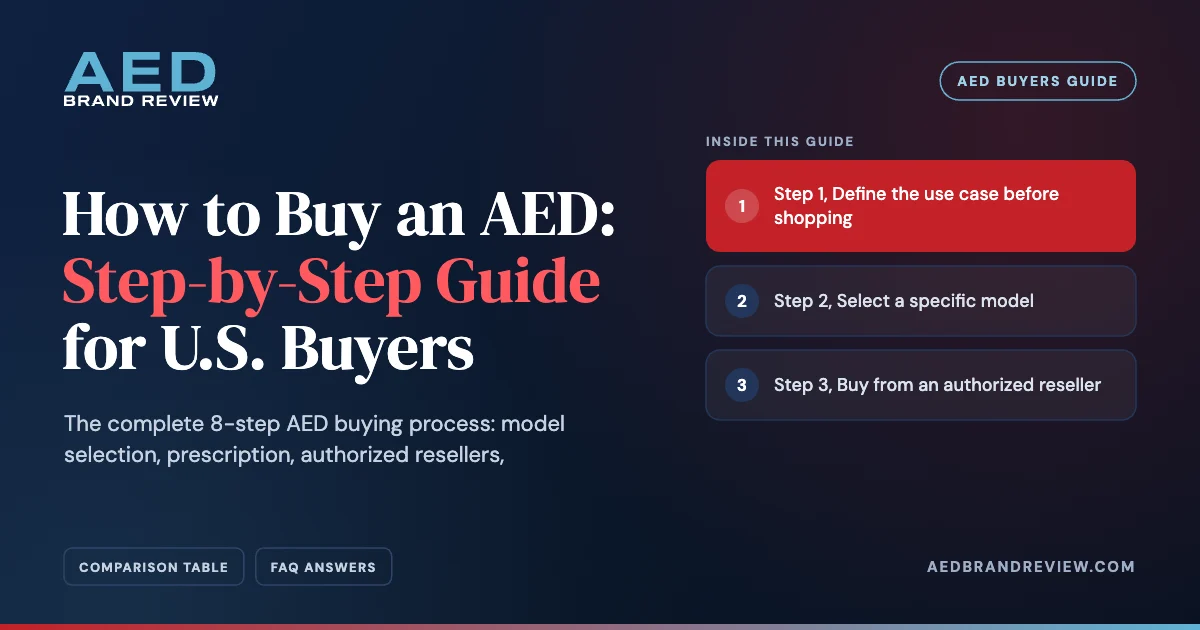
Quick AnswerBuying an AED in the U.S. is an 8-step process taking 1 to 3 weeks: (1) define your use case, (2) select a model, (3) buy from an authorized reseller (who provides the FDA-required physician prescription free), (4) order accompanying cabinet + signage, (5) install with the handle no higher than 48″ (ADA), (6) register with state DPH + PulsePoint, (7) schedule responder CPR/AED training, and (8) set the monthly inspection cadence. Expect $2,500 to $3,000 total for the first deployment.
Step 1, Define the use case before shopping
Most people start by browsing models. That’s backward. Start by writing down four things about your deployment: where the AED will sit (indoor/outdoor/mixed), who’s most likely to be the first responder (trained employee, untrained bystander, healthcare worker), whether children might be present (visitors count), and your total budget across 10 years, not just the upfront purchase.
This five-minute exercise eliminates 60% of the model universe before you look at a single spec sheet. An indoor office with adult-only employees and a $3,000 ten-year budget points to one set of devices; a school athletic field with pediatric exposure and a $5,000 budget points to a completely different set. The Find Your Perfect AED quiz automates this exact framing.
Step 2, Select a specific model
Once the use case is clear, narrow it to a specific make and model. Don’t shop by brand alone, Philips, ZOLL, HeartSine, Defibtech, LIFEPAK, and Cardiac Science each have multiple models targeting different deployments. A Philips HeartStart OnSite and a Philips HeartStart FRx look similar but differ in IP rating, pediatric pathway, and price by about $500. The model picks the right model; the brand follows.
Take the 2-minute quiz
Get a specific model recommendation matched to your use case, responder profile, pediatric needs, and budget. Scored against a 9-device U.S. database.
Step 3, Buy from an authorized reseller
This is where most first-time buyers lose money or compliance footing. AEDs and pads sold on Amazon, eBay, and marketplace third-party sellers carry real counterfeit risk, the FDA’s Safety Communications have flagged counterfeit AED pads repeatedly. Counterfeit pads can fail at the moment of cardiac arrest. They also void manufacturer warranties.
Manufacturer-authorized resellers handle the boring but critical parts of the transaction: they include the FDA-required physician prescription free with purchase, they ship OEM consumables, they honor warranties, and they provide return paths if the device arrives damaged. The major U.S. authorized resellers include AED Leader, Henry Schein Medical, Bound Tree Medical, and Cintas HealthCare. Buying through any of them is dramatically safer than the marketplace alternative.
Step 4, Order the cabinet, signage, and accessories
The AED ships with adult pads, the battery, the prescription, and the operator’s manual, that’s it. The cabinet, ISO 7010 signage, mounting hardware, and any pediatric pads are separate purchases. Order them at the same time as the device so they all arrive together.
| Accessory | Typical cost | When to buy |
|---|---|---|
| Wall cabinet (alarmed, non-heated) | $135 to $297 | Indoor public-access deployment |
| Heated outdoor cabinet | $600 to $1,200 | Outdoor deployment with sub-32°F winters |
| ISO 7010 E010 wall sign + flag sign | $25 to $60 | Every deployment |
| Pediatric pads (separate set) | $127 to $279 | Schools, daycare, family-facing facilities |
| Backup adult pads | $60 to $282 | Recommended one set in inventory |
| Maintenance log binder | $0 to $25 | Every deployment |
Step 5, Install the cabinet at the right height
The cabinet’s operating handle must sit no higher than 48 inches and no lower than 15 inches above the finished floor, that’s the ADA Standards for Accessible Design reach range. Above 48 inches and you’ve created a wheelchair-accessibility problem. Below 15 inches, and a kneeling rescuer struggles. Mount the ISO 7010 sign directly above the cabinet, and add a perpendicular “flag” sign that projects into the corridor so the cabinet is visible from down the hall. See our AED mounting, cabinet, and signage compliance guide for the full installation specs.
Step 6, Register with state EMS and PulsePoint
Most states require AED registration with the state Department of Health or the local Emergency Medical Services authority. Registration is free, takes about 10 minutes online, and gets your device on the 911 dispatch map, meaning a 911 caller anywhere near your facility can be directed to your AED in real time.
Also, register on PulsePoint AED Registry. PulsePoint integrates with 911 dispatch systems in over 4,000 U.S. communities and powers the bystander notification network that gets nearby CPR-trained citizens involved before EMS arrives. Skipping registration is one of the most common ways a brand-new AED program quietly fails. See our step-by-step EMS registration walkthrough.
Step 7, Train designated responders
Plan for at least 2 to 3 staff per operating shift to hold current Heartsaver CPR/AED certification, or BLS for Healthcare Providers if you’re in a clinical setting. Course cost runs $60 to $110 per person for Heartsaver, $75 to $130 for BLS. AED Leader and other AHA-aligned training partners run on-site batch courses for organizations with 6+ trainees, typically capturing a 10 to 15% group discount.
Step 8, Establish the inspection and program cadence
Day one of the program is the most important day for the next ten years. Set a recurring monthly calendar reminder for documented inspection. Designate a named program owner (by job title and by backup person). File the prescription, warranty card, and operator’s manual in a single labeled binder or shared-drive folder. Most program audit failures trace back to this exact first-month omission. Our AED program management playbook covers the year-round cadence.
Realistic timeline by facility type
Recertified prices across all seven models
Recertified units are the same models under the same FDA premarket approvals, restored, tested and sold with a minimum three year warranty.
| Model | New | Recertified | You keep | Buy |
|---|---|---|---|---|
| Philips HeartStart OnSite | $1,589 | $875 | $714 (45%) | AED Leader or Response Ready |
| Philips HeartStart FRx | $2,099 | $875 | $1,224 (58%) | AED Leader or Response Ready |
| ZOLL AED Plus | $2,082 | $875 | $1,207 (58%) | AED Leader or Response Ready |
| ZOLL AED 3 | $2,399 | $1,150 | $1,249 (52%) | AED Leader or Response Ready |
| HeartSine Samaritan PAD 350P | $1,411 | $875 | $536 (38%) | AED Leader or Response Ready |
| HeartSine Samaritan PAD 450P | $1,761 | $875 | $886 (50%) | AED Leader or Response Ready |
| Cardiac Science Powerheart G5 | $2,157 | $1,225 | $932 (43%) | AED Leader or Response Ready |
Prices verified 30 September 2026 against the public product data of both stores. Both list identical recertified prices, so buy from whichever fits your order size: AED Leader for one to four units, Response Ready for five or more and for compliance and fleet programmes. New prices are the AED Leader list price on the same date.
The honest risk. A recertified AED is a used device. The three year minimum warranty is what makes the saving worth taking. Read recertified versus new and how to choose a refurbished AED before you decide.
| Facility type | To install | Install to “fully running.” |
|---|---|---|
| Home / small business | 5 to 7 business days | Same week |
| Mid-size office (50+ staff) | 5 to 10 business days | 1 to 2 weeks (training scheduling) |
| K-12 school | 7 to 14 business days | 2 to 4 weeks (CERP + drill setup) |
| Multi-site enterprise | 10 to 20 business days | 4 to 8 weeks (fleet rollout) |
Five mistakes that delay or invalidate the purchase
- Buying on Amazon from a third-party seller. Counterfeit pads, no warranty, no prescription, no support path.
- Forgetting state mandate checks. Many states mandate AEDs in K-12 schools, fitness facilities, and dental sedation offices. See AED Laws by State.
- Mounting above 48 inches. An ADA violation that surfaces in audits.
- No designated program owner. Expirations get missed. Audits fail.
- Skipping registration. Can void Good Samaritan immunity in a handful of states.
Buying for a house rather than a workplace? Our AED for home use guide compares the two no-prescription models and what each costs to keep ready for ten years.
Frequently Asked Questions
How long does it take to buy and deploy an AED?
1 to 3 weeks from research to fully installed and trained. Procurement and shipping take about a week; the rest is installation, registration, and training scheduling.
Do I need to call my own doctor for the AED prescription?
No. Reputable resellers, AED Leader, Henry Schein, Bound Tree, include the physician prescription free with purchase. Your physician is not involved.
Can I buy an AED on Amazon?
Not recommended unless the listing is from a manufacturer-authorized seller. Third-party marketplace AED pads have a documented counterfeit problem flagged by the FDA.
Does the AED come with everything I need to deploy it?
You get the device, adult pads, battery, prescription, and operator’s manual. The cabinet, signage, pediatric pads, and training are separate purchases.
What’s the minimum total cost to fully deploy one AED?
About $2,500 to $3,000 for device + cabinet + signage + initial training of 2 staff in most workplace settings.
Do I need a prescription if I’m buying a home AED?
Usually yes. Two AED families are FDA-approved (PMA) for over-the-counter sale: the Philips HeartStart OnSite/Home and the HeartSine samaritan PAD 350P. Every other AED needs a prescription, which resellers include free.
Should my AED be indoor-only or outdoor-rated?
If there’s any chance it’ll be deployed outside (athletic field, pool deck, marina, construction trailer), choose IP55+ (Philips FRx, ZOLL AED Plus, HeartSine PAD 350P/360P/450P). Indoor-only saves about $300.
How many AEDs does my facility actually need?
For most single-floor facilities under 50,000 sq ft, one centrally placed AED satisfies the AHA 3-minute rule. Larger or multi-floor facilities need more. Use the AED Quantity Calculator for site-specific math.
What’s the difference between Heartsaver CPR/AED and BLS training?
Heartsaver is the lay-rescuer course (2.5 to 3 hours, $60 to $110). BLS is the healthcare-provider course (3 to 4 hours, $75 to $130) required for nurses, paramedics, and many dental clinical staff.
Can my employer pay for the AED on a corporate card?
Yes, and in most cases, the purchase qualifies as a Section 179 deductible business expense in the year of purchase. See AED tax deductions.
What’s the cheapest legitimate AED I can buy?
The Defibtech Lifeline at $1,478.80 is American-made with an 8-year warranty, but the HeartSine samaritan PAD 350P at $1,411 at AED Leader is the lowest-priced new AED we track.
Is a refurbished AED a real option?
Yes, from an FDA-registered refurbisher, refurbished AEDs are FDA-approved and run about 38 to 58% below new at AED Leader, with a minimum three-year warranty. See Refurbished vs New AEDs.
Should I register the AED with the manufacturer, too?
Yes, mail the warranty registration card or register online within 30 days of receipt. This activates your warranty and ensures you receive direct recall notifications.
What happens if my AED arrives damaged?
Photograph the damage before opening the device, and notify the seller within 48 hours. Authorized resellers accept returns and replacements for damage-on-receipt.
How long does the AED itself last before needing replacement?
Most consumer-grade AEDs have a deployed life of 8 to 10 years before manufacturer service support ends. Plan for replacement around year 8 to 10.
Take the quiz, 2 minutes, free.
Sources & References
Disclaimer: State and facility-specific compliance overlays exist. Verify with counsel and your state Department of Health before deployment.