The most common AED-buying question on Google is some version of “do I really need a prescription to buy this?” The answer is yes, and also, you don’t actually have to do anything. The FDA requires a physician’s prescription for nearly every AED sold in the United States, but reputable resellers handle the prescription as part of the purchase. You won’t ever speak to a physician, sign a form, or pay an additional fee. Here’s how the regulatory framework actually works in practice.
Quick AnswerThe FDA classifies AEDs as Class III medical devices and requires a physician’s prescription for most U.S. AED sales. In practice, manufacturer-authorized resellers (AED Leader, Henry Schein, Bound Tree) provide the prescription free as part of the standard purchase. Buyers don’t contact their own physician. The Philips HeartStart Home was approved for over-the-counter sale in 2004. Today the OTC exceptions are the HeartStart Home and OnSite and the HeartSine samaritan PAD 350P (approved for OTC sale in 2022), though most retailers still process a prescription for documentation purposes.
Philips HeartStart OnSite at AED Leader, $1,589
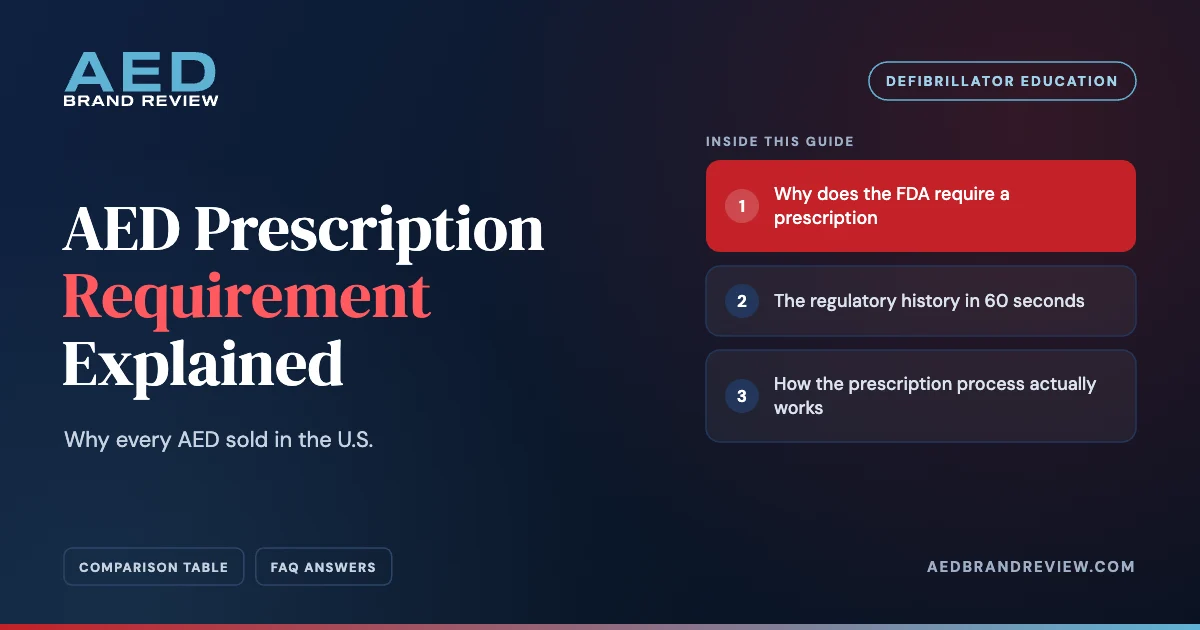
Why does the FDA require a prescription
AEDs sit at the highest tier of FDA medical device classification: Class III. That tier includes devices that “support or sustain human life”, implantable defibrillators, heart valves, dialysis equipment. Class III devices require Premarket Approval (PMA), ongoing manufacturer quality-system audits, and prescription-only distribution unless the FDA specifically approves the device for OTC sale.
The prescription requirement, codified under the Food, Drug, and Cosmetic Act and FDA regulation 21 CFR 801.109, ensures that every AED enters service through medically supervised channels. It’s not about gatekeeping access; it’s about traceability. Every AED has a known chain of custody from manufacturer to deployed location.
The regulatory history in 60 seconds
From the 1990s through 2004, every U.S. AED required prescription distribution. In September 2004, the FDA approved over-the-counter sale specifically for the Philips HeartStart Home Defibrillator, the first AED to receive OTC status. The approval was paired with a labeling change emphasizing simplified bystander operation. The HeartStart OnSite shares that OTC status, and in 2022 the FDA approved the HeartSine samaritan PAD 350P for OTC sale (the 360P and 450P still need a prescription). Most other manufacturers have not pursued OTC approval, partly because their distribution model already runs through reseller-handled prescriptions without buyer friction.
How the prescription process actually works
1
You order the AED from an authorized reseller
AED Leader, Henry Schein Medical, Bound Tree, Cintas HealthCare. The order form captures basic information about the organization purchasing and the deployment location.
2
The reseller’s contracted physician issues a prescription
Authorized resellers maintain ongoing contracts with licensed physicians who issue prescriptions for AED sales at scale. The prescription is generated automatically as part of the order workflow at no additional cost.
3
The prescription ships with the device
The physical prescription document arrives in the AED box. File it in your AED program records, auditors and state DPH may request it during compliance reviews.
What’s actually on the prescription
- Prescribing physician’s name and state license number
- Patient name (your organization name)
- Device make, model, and serial number
- Date of issue
- Authorization statement for purchase and intended use
That’s it. It’s a one-page document, not a clinical record. The legal function is to satisfy the FDA distribution requirement and to document the device’s chain of custody.
The Philips HeartStart Home OTC exception
The Philips HeartStart Home (the residential-marketed version of the HeartStart OnSite) is available without a prescription, as are the OnSite itself and the HeartSine samaritan PAD 350P. In practice, even most online retailers selling the HeartStart Home process a prescription for documentation purposes, partly because the rest of their compliance workflow is built around prescription tracking and partly because some state DPH AED registration portals request the prescription regardless.
If you’re buying a home AED purely for residential use and want to skip any documentation friction, the HeartStart Home, OnSite or HeartSine 350P is the path of least resistance. For any business, school, or facility deployment, the prescription gets processed routinely.
State variations, and why there really aren’t any
The prescription requirement is set federally by the FDA (21 CFR 801.109), and we know of no state that adds a separate AED prescription requirement on top of the federal floor. States do regulate AED registration, mandatory placement, and training, but the prescription step is identical across all 50 states. Verify state-level compliance using our AED Laws by State hub.
Compliance implications, why the prescription matters
Three reasons to file the prescription carefully:
- State AED registration. Several state Department of Health AED registration portals request prescription documentation as part of the registration record.
- Audit defense. A documented prescription + chain of custody is part of a defensible AED program file.
- Resale or relocation. If you ever sell or relocate the device, the original prescription documents the device’s regulatory provenance.
What happens if you buy an AED without a prescription
The seller, not you, has technically violated FDA regulations. Practically, three problems for the buyer follow:
- Manufacturer warranties may not be honored if the device is entered into distribution outside authorized channels
- State registration may be incomplete
- Counterfeit pads and consumables are statistically more likely from non-authorized sellers
Avoid the problem by buying through authorized resellers from the start.
Find the right AED first
Match a specific model to your use case, then order from an authorized reseller who handles the prescription automatically.
Replacing your AED pads or battery
AED pads and batteries expire on a fixed schedule whether the device is ever used or not, and they are the single most common reason an AED fails when it is needed. In the largest published analysis of FDA-reported AED events, 40,787 cases, batteries accounted for 23.2 per cent of failures and pads and connectors for 23.7 per cent, so 46.9 per cent of all AED failures are consumables (DeLuca et al., Annals of Emergency Medicine, 2012, PMID 21872969). Below is every current replacement part with its price and service life, verified against seller product data on 12 September 2026.
| Model | Adult pads | Battery | Pediatric option | 10 year consumable cost |
|---|---|---|---|---|
| Philips HeartStart OnSite | M5071A $99.00, 2 years | M5070A $249.00, 4 years | Separate M5072A cartridge, prescription only | About $894 |
| Philips HeartStart FRx | SMART Pads II 989803139261 $89.00, 2 years | M5070A $249.00, 4 years | Infant/Child Key $139.00, reusable | About $854 |
| ZOLL AED Plus | CPR-D Padz 8900-0800-01 $230.00, 5 years | Lithium set of 10 $100.00, 5 years | Pedi-padz II $155.00, 2 years | About $330, the lowest we track |
| ZOLL AED 3 | CPR Uni-padz 8900-000280-01 $234.00, 5 years | 8000-000696 $201.00, 5 years | None needed, Uni-padz cover children | About $435 |
| Defibtech Lifeline | DDP-100 $75.15 | DBP-1400 $229.10 | DDP-200P $130.25 | About $530 |
| Defibtech Lifeline VIEW | DDP-2001 $83.05 | DCF-2003 $240.45 | DDP-2002 $136.40 | About $813 |
| HeartSine Samaritan PAD | Pad-Pak-01 $236.00, pads and battery in one cartridge | Included in the Pad-Pak, there is no separate battery | Pediatric Pad-Pak PAD-PAK-02 $279.00 | About $472 |
| Cardiac Science Powerheart G5 | XELAED001C $88.00 | XBTAED001A $495.00, 4 years | XELAED003C $127.00 | About $1,342, the highest we track |
| Physio-Control LIFEPAK CR2 | Quik-Step 11101-000021 $196.00, adult and child in one set | LIFEPAK CR2 lithium battery $341.00, about 4 years | None needed, the Quik-Step set covers children | Not published per part |
Prices verified against the public product data of AED Leader on 30 September 2026. Service life is the manufacturer figure where one is published; where it is not, check the expiry date printed on the part itself. Ten year consumable cost is our own calculation from those part prices and service lives: the replacement parts bought within ten years, after the first set that comes with the device.
Three things owners get wrong
- Buying the wrong Philips pad. The FRx uses SMART Pads II, part 989803139261. SMART Pads III belong to the FR3, a different device. The OnSite uses M5071A and the two are not interchangeable.
- Assuming the pediatric part is optional. On a ZOLL AED Plus, Pedi-padz II cost $155.00 and last two years, which is about $775 across a ten year life. On a ZOLL AED 3 or a LIFEPAK CR2 the pads already cover children and that cost is zero.
- Tracking the wrong date. HeartSine combines the pads and battery into one Pad-Pak cartridge, so there is a single expiry to track. Every other model here has two parts on two separate clocks.
Full replacement schedule by model is on our AED pads and batteries page. If you are still choosing a device, the ten year running cost is usually a bigger number than the discount you are negotiating: see every AED brand ranked by price and ten year cost.
What about used or refurbished AEDs?
Refurbished AEDs from FDA-registered refurbishers ship with a new prescription documenting the refurbishing organization’s authorization to redistribute. The original manufacturer’s prescription doesn’t transfer. Used AEDs sold through marketplace channels typically lack a transferable prescription, another reason refurbished-from-registered-refurbisher beats marketplace used.
International AED imports
FDA distribution rules apply to any AED sold in U.S. commerce, including imports. Importing a non-U.S. AED for personal use technically requires the same prescription framework, and most international AED models are not FDA-approved. Stick with FDA-approved, U.S.-distributed devices.
Frequently Asked Questions
Do I really need a prescription for an AED?
Yes, federal FDA requirement for most models (the Philips HeartStart Home and OnSite and the HeartSine 350P are OTC). The reseller handles it for free as part of the purchase, so you won’t need to involve your own physician.
How do I get an AED prescription?
Buy from a manufacturer-authorized reseller. The reseller’s contracted physician issues the prescription as part of the standard order process.
Is there an AED I can buy without a prescription?
Yes. The Philips HeartStart Home and OnSite and the HeartSine samaritan PAD 350P are FDA-approved for over-the-counter sale. Many retailers still process a prescription for documentation even on OTC sales.
What does an AED prescription cost?
$0 when included free with purchase from an authorized reseller. Standalone prescriptions from third-party services typically cost $25 to $75.
What if my reseller doesn’t include a prescription?
Use a different reseller. Reputable U.S. AED retailers always include the prescription as part of the standard purchase.
Does the prescription expire?
The original prescription stays valid for the life of the device. New device purchases require new prescriptions.
Can I use one prescription for multiple AEDs?
No, each AED needs its own prescription. Authorized resellers issue them per device as part of bulk fleet orders.
What state laws affect the AED prescription?
None, the prescription requirement is federal (FDA), and we know of no state that adds its own prescription rules. States regulate placement, registration, and training, not the prescription itself.
Do home AEDs require a prescription?
Yes, except the Philips HeartStart Home and OnSite and the HeartSine samaritan PAD 350P, which are FDA-approved for over-the-counter sale.
What happens if I lose the prescription?
Contact your original reseller. Most can reissue or provide a duplicate from their records.
Does Medicare cover an AED purchase?
Generally, no, AEDs aren’t typically covered under Medicare durable medical equipment. The wearable LifeVest is a separate category covered for specific cardiac diagnoses.
Can I deduct the AED purchase on my taxes?
For business purchases, generally yes, under IRS Section 179. For personal home AED purchases, sometimes via HSA/FSA. See AED tax deductions.
How long does the reseller take to process the prescription?
Typically, same-day to 24 hours, it’s part of the standard order workflow, not a separate step you wait on.
Can a nurse practitioner prescribe an AED?
In most states, yes, nurse practitioners and physician assistants can prescribe per state scope-of-practice rules. Reseller-contracted prescribers are typically physicians, but state-licensed NPs are also acceptable.
Is the AED prescription tracked in any national database?
No central database. The reseller maintains records, and many state DPH registries capture device serial + prescription reference at AED registration.
Get hands-on AED training in under 3 hours.
Sources & References
Disclaimer: Regulatory framework as of September 2026. Verify current FDA guidance with the reseller before purchase.