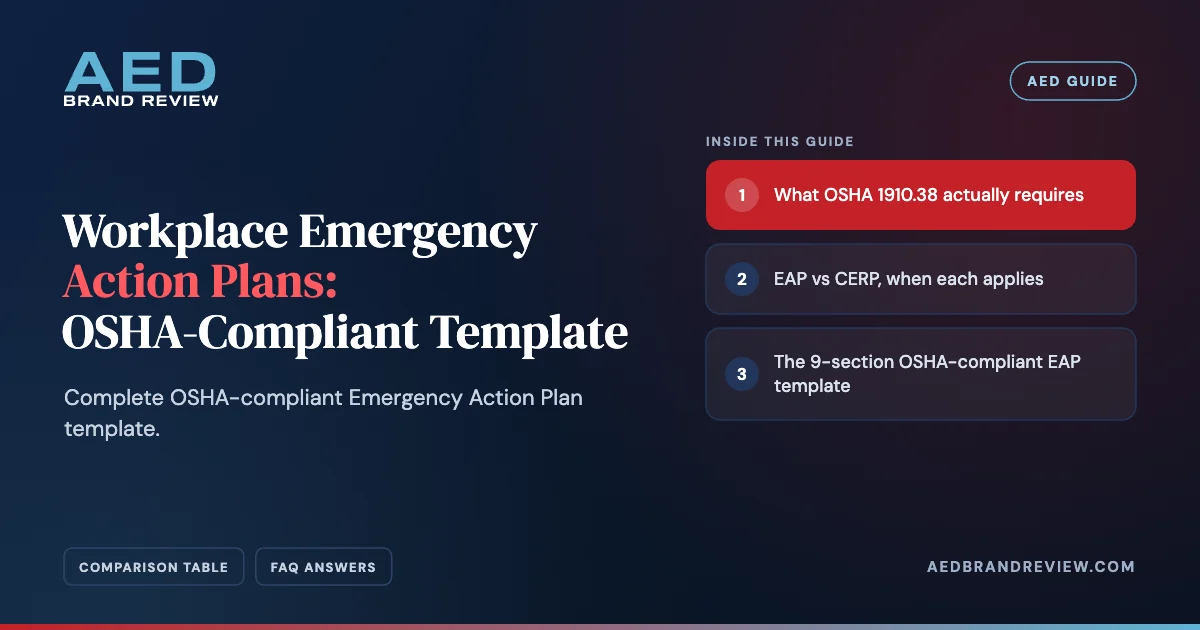
OSHA requires a written Emergency Action Plan (EAP) under 29 CFR 1910.38 whenever another OSHA standard calls for one, for example where employees evacuate rather than fight fires. The EAP covers fire response, evacuation, severe weather, and medical emergencies, including, increasingly, sudden cardiac arrest. For organizations with AEDs on site, the cardiac response sits inside the EAP rather than as a separate document, and the way it’s integrated determines whether the AED is part of an executable plan or a checkbox on the wall. This guide is the complete OSHA-aligned EAP framework with explicit AED integration, what the regulation requires, how to draft it, who needs to participate, and a template structure your facility can populate.
What OSHA 1910.38 actually requires
Per 29 CFR 1910.38, an EAP must be in writing, kept in the workplace, and available for employee review. Workplaces with 10 or fewer employees may communicate the plan orally. The plan must include, at a minimum:
- Procedures for reporting a fire or other emergency
- Procedures for emergency evacuation, including types of evacuation and exit route assignments
- Procedures to account for all employees after evacuation
- Procedures to be followed by employees performing rescue or medical duties
- Procedures for employees who remain to operate critical plant operations before they evacuate (medical and AED procedures are a best-practice addition, not an OSHA minimum)
- Name or job title of every employee who may be contacted by employees who need more information about the plan
- An employee alarm system that complies with 29 CFR 1910.165
EAP vs CERP, when each applies
| Document | Scope | Required by | Audience |
|---|---|---|---|
| Emergency Action Plan (EAP) | Broad, fire, weather, evacuation, medical | OSHA 1910.38 (when another OSHA standard requires one) | OSHA compliance, employer-wide |
| Cardiac Emergency Response Plan (CERP) | Narrow, cardiac arrest response specifically | ~21 state K-12 mandates, AHA recommendation | Schools, fitness facilities, dental, and healthcare |
| Best practice | Both | , | CERP integrated into or appended to EAP |
For most U.S. workplaces with AEDs, the EAP is the umbrella document; the CERP is the cardiac-specific section within it.
The 9-section OSHA-compliant EAP template
1
Facility Information & Plan Overview
Facility name, address, occupancy, total employees, hours of operation, primary contact, plan effective date, plan revision history.
2
Emergency Reporting Procedures
How to report emergencies internally (phone tree, intercom, employee alarm). External reporting (911 dial-out instructions, address of facility). Designated reporters per shift.
3
Evacuation Procedures & Routes
Primary and secondary evacuation routes per floor. Posted floor plans. Exit assignments by area. Special procedures for employees with disabilities. Designated assembly areas outside the building.
4
Accountability Procedures
How employees are accounted for after evacuation. Designated headcount role per area. Reporting to the facility manager. Notification to the fire department of any unaccounted persons.
5
Rescue & Medical Duties, INCLUDING AED RESPONSE
Designated medical responders by name. AED locations on floor plans. Cardiac emergency response sequence (CERP integration). Other medical scenarios (choking, bleeding, allergic reaction). Triage protocol if multiple injuries.
6
Emergency Reporting Contacts
911, local police, local fire department, EMS, poison control. Facility manager, HR director, security. Key vendors (HVAC, electrical) for facility issues. Insurance broker for incident reporting.
7
Training & Drills
Initial training schedule for new employees. Annual refresher training schedule. Fire evacuation drill cadence (typically annually). Cardiac response drill cadence (semi-annually). Documentation of all training and drills.
8
Roles & Responsibilities
Named individuals (not just titles) for: plan owner, evacuation coordinator, medical response lead, accountability coordinator, EMS liaison, communications lead. With designated backups for each role.
9
Plan Review & Revision
Review cadence (minimum annually). Revision triggers (facility layout change, staffing changes, regulatory updates, post-incident lessons learned). Version control. Distribution log.
Integrating AED response into Section 5
The medical-duties section is where the AED response lives in the EAP. A complete AED-integrated medical-duties section includes:
- AED locations, physical address, building, floor, room. Floor-plan diagram attached.
- Trained responders, designated by name and shift, with current certification expiration dates.
- Response sequence , discovery → 911 → AED retrieval → CPR → AED deployment → EMS handoff.
- EMS coordination, facility access for EMS, designated greeter role, elevator hold (multi-floor).
- Post-event procedures , pad replacement, incident report, debrief, and state EMS deployment reporting.
- Pediatric considerations, pediatric pad availability if children are on-site (visitors, daycare, family events).
Training requirements under 1910.38
OSHA requires the employer to designate and train employees to assist in safe evacuation and emergency response. Training must occur:
- At the initial plan development
- When new employees are hired into covered roles
- When the plan changes
- When an employee’s responsibilities under the plan change
For AED-integrated EAPs, this typically means annual Heartsaver CPR/AED certification for designated medical responders plus annual EAP refresher for all employees. See AED Training Requirements by State for certification specifics.
The 11-employee threshold and exceptions
Workplaces with 10 or fewer employees are exempt from the written EAP requirement and may communicate the plan orally. However, “small employer” exemptions don’t apply to:
- Specific industries with their own standards (e.g., 1910.119 process safety management)
- State plans that may impose stricter requirements
- Workplaces with hazardous materials or specific OSHA-regulated equipment
Even where not required, a written EAP is strongly recommended for any workplace , insurance carriers, leasing agreements, and tort defense all benefit from documented planning.
Common EAP audit findings
✓ Audit-ready EAPs include
- Named individuals with current contact info
- Floor-plan diagrams with evacuation routes + AED locations
- Documented training records for designated responders
- Annual review date and revision history
- Distribution log (employees acknowledged receipt)
- Drill documentation with outcomes
✗ Common audit failures
- A plan exists, but no one knows where it is
- Named responders no longer work there
- Last revised 5+ years ago despite facility changes
- No documented drill history
- Generic language not tailored to the facility
- AED section limited to “call 911” with no responder roles
How to draft your EAP, a 4-week process
Week 1 · Team formation & kickoff
Convene EHS lead + HR + facilities + safety committee. Designate plan owner. Schedule site walkthrough.
Week 2 · Site walkthrough & data collection
Photograph and document evacuation routes, exits, alarms, AED locations, and assembly areas. Verify floor plans are current. Map employee assignments to areas.
Week 3 · Template population
Fill the 9-section template with facility-specific data. Draft response sequences. Compile contact lists.
Week 4 · Review, training, distribution
Internal review by HR + legal counsel. Train designated responders on their roles. Distribute to all employees. File the master copy in the HR and facility manager’s office.
Industry-specific EAP examples
Industry case · Manufacturing
500,000 sq ft food-processing plant
EAP integrates fire response, ammonia leak response (cold-chain refrigeration), and cardiac response. The AED program covers 6 deployed devices across the production floor, break rooms, and the maintenance shop. Shift coverage means at least 2 trained responders on every shift, including overnight. CERP appended to EAP Section 5. The annual drill schedule includes both fire evacuation and cardiac response scenarios. Documented in the plant safety management system, reviewed annually.
Replacing your AED pads or battery
AED pads and batteries expire on a fixed schedule whether the device is ever used or not, and they are the single most common reason an AED fails when it is needed. In the largest published analysis of FDA-reported AED events, 40,787 cases, batteries accounted for 23.2 per cent of failures and pads and connectors for 23.7 per cent, so 46.9 per cent of all AED failures are consumables (DeLuca et al., Annals of Emergency Medicine, 2012, PMID 21872969). Below is every current replacement part with its price and service life, verified against seller product data on 12 September 2026.
| Model | Adult pads | Battery | Pediatric option | 10 year consumable cost |
|---|---|---|---|---|
| Philips HeartStart OnSite | M5071A $99.00, 2 years | M5070A $249.00, 4 years | Separate M5072A cartridge, prescription only | About $894 |
| Philips HeartStart FRx | SMART Pads II 989803139261 $89.00, 2 years | M5070A $249.00, 4 years | Infant/Child Key $139.00, reusable | About $854 |
| ZOLL AED Plus | CPR-D Padz 8900-0800-01 $230.00, 5 years | Lithium set of 10 $100.00, 5 years | Pedi-padz II $155.00, 2 years | About $330, the lowest we track |
| ZOLL AED 3 | CPR Uni-padz 8900-000280-01 $234.00, 5 years | 8000-000696 $201.00, 5 years | None needed, Uni-padz cover children | About $435 |
| Defibtech Lifeline | DDP-100 $75.15 | DBP-1400, part DCF-200 $229.10 | DDP-200P $130.25 | About $530 |
| Defibtech Lifeline VIEW | DDP-2001 $83.05 | DCF-2003 $240.45 | DDP-2002 $136.40 | About $813 |
| HeartSine Samaritan PAD | Pad-Pak-01 $236.00, pads and battery in one cartridge | Included in the Pad-Pak, there is no separate battery | Pediatric Pad-Pak PAD-PAK-02 $279.00 | About $472 |
| Cardiac Science Powerheart G5 | XELAED001C $88.00 | XBTAED001A $495.00, 4 years | XELAED003C $127.00 | About $1,342, the highest we track |
| Physio-Control LIFEPAK CR2 | Quik-Step 11101-000021 $196.00, adult and child in one set | LIFEPAK CR2 lithium battery $341.00, about 4 years | None needed, the Quik-Step set covers children | Not published per part |
Prices verified against the public product data of AED Leader on 30 September 2026. Service life is the manufacturer figure where one is published; where it is not, check the expiry date printed on the part itself. Ten year consumable cost is our own calculation from those part prices and service lives.
Three things owners get wrong
- Buying the wrong Philips pad. The FRx uses SMART Pads II, part 989803139261. SMART Pads III belong to the FR3, a different device. The OnSite uses M5071A and the two are not interchangeable.
- Assuming the pediatric part is optional. On a ZOLL AED Plus, Pedi-padz II cost $155.00 and last two years, which is about $775 across a ten year life. On a ZOLL AED 3 or a LIFEPAK CR2 the pads already cover children and that cost is zero.
- Tracking the wrong date. HeartSine combines the pads and battery into one Pad-Pak cartridge, so there is a single expiry to track. Every other model here has two parts on two separate clocks.
Full replacement schedule by model is on our AED pads and batteries page. If you are still choosing a device, the ten year running cost is usually a bigger number than the discount you are negotiating: see every AED brand ranked by price and ten year cost.
Recertified prices across all seven models
Recertified units are the same models under the same FDA premarket approvals, restored, tested and sold with a minimum three year warranty.
| Model | New | Recertified | You keep | Buy |
|---|---|---|---|---|
| Philips HeartStart OnSite | $1,589 | $875 | $714 (45%) | AED Leader or Response Ready |
| Philips HeartStart FRx | $2,099 | $875 | $1,224 (58%) | AED Leader or Response Ready |
| ZOLL AED Plus | $2,082 | $875 | $1,207 (58%) | AED Leader or Response Ready |
| ZOLL AED 3 | $2,399 | $1,150 | $1,249 (52%) | AED Leader or Response Ready |
| HeartSine Samaritan PAD 350P | $1,411 | $875 | $536 (38%) | AED Leader or Response Ready |
| HeartSine Samaritan PAD 450P | $1,761 | $875 | $886 (50%) | AED Leader or Response Ready |
| Cardiac Science Powerheart G5 | $2,157 | $1,225 | $932 (43%) | AED Leader or Response Ready |
Prices verified 30 September 2026 against the public product data of both stores. Both list identical recertified prices, so buy from whichever fits your order size: AED Leader for one to four units, Response Ready for five or more and for compliance and fleet programmes. New prices are the AED Leader list price on the same date.
The honest risk. A recertified AED is a used device. The three year minimum warranty is what makes the saving worth taking. Read recertified versus new and how to choose a refurbished AED before you decide.
Industry case · Corporate office
Multi-tenant 30-floor office tower
Each employer tenant maintains its own EAP. Building owner maintains property-level EAP including AED locations in lobbies and amenity floors. Coordination between tenant and property EAPs documented. Evacuation routes follow standardized floor-plan diagrams posted near every elevator and stairwell. Tenant cardiac response sequences integrate with property-level AED placement. See our multi-floor placement guide.
Frequently Asked Questions
Does my workplace need an Emergency Action Plan?
Per OSHA 29 CFR 1910.38, a written EAP is required whenever another OSHA standard calls for one, such as the fire extinguisher or process safety rules. Workplaces with 10 or fewer employees may communicate the plan orally. Specific industries (process safety management, hazardous materials) have additional requirements regardless of employee count.
What’s the difference between an EAP and a CERP?
An EAP is broader, fire, evacuation, weather, and medical, required by OSHA. A CERP is narrower, cardiac arrest response , required by state mandates for schools, fitness, dental, and healthcare. Best practice integrates the CERP into the EAP’s medical-duties section.
How often must an EAP be reviewed?
OSHA requires review when conditions change, facility layout, staffing, regulations, and post-incident. Best practice: annual review with documented revision date and version control.
Who can write the EAP?
Typically, an EHS officer, safety committee chair, HR director, or facilities manager. Final review by legal counsel is recommended. The plan must be developed in consultation with employees in covered roles.
What training does the EAP require?
Per 1910.38, employers must train designated employees at plan development, on hire, when the plan changes, and when employee responsibilities change. AED-integrated EAPs typically require annual Heartsaver CPR/AED for designated responders plus annual EAP refresher for all employees.
Does the EAP need to cover AED response?
OSHA doesn’t specifically mandate AED inclusion in the EAP. However, if AEDs are on-site, integrating them into the medical-duties section is best practice and supports General Duty Clause defensibility. State mandates may explicitly require AED procedures.
What happens if OSHA finds our EAP non-compliant?
Citations and fines depend on severity. OSHA’s 2025 maximum penalty for a serious or other-than-serious violation is $16,550 per violation. Willful or repeated violations can reach $165,514 each (2025 figures).
Get your team certified the easy way.
Sources & References
Disclaimer: OSHA enforcement decisions are case-specific. This article is informational. Consult safety counsel and your local OSHA Area Office for specific guidance.