Twelve verifications separate a smooth AED purchase from one that gets stuck or invalidated post-deployment. Most aren’t obvious until something goes wrong six months later, a missed state mandate, a wrong-rating device, a designated owner who quietly left the organization. Run this list before you click Buy. The whole exercise takes 60 to 90 minutes and prevents thousands of dollars of expensive corrections.
Quick AnswerTwelve checks before AED purchase: (1) use case clearly defined, (2) state mandate verified, (3) pediatric needs identified, (4) IP rating matches environment, (5) brand standardization considered, (6) 10-year TCO modeled, (7) cabinet and signage budgeted, (8) training partner selected, (9) authorized reseller confirmed, (10) prescription path verified, (11) registration plan ready, (12) designated program owner named. Full review takes 60 to 90 minutes.
Why pre-purchase verification matters
The cost of buying the wrong AED isn’t the $1,500 device. It’s the $500 cabinet ordered to fit the wrong unit, the $200 in non-OEM pads that void warranty, the $400 in re-procurement when you discover the model doesn’t meet your state’s dental sedation mandate, and the program owner’s time across all of it. Pre-purchase verification is the cheapest insurance against compounding mistakes.
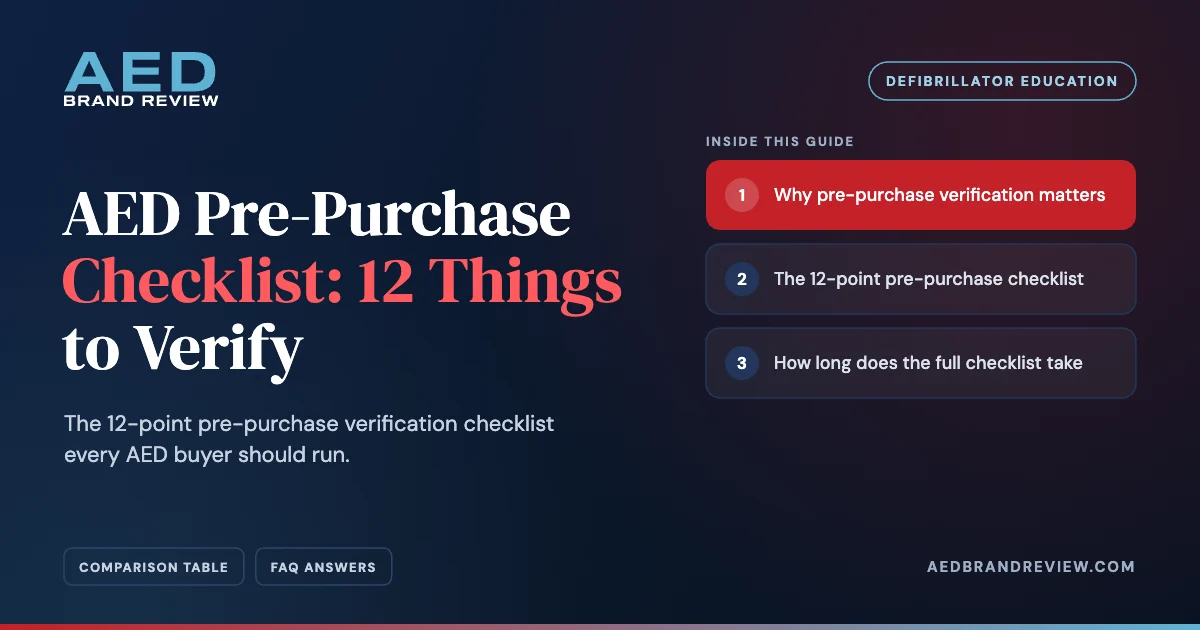
The 12-point pre-purchase checklist
- ☐ Use case clearly defined. Indoor or outdoor · trained or untrained responder · pediatric or adult-only · single deployment or fleet
- ☐ State mandate verified. Schools, fitness, dental sedation, and other facility types have state-specific requirements. Cross-reference with AED Laws by State.
- ☐ Pediatric needs identified. Even occasional pediatric exposure (visitor children, family events) justifies pediatric pad capability.
- ☐ IP rating matches the environment. IP21 indoor-only; IP55+ for any outdoor, humid, or construction exposure.
- ☐ Brand standardization assessed. For multi-site buyers, single-brand standardization captures a 15 to 25% volume discount.
- ☐ 10-year TCO modeled. Run through the AED Cost Calculator: pads, battery, cabinet and training all add to the sticker price over ten years.
- ☐ Cabinet and signage budgeted. Alarmed cabinet preferred for public access; ISO 7010 E010 signage recommended for findability.
- ☐ Training partner selected. Heartsaver CPR/AED through an AHA-aligned partner like AED Leader; BLS if clinical setting.
- ☐ Authorized reseller confirmed. AED Leader, Henry Schein, Bound Tree, not marketplace third-party sellers.
- ☐ Prescription path verified. For prescription-labelled models, confirm the reseller includes the physician prescription free with purchase; the Philips HeartStart OnSite and Home and the HeartSine 350P do not need one.
- ☐ Registration plan ready. State DPH registration + PulsePoint AED Registry within 30 days of installation.
- ☐ Designated program owner named. EHS lead, HR coordinator, facilities manager, or school nurse, by name + documented backup.
How long does the full checklist take
About 60 to 90 minutes for a first-time single-device buyer. State mandate verification (item 2) is typically the longest single check because it requires cross-referencing your facility type plus state regulations. The investment pays back the first time a verification catches an issue before purchase, typically saving $500 to $2,000 in mistakes.
Top 3 most-missed items in real-world deployments
Item 3, Pediatric pad capability
“No kids in my office” misses visitor children, family events, and client meetings with children. Pediatric pads cost $127 to $279 at AED Leader and last 2 to 4 years on the shelf. Buying once at install is dramatically cheaper than scrambling for them after an event.
Item 2, State mandates
Many states mandate AEDs in K-12 schools, fitness facilities, or dental offices providing moderate or deeper sedation. Several states regulate childcare, lifeguarded pools, and licensed health clubs. Buying an AED in a mandated state without verifying compliance creates real litigation exposure if a cardiac event occurs.
Item 12, Designated program owner
“We’ll figure it out” is what every program owner says before they don’t. Without a named owner, by role, by individual, with a backup, expirations lapse, inspections become sporadic, and audits fail. The single most important pre-purchase decision is who specifically owns the program. See the AED program management playbook.
How the calculator and quiz cover the heavy lifting
The Find Your Perfect AED quiz handles items 1, 3, and 4 automatically. The Cost Calculator handles item 6. State law verification (item 2) is your responsibility, but it takes 10 to 15 minutes through our state law hub. The other items are practical organizational decisions.
Start the verification, match a model first
The quiz asks four questions in about 60 seconds: location, quantity, children and CPR training.
Recertified units are the same models under the same FDA premarket approvals, restored, tested and sold with a minimum three year warranty. Prices verified 30 September 2026 against the public product data of both stores. Both list identical recertified prices, so buy from whichever fits your order size: AED Leader for one to four units, Response Ready for five or more and for compliance and fleet programmes. New prices are the AED Leader list price on the same date. The honest risk. A recertified AED is a used device. The three year minimum warranty is what makes the saving worth taking. Read recertified versus new and how to choose a refurbished AED before you decide. Recertified prices across all seven models
Model New Recertified You keep Buy Philips HeartStart OnSite $1,589 $875 $714 (45%) AED Leader or Response Ready Philips HeartStart FRx $2,099 $875 $1,224 (58%) AED Leader or Response Ready ZOLL AED Plus $2,082 $875 $1,207 (58%) AED Leader or Response Ready ZOLL AED 3 $2,399 $1,150 $1,249 (52%) AED Leader or Response Ready HeartSine Samaritan PAD 350P $1,411 $875 $536 (38%) AED Leader or Response Ready HeartSine Samaritan PAD 450P $1,761 $875 $886 (50%) AED Leader or Response Ready Cardiac Science Powerheart G5 $2,157 $1,225 $932 (43%) AED Leader or Response Ready
Insurance broker pre-purchase check (bonus item)
Before buying, email your commercial insurance broker that you’re implementing an AED program. Many carriers offer 1 to 3% premium discounts for documented AED programs. The discount eligibility may require specific documentation at install, better to know the requirements before you buy than after. See AED insurance coverage.
Stakeholder approval, who needs to sign off
- Finance, capital allocation for device + first-year operational
- HR, designated responder training scheduling
- Facilities, mounting location and electrical for the alarmed cabinet
- Legal counsel, Good Samaritan/liability framework review (optional but recommended)
- Insurance broker, premium discount eligibility
- For schools/healthcare/clinical, medical director or DON sign-off
Documentation to prepare before purchase
- Facility floor plan (for installation planning + AED placement)
- Square footage for the AED Quantity Calculator
- Designated responder list with current certification status
- EMS jurisdiction contact (for registration)
- Insurance broker contact (for premium discount application)
Frequently Asked Questions
How long does AED pre-purchase verification take?
60 to 90 minutes for a first-time buyer. State mandate verification is the longest single step.
What’s the single most-missed pre-purchase item?
Naming a designated program owner. Without it, the program quietly fails post-purchase.
Do I need to verify all 12 items?
Yes, each protects against a different failure mode. Skipping items doesn’t save time; it shifts failure modes downstream.
Where do I find state mandates for my facility type?
The AED Laws by State hub or directly through your state Department of Health AED program page.
What if I’m buying multiple AEDs for different sites?
Run the checklist per site at first, then consolidate to a single-brand standardization decision that captures volume pricing.
Should I verify the pads and battery before buying the device?
Confirm OEM consumable cost and shelf life, they add about $330 to $1,342 to 10-year TCO. The pad cost comparison covers per-brand numbers.
What documentation should I have ready before procurement?
Facility floor plan, responder list, EMS jurisdiction, broker contact, and finance authorization.
Can the AED quiz replace this checklist?
The quiz handles items 1, 3, 4. The other items are organizational and compliance decisions you need to verify separately.
Should I get legal counsel involved before buying?
For most workplace deployments, optional. For schools, healthcare, and mandated state facilities, recommended at the program-design stage.
What’s the budget verification methodology?
Model full 10-year TCO including device, cabinet, signage, pads, battery, training, registration, and inspection labor. The Cost Calculator automates the math.
Should I check the insurance broker before or after purchase?
Before, confirm premium discount requirements so your documentation matches them from day one.
Who should be the designated program owner?
Depends on facility type. Schools: nurse or athletic director. Workplaces: EHS or HR. Faith communities: facilities chair. Named by role and by individual.
What if I can’t find my facility type in the state mandate database?
Call your state Department of Health AED program directly. Mandate language sometimes uses different facility classifications than the colloquial name.
Do I need to verify state mandates if my state isn’t a mandate state?
Yes, even non-mandate states have profession-specific rules (licensed daycare, healthcare, fitness). Verify your specific facility type.
Can I delegate the checklist to a procurement officer?
Yes, but the designated program owner (item 12) should review and approve. Procurement handles transactions, and the program owner handles ongoing operations.
Get hands-on AED training in under 3 hours.
Sources & References
Disclaimer: Pre-purchase guidance. State-specific compliance must be verified separately with the state DPH or counsel.